Wednesday, December 5, 2018

THE END OF THE END OF THE EARTH BY JONATHAN FRANZEN

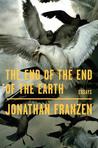
The End of the End of the Earth: EssaysThe End of the End of the Earth: Essays by Jonathan Franzen
My rating: 4 of 5 stars

”If you stand in a forest in Southeast Asia, you may hear and then begin to feel, in your chest, a deep rhythmic whooshing. It sounds meteorological, but it’s the wingbeats of Great Hornbills flying in to land in a fruiting tree. They have massive yellow bills and hefty white thighs; they look like a cross between a toucan and a giant panda. As they clamber around in the tree, placidly eating fruit, you may find yourself crying out with the rarest of all emotions: pure joy. It has nothing to do with what you want or what you possess. It’s the sheer gorgeous fact of the Great Hornbill, which couldn’t care less about you.”

I always love those moments when something reminds me of how insubstantial I am, compared to the forces of nature. The ultimate feeling of insignificance for me was to see, in a flash of lightning, a tornado, in all its beautiful glory, just off the road from where I was riding in a car. The sight of this destructive power of swirling winds inspired instant terror and awe, and as the lightning faded, the terror for me increased exponentially with the descending of complete and utter darkness. I was so unnerved I buckled my seatbelt (this was the 1980s) as if that act would shield me from the onslaught of such a power entity.

I’ve been remiss about reading Jonathan Franzen novels. I’ve liked what I have read. He has a self-deprecating style that allows me to see the human in the writer, even as he dazzles me with insightful prose. He questions his own beliefs and is a master at disputing both sides of an argument within himself. This could lead to indecision, but that doesn’t seem to be an insurmountable hazard for him. He still continues to move forward, even as he keeps a tongue pressed into his cheek to remind himself that he could be completely wrong in his assessment.

Franzen is a Bird Lister, and winged beasts figure prominently into these sixteen essays. As a gently mad book collector, I am always excited to find someone whom I can perceive to be more insane than myself. These bird listers go to great, sometimes dangerous, lengths to check a bird off their list. Franzen’s excitement at seeing a Jamaican Blackbird, or an Opal-rumped Tanager, or a Saint Lucia Black Finch are equal to my own excitement at finding a rare Graham Greene, or a bright copy of a Virginia Woolf vastly underpriced, or say an interesting appearing book by an author I’ve never heard of before. Of course, I slide my new acquisition onto my bookshelf, while he hopefully retains at least a mental image of the bird he has spotted. He might be slightly more mad than I.

Franzen’s girlfriend offers to go with him anywhere in the world. He suggests the idea of going to Antarctica, which he regrets almost immediately. He is unsure why, out of all the destinations in the world, he chose to torture her with the idea of attempting to vanquish the frozen, southern extremes of the planet. ”By this point, I, too, had a developed a vague aversion to the trip, an inability to recall why I’d proposed Antarctica in the first place. The idea of ‘seeing it before it melts’ was dismal and self-canceling: why not just wait for it to melt and cross itself off the list of travel destinations?”

I like the practicality of waiting for Antarctica to melt and crossing it off the bucket list. I’ve become more annoyed with the whole concept of a bucket list in recent years. This list has become a grand piano, suspended over my head, ready to fall on me the moment I show any weakness or hesitation in accepting an opportunity to cross something off the list. The list is not stagnant, either. As I cross things off, more things are added. It is a list that can not be conquered; by design, I am destined to fail.

The book is not all about birds, who are harbingers of the end of the end of the earth, as his title suggests, or about climate change. He also talks about his relationship with William Vollmann and his reverence for one of my favorite writers, Edith Wharton. He drops in a few mentions of writers like Rachel Cusk, whom I have not read, and Karl Ove Knausgaard, whom I have not read enough of. If I read a grouping of essays and don’t come away with an expanded book reading list (which is in some ways worse than a bucket list), I am disappointed.

Moreover, Franzen delves into the research of Sherry Turkle, who explores the impact that technology is having on who we are. ”Our rapturous submission to digital technology has led to an atrophying of human capacities like empathy and self-reflection, and the time has come to reassert ourselves, behave like adults, and put technology in its place.”

I have recently started feeling better about our future relationship with technology. I’ve heard more and more dissatisfaction coming from people twenty plus years younger than myself, so it isn’t just nervous old fuddy duddies, like me, who are starting to understand the diminishing returns of more advanced technology. It is the same theory as being rich. Once you reach a certain level of comfort, your happiness meter starts to plummet with the more money you acquire. What most people find is that you are happier when you are comfortable financially, which could be equated to reaching that level where technology is helping to improve your life. The trouble begins when money starts to rule your every thought or when technology begins to take over your life.

The big questions that Jonathan Franzen seems to be seeking answers to in writing these essays are, can we adapt our thinking enough to save the birds, save the planet, and in the process liberate ourselves from our own destruction? The environment should not be a political issue. Scientists are in agreement about the starkness of the facts. We should not be putting ourselves in a position where nature can bring her absolute worst against us. The tornados, the wildfires, the hurricanes, the torrential rains, the droughts are all punishments, increasing in frequency and velocity, as we continue to abuse this lovely, lovely blue planet. We, whether we want to accept the task or not, are the elected stewards, and we must make better, tougher, more responsible decisions going forward.

I want to thank Farrar, Straus, Giroux for providing me with a copy in exchange for an honest review.

If you wish to see more of my most recent book and movie reviews, visit http://www.jeffreykeeten.com
I also have a Facebook blogger page at:https://www.facebook.com/JeffreyKeeten

View all my reviews

Monday, December 3, 2018

A Brownstein Memoir

Hunger Makes Me a Modern GirlHunger Makes Me a Modern Girl by Carrie Brownstein
Reviewed by Jason Koivu
My rating: 4 of 5 stars

Way more serious and far less funny than I expected. Also, very little about Portlandia. One sentence to be precise.

But that's okay! Having loved Sleater-Kinney and collected 7"s from that band and her prior, Excuse 17, back in the 90s, I probably would've read this book anyway. I'm always ready to hear more stories about riot grrrl and Olympia!

Back then her S-K bandmate Corin Tucker was the one I gave a shit about. I'd fallen in love with Tucker's voice from her previous band, Heavens To Betsy. The tremulous tone yet strident thrust of her borderline manic singing filled each song with a dangerous urgency. You felt like at any moment, this was a person who might come spectacularly unhinged and, emotionally or physically, you could be caught in the crossfire.

There is plenty about Tucker in Carrie Brownstein's Hunger Makes Me a Modern Girl, but that's the thing, this is Brownstein's book. It's about her journey, and wow, it turned out to be a hell of a ride! Without giving away too much, she endured a youth that could easily have turned her into a societal nightmare, another soul damaged by upbringing that might have continued the cycle and spread the negative over others. Instead, she found a niche and fought for it. She became a success in one chosen field (music), then another (acting), and now she's succeeded as an author, too. That's determination!

View all my reviews

Friday, November 30, 2018

Secrets


Jordan Castillo Price
JCP Books
Reviewed by Nancy
5 out of 5 stars


Summary


Victor Bayne’s job as a PsyCop involves tracking down dead people and getting them to spill their guts about their final moments. It's never been fun, per se. But it's not usually this annoying.

Vic has just moved in with his boyfriend Jacob, he can’t figure out where anything’s packed, and his co-worker is pressuring him to have a housewarming party. Can’t a guy catch a break?

On a more sinister note, Vic discovers there’s absolutely no trace of him online. No trace of anyone else who trained at "Camp Hell," either. Everyone Vic knows has signed a mysterious set of papers to ensure his “privacy.” The contracts are so confidential that even Vic has never heard of them. But Jacob might have.

What other secrets has Jacob been keeping?


My Review


I really enjoyed the fourth story in the Psy Cop series. When Vic browses the internet, he realizes his name, the name of the psych training institute where he was institutionalized (Camp Heliotrope), and the names of others he knew there cannot be found. Jacob is asked to help solve an unusual sexual assault case. Vic is starting to learn more about his abilities. And everyone has secrets… even Jacob.

Secrets is another fun story that introduces new characters and revisits old ones. Lisa Gutierrez, Vic’s second partner, is back and coming to terms with her psychic abilities. Crash, Jacob’s ex, knows about Jacob’s case and Vic reveals his jealous side. As always, Jacob can’t get enough of Vic.

Thursday, November 29, 2018

Thor: God of Thunder, Volume 1: The God Butcher

Thor: God of Thunder, Volume 1: The God ButcherThor: God of Thunder, Volume 1: The God Butcher by Jason Aaron
My rating: 5 of 5 stars

Someone is hunting down and killing every god they can find.
description
Thor has fought this God Butcher
description
description
and he surprisingly survived. Now the butcher carries out his work and he's saving Thor for last. The butcher has been a thorn in Thor's side for thousands of years
description
and he's seeking to stop him.

The God Butcher is hands down the most interesting and well written Thor story I have ever read. It also is the first time I've ever seen Thor depicted in a manner that he or other eternals are prayer answering helpful gods. Seeing Thor come to the aid of people on a far off planet that needed water was surprising to say the least.

Witnessing Thor so shaken and uncertain is also surprising because other than times he's been depowered, Thor always presents himself as in search of a good battle and generally jovial. Thor is pensive and desperate to stop The Good Butcher and he's getting increasingly aggravated at only finding dead gods rather than their killer.

The God Butcher was thrilling and I'm excited to see where the story heads from here.

View all my reviews

Wednesday, November 28, 2018

LADDER TO THE SKY BY JOHN BOYNE

A Ladder to the SkyA Ladder to the Sky by John Boyne
My rating: 5 of 5 stars

”I was a good-looking boy and I brought him back to life. I may have taken advantage of his good nature, but why not? I flirted with him, made sure that I remained sexually ambiguous at all times. Always a possibility but never a certainty. I led him on to the point where he was so overwhelmed with desire that I think there was literally nothing he wouldn’t have done for me, had I asked. And then, when I got everything I needed from him, I wrote….”

What’s wrong with that?

Well, a lot, but then the world is full of givers and users, and sometimes the givers become users, and when circumstances become dire enough, even users can sometimes become givers. We all have users in our life, those people who always remind us of how good a friend we are when they need something, but when we need something in return, suddenly they are not as good a friend as they professed to be. Hopefully, none of you have a Maurice Swift in your life.

Other reviewers make comparisons with Patricia Highsmith novels, which is spot on, but Swift reminds me the most of the main character (I’d tell you his name, but part of the subterfuge of the novel is his identity) in A Kiss Before Dying by Ira Levin. If you like novels involving sociopaths, who are infinitely fascinating because of their ability to walk among us and seem reasonably normal, then definitely put the Levin on your reading list.

Now the question becomes, as you get to know Swift, is he a more garden variety sociopath, or is he a full out psychopath?

The book explores the idea of harm, or should I say degrees of inflicted harm? Is stealing ideas really wrong? Does a man’s life story belong to him once he has told it to someone else? Is taking a good idea poorly written by another writer and turning it into a much better presented story really immoral? After all, isn’t the idea just lost in bad prose until someone, say a Maurice Swift, who is a good writer, can salvage it for literature?

Swift’s father is a plumber by trade, and the family intends for Maurice to be a plumber, as well. To them, writers only come from well-to-do families who can afford to give their offspring an Oxford level education. There is this great scene that, in varying degrees, plays out in families all over the world when a child comes to their parents and says I want to be a writer, painter, dancer, or musician. Mention any of those professions, and it will send a finger of fear down any middle class patriarch’s back. Swift makes the mistake of mentioning to his father D. H. Lawrence’s modest background before becoming a well respected author as an example that a plumber’s son, too, can become a writer.

”’That D. H. Lawrence only wrote filth,’ replied his father. ‘Naked men wrestling with each other and posh pieces having it off with the gamekeeper. Queer stuff, if you ask me. Written for poofters with fancy ideas. I’ll not have any of it in the house.’”

I think Dad might have a flair for writing himself. ”Posh pieces having it off with the gamekeeper.” It got me all tingly.

One of my favorite parts of the book is when Maurice Swift, as the companion to yet another writer he is using to gain influence in the publishing industry, visits Gore Vidal. Now, Gore appreciates a chiseled pair of buttocks and a rigid, muscular stomach as much as the next gay man, but he is no one’s fool. His interactions with Swift are simply marvelous. The sexual teasing and charm that Swift has used so effectively on other male writers is more of an irritation to Gore, who may have seen some of himself in the foppish hair, good looks of Swift. (Of course, Gore had been better looking, whittier, and more elegant.).

”He felt a sudden desire to anger-fuck the boy, then toss him over the cliffs into the sea below, to watch as his body bounced off the rocks and his bones smashed into a thousand pieces.”

Goodness, now there is a frightening view of the mind of an aging man who finds the manipulations of youthful, mercenary exuberance to be something to shatter rather than preserve. Of course, if Swift had been more polished and less overtly, coldly calculating and had displayed more naive charm, then maybe he might have had more success lowering Gore’s defenses.

If Swift had been born with a creative mind, would he have been so feral in his interactions with his mentors, his “loved” ones, his proteges? If plot ideas were bubbling out of him like an erupting Vesuvius, would he have felt so much desperation? Is he willing to let himself become more psychopath than sociopath? I don’t think Swift would have ever been very likeable or a model of human behavior, but maybe if he had been blessed with an inventive well spring of a mind, his impact on those he associates with would be less catastrophic.

”’I suppose it’s difficult to talk about a work in progress. You never know who might steal your ideas.’” There is a reason why writers are careful about discussing plots or letting too many people read their work before it is finished. You don’t have to know someone like Maurice Swift to feel the need to be careful. I remember once in college I was writing some fiction for fun and someone I knew, with whom I shared it, took all the characters’ names in my story and used them in a story he was working on. It was really WEIRD. I kind of laughed it off, but at the same time I felt violated, like something had been stolen from me. He acted like it was no big deal.

Unbridled ambition can be a positive thing in the lives of those surrounding it, or it can be a fast moving car that leaves people it touches crushed, bereft, and walking down a lonely road, watching the taillights disappear over the horizon. This is a cautionary tale about the hazards of beauty without substance. Do not be fooled.

I can’t really imagine a serious reader or writer who would not like this book. Given the numerous points of potential discussion this novel provides, it would make a great book club book. How far would you go to be successful? You may not go as far as Maurice Swift, but what degree is acceptable? Maybe you will find out things about your book club members you never knew before!

If you wish to see more of my most recent book and movie reviews, visit http://www.jeffreykeeten.com
I also have a Facebook blogger page at:https://www.facebook.com/JeffreyKeeten

View all my reviews

Monday, November 26, 2018

The Power Walking Dead

Rise of the Governor (The Walking Dead #1)Rise of the Governor by Robert Kirkman
Reviewed by Jason Koivu
My rating: 4 of 5 stars

Realizing there wasn't enough horror in my reading world and being a fan of The Walking Dead tv show, I figured a book based on the backstory of one of the franchise's most notorious characters was a safe bet for some good reading. I was correct!

Rise of the Governor is wall-to-wall anus-puckering tension and heart-thumping action. The author's workman-like prose powers the story forward at an almost non-stop pace (jesus there's a lot of dashes going on here!) from beginning to end.

And what an end! I was legitimately bamboozled by a nice twist the author added. It was necessary to my overall enjoyment. I mean, it would've been a dang good book without it, but with it Rise of the Governor is elevated a notch or two in my overall estimation.

A powerful start to the Governor's saga!

View all my reviews

Superb Steam!

Etiquette & Espionage (Finishing School, #1)Etiquette & Espionage by Gail Carriger
Reviewed by Jason Koivu
My rating: 5 of 5 stars

Fantastic fun! Packed with Wodehousian humor!

Whip-smart author Gail Carriger kicks off a diabolically clever girl's school espionage series in style!

Whereas Austen prodded the society she was associated with, Etiquette & Espionage pokes fun at the Regency, early Victorian and Industrial Age manners and dress in a way that brands it with a slap on the ass!...a loving one though. It's clear that Carriger has an affinity for the period.

Set in a steampunk world, the book is all gussied up in the sort of lavish detail that evokes a magical world. The addition of supernatural creatures and the fantastical school makes one leap to make Harry Potter parallels, but actually the overall tone of this is more like Jonathan Stroud's wonderful Bartimaeus triology.

Clever, funny, and flat out fun!


View all my reviews

Friday, November 23, 2018

The Darker Side of Trey Grey


Tara Spears
T.O.S.O.L. Books
Reviewed by Nancy
3 out of 5 stars


Summary


No one told Trey Grey that life could be dark and unpredictable. With the death of his father when he was eight, his mother’s departure from Earth on a syringe full of Heroin and the brutal abuse of his stepfather, Trey learned these lessons all too well on his own.

Now at twenty years of age, he is nearing the completion of his accounting degree and can finally glimpse the end of his life as a prostitute, the only profession he has ever known.

Wracked by nightmares of Willie’s years of abuse, and controlled by severe obsessive-compulsive disorders as a result, he seems to have a tentative handle on his own life. That is, as long as he keeps a death-grip and no one touches his Camaro, kitten.

But even the best laid plans can be torn to gory bits.

His savior comes in the unlikely form of a spiky-haired blond named Justin, after a night of drunken debauchery that neither of them seems able to forget. Justin might just need Trey as much as Trey needs him.

Trey travels through his fearscapes and begins to find his own forgiveness, but at what cost to the manic-depressive Justin? Will they be able to live through the trauma of each other’s lives and find their own version of normal?


My Review


First off, I really hope that the author sent me an uncorrected review copy and this was not the final published version. I would have been very annoyed if I had paid $3.99 for it. Though my tolerance is higher for errors in self-published books, there were so many here that they threw me out of the story on many occasions. Typos I can handle, but constant misuse and abuse of words was much harder to put up with.

“too” instead of “to”

The club was roué, fashionable and raunchy all at once.

She has a reprobation toward sex.

My hips thrust fallaciously…

And it goes on…

The woman-hating that goes on in the m/m romance genre is so prevalent, that it wasn’t a surprise to me here. It’s OK to include well-developed, interesting, intelligent female characters with full lives in stories that focus on men’s relationships. Women are part of men’s lives too, if not as lovers, then certainly as mothers, sisters, friends, or co-workers. They don’t all have to be bitchy, bitter, lonely, gossipy, or meddlesome.

There were inconsistencies in this story that were a little off-putting. Halfway in, Trey and Justin knew each other for a week. 232 pages later, they knew each other only 3 days. In either case, they fell in love just a little too quickly for my liking, particularly considering Trey’s history of physical and emotional abuse, his mental illness, and his years working as a prostitute. Justin, like Trey, has difficulty with relationships. He is also deeply insecure and suffers from depression. Even though this is Trey’s story, I wish Justin’s mental illness was portrayed a little more convincingly. He was a very strong character while supporting Trey and didn’t show evidence of his depression. Other times, he was needy and insecure.

Some of the medical and psychological aspects didn’t ring true either. I’m far from an expert, but I would think if you stab yourself with a 3-inch wide butcher knife, you would do more damage than just nick your diaphragm. Trey’s suicide attempts and self-harming behavior were treated far too casually. Realistically, he would have had to be evaluated by a psychiatrist and receive extensive treatment, or even hospitalization, if he was determined to be a risk to himself.

Trey’s physical, sexual and emotional abuse by his stepfather was shown in flashbacks. He had recurring nightmares, and difficulty enjoying sex, until Justin entered his life. Despite the inconsistencies and inaccuracies here, I felt the author realistically portrayed the effects of severe child abuse on adult survivors and created two broken but strong characters that were very easy to care about.

I enjoyed being a part of Trey’s and Justin’s lives as they handle their struggles and cope with life’s challenges. Their strength drew me in and kept me involved right up to the very end.

Flaws notwithstanding, I am very much looking forward to the sequel.

Thursday, November 22, 2018

Gates of the Dead

Gates of the Dead (Tides of War)Gates of the Dead by James A. Moore
My rating: 4 of 5 stars

The gods were defied and demanded the men who defied them to be their sacrifices. Then one of the gods brethren were struck down and the gods determined to wipe the world clean and start over. They want Brogan McTyre dead, but he has powerful help and other plans. Plans to end the gods that murdered his entire family.

Gates of the Dead was an enjoyable conclusion to The Tides of War trilogy. Brogan has had one goal since partway through the first book of the series, to kill the gods who killed his family. He's been fortunate to have trustworthy friends and unlikely allies. It helps that the gods indiscriminately try to kill everyone because of the choice of a few individuals. They are truly a petty bunch.

This book had reasonable explanations to the series questions which were largely provided by the Galeans. The gods told Galea much about the world and their nature including the truth about the demons and gods themselves. The Galeans didn't know or understand everything, but they had substantial knowledge of the world and unveiled it to Brogan and his allies.

The gods were honestly just massive pricks. I guess becoming an unquestioned power could make anyone arrogant and dismissive, but they and their servants the He-Kisshi took it to another level. I seldom have wanted a group to be destroyed as badly as the gods and their servants.

Gates of the Dead was a fun revenge tale told on a massive world altering scale.

4 out of 5 stars

I received this ARC from NetGalley in exchange for an honest review.

View all my reviews

Monday, November 19, 2018

An Admirable Western

The Quick and the DeadThe Quick and the Dead by Louis L'Amour
Reviewed by Jason Koivu
My rating: 4 of 5 stars

Shakespeare this ain't, but boy howdy The Quick and the Dead is a damn good time!

Yeah, dialogue is often stilted and the character of Con Vallian sometimes comes off as a deus ex machina kind of guardian angel. However, there's still a lot to like here, such as some of the characters' development as the book progresses. A strong female is always a pleasant addition to westerns. The story's pacing is good with a solid amount of action, balanced with timely introspection.

For such a short book, Louis L'Amour manages to pack in plenty of punch. Recommended for western fans!


View all my reviews