Thursday, June 13, 2013

There's Nothing Wrong With a Little Trouble

Trouble Will Find Me

The National

Released by 4AD Records


5 Out of 5 Stars
Reviewed by Amanda


Melancholy is a word that has become synonymous with the indie rock sound of The National, but there are some surprises on their sixth studio album Trouble Will Find Me.  Don’t worry—for those who love the band’s trademark brooding nature, there’s still plenty of the outsider’s angst and alienation (Humiliation), the introvert’s painful interactions with a world he doesn’t understand how to be in  (Demons), addictive relationships that seem based more on the identification with another fragmented, damaged individual than on romantic longing (This is the Last Time).  However, the pervading darkness of previous albums seems to have given away (ever so slightly, mind) to, dare I say, the tiniest, faintest, is-it-really-there sliver of optimism?

The cover image of Trouble Will Find Me features a female face bisected with a mirror, so that one half appears to be asleep while the other half is disconcertingly awake.  This duality of awareness and unconsciousness frames the album’s lyrical content, which often juxtaposes a cautious hope and weary resignation.  Lead singer Matt Berninger writes song lyrics that reject predictable patterns—opting for a word that doesn’t quite rhyme when a more clichéd one will do, or squeezing in more syllables than the music’s rhythm seems willing to allow because he has so much more to say.  The result creates complex surprises for listeners who have become jaded to the predictability of shallow pop lyrics.  His eccentric turns of phrase often focus on the mundane, refusing to idealize life in overwrought, poetic language because life itself in its barest, most raw form is poetry.  In The National’s distinct sound, it is Berninger’s resonant and haunting baritone and the band’s orchestral layers that bring eloquence and emotional weight to these everyday fears and neuroses.

Unlike previous albums, there is an unexpected buoyancy to the music, if not always to the lyrics.  In Sea of Love, Berninger fears the prospect of succumbing to love, despite watching others willingly surrender  (“I see people on the floor.  They slide into the sea . . . I see you rushing down [don’t drag me in]”).  His words worry that “If I stay here, trouble will find me,” but the upbeat tempo suggests that trouble may be just what he needs; perhaps it will take “trouble” to upset the routine and force him to live outside of himself.  Don’t Swallow the Cap reveals a speaker who recognizes “I have only two emotions, careful fear and dead devotion.  I can’t get the balance right.”  This divergence is further emphasized by Berninger singing in the upper registers of his vocal range, layered over his own mumbling, more familiar bass.  The result is a pleasing rasp that suggests he’s closer to finding the balance than he might think. 

For the purists, there are still several more traditionally National tracks.  In Demons, an awkward Berninger resigns himself to an inability to maintain an optimistic outlook (“Every day I start so great and then the sunlight dims . . . When I walk into a room I do not light it up.  Fuck.”).  In This is the Last Time, the “sea of love” has become a swamp, sucking him under and yet “You’re the only thing I want.”  Repeatedly chanting “this is the last time” as a mantra, he seems to be trying to convince himself (and us) that he will eventually leave, though he knows the cyclical nature of the relationship will drag him down again.  In the achingly reflective Slipped, he is routinely drawn back to the place (emotional and physical) where a relationship fell apart, acknowledging his culpability as “I’ll never be anything you ever want me to be."

In terms of sound, Trouble Will Find Me has more in common with Alligator and Boxer than 2010’s High Violet, which featured a darker rock sound.  While I enjoyed the 2010 effort, this return to a more stripped down, poignant album is a reminder of why I fell in love with The National in the first place, and yet there’s enough difference here to hint at the promise of all that is to come.

Spencer Quinn's Chet and Bernie mysteries, doggone good fun!


A CAT WAS INVOLVED (Chet and Bernie #0.5)
SPENCER QUINN
Atria Books
$0.99 eBook, available now

Reviewed by Richard, 3.5* of five

The Publisher Says: Spencer Quinn’s first original e-short story reveals how everyone’s favorite detective duo—Chet the Dog and P.I. Bernie Little—came to meet before their first big case in Dog On It.As fans know, Chet first met Bernie on that fateful day when he flunked out of K-9 police school. The details of that day though have always remained a little vague (like so much in Chet’s doggy brain). All we know is that Chet had been the best leaper in his K-9 class, but for some reason he failed his final leaping test...and that a cat was involved...and that there was some blood. But whose? The test, the cat, the blood—all pieces of a puzzle that, when solved, will bring down a dangerous gang of thieves—and signal the start of a beautiful friendship.

This fateful day has been alluded to in every book in the series, and now fans of Chet and Bernie will finally get to find out what actually happened. For these two beloved characters, it was something like love at first sight—and, for Chet, at first smell, too.

My Review: Here's what you need to know...it's exactly as much fun as you'd expect it to be; it's got the trademark Chet narration that leaves nothing to a human imagination except why we don't get to think this way; and it breaks from the canon of history set up in the first two books about Bernie's marriage and Chet's place in it.

Like all !&$^!%(^%!$*$$(^$)&%)^(%*!$ ebooks, I can't quote anything to you because how? But the story's only 39pp or so, and it blows by faster than one actually wants it to, and it costs a whopping ninety-nine cents. It's actually not necessary to read from a series standpoint, but heck, for chump change, buy it, read it, and smile for a half-hour. Sounds like a win to me!

Creative Commons License
This work is licensed under a Creative Commons Attribution-NonCommercial-ShareAlike 3.0 Unported License.
* * * * * * * * * * * * * * * * * * * * * * * * * * * * * * * * * * * * * * * * * * * * * * * * * * * * * * * * * * * * * * * * * * * * * * * * * * * * * * * * * * * * * * * * * * * * * * * * * * * * * * * * * * * * * * * * * * * * * * *


DOG ON IT (Chet and Bernie #1)
SPENCER QUINN
Atria Books
$15.00 trade paper, available now

Reviewed by Richard, 3.8* of five

The Publisher Says: As sidekicks, Maxwell Smart and Agent 99 have nothing on Chet and Bernie. This charming detective duo make their debut in Dog On It, the first volume in Spencer Quinn's new mystery series. The fast-paced and funny tale is narrated by the inimitable Chet, Bernie's best friend and canine partner, whose personality and preferences are never in doubt: "I liked to sleep at the foot of Bernie's bed, but my favorite napping spot was in the breakfast nook, under the table with my back against the wall, all cool and shady, plus there was often good snacking around Bernie's chair."

Bernie's enterprise, the Little Detective Agency, limps along, waiting for the next job to arrive. While Chet freely admits that he doesn't always understand the humans around him, the mutt who failed to graduate from the police academy quickly establishes that he's got a nose made for sniffing out trouble -- as well as the tasty morsel.

When the story begins, Chet and Bernie are settled into the companionable routine they established when Bernie got divorced and lost custody of his son. Riding shotgun for stakeouts in Bernie's beat-up convertible (and snarfing up doughnuts and beef jerky) is the perfect life for Chet, though he knows Bernie's worried about cash flow.

But their luck is about to change. During a nighttime stroll through the neighborhood -- an older enclave in the southwestern desert that Bernie fears will soon be eclipsed by new development -- the pair encounter a panicked neighbor, Cynthia Chambliss. Waving a wad of bills, she beseeches Bernie to find her daughter, Madison, a 15-year-old who has been missing for several hours.

Bernie heeds the call of cash and the urgency of parental concern, but Madison soon returns home on her own, only to disappear again in short order -- this time for several days. Cynthia frantically rehires Bernie, but her ex, Damon Keefer, refuses to cooperate, insisting that Bernie be taken off the investigation. Nevertheless, intrigued by the young girl's apparent connections to a group of Russian thugs, Bernie and Chet follow a trail of clues that leads them into more danger than they'd bargained for.

As Chet and Bernie race across the desert toward Las Vegas in their sandblasted Porsche, Quinn's narrative unfolds with mounting suspense. At every stage of their journey, readers will warm to Chet's loyalty and courage -- to say nothing of his delightfully doggy digressions -- and be captivated by Spencer Quinn's deft blend of humor and thrills in this enormously entertaining tale, bound to be the first of many adventures.

My Review: Chet and Bernie. Say it with me, now. Chet and Bernie. Get used to saying it, because once you read this book, you'll be saying it a lot to others who haven't read it yet.

Chet's a dog. Bernie's a schlub. They're a team, crime solving magic of a team. In a mystery world dominated by cat cozies, they're very unusual and very much a pair of guys. This makes them a breath of fresh air at the least, and a cold Alberta Clipper to blow the cobwebs full of cat-dander out of the bookstores. Come back to the fold, gentlemen, there's a voice a lot like the one in your head all ready to talk to you, and it's a dog's!

It's wonderful to read something that's got a new slant on an established trope (read: hoary old cliche), and slants it well enough to keep a cynical old sourpuss like me leaning forward in his seat, eager to see what Chet's going to do next, what Bernie's brain's going to wrest from its depths to help the innocent and land on the wicked with all six feet (four Chet's). LT member cameling gets all the credit for shoving this book into my awareness. Bless you, dear madam.

Oh yeah...the schlub gets the girl, too. The right girl. Never mind that she's a vegetarian...who among us is without major character flaws?...she loves Chet.

Fetch! Sit! Read!

Creative Commons License
This work is licensed under a Creative Commons Attribution-NonCommercial-ShareAlike 3.0 Unported License.
* * * * * * * * * * * * * * * * * * * * * * * * * * * * * * * * * * * * * * * * * * * * * * * * * * * * * * * * * * * * * * * * * * * * * * * * * * * * * * * * * * * * * * * * * * * * * * * * * * * * * * * * * * * * * * * * * * * * * * *

THEREBY HANGS A TAIL (Chet and Bernie #2)
SPENCER QUINN
Atria Books
$15.00 trade paper, available now

Reviewed by Richard, 3.5* of five

The Publisher Says: The second book of an irresistible series narrated by a loveable and wise dog. In the newest Chet and Bernie mystery, Chet gets a glimpse of the show dog world turned deadly. "We run a detective agency, me and Bernie, called the Little Detective Agency on account of Little being Bernie's last name. My name's Chet, pure and simple. Headquarters is our house on Mesquite Road, a nice place with a big tree out front, perfect for napping under, and the whole canyon easily accessible out back, if it just so happens someone left the gate open. And then, up in the canyon -- well, say no more."

Praised by Stephen King as "a canine Sam Spade full of joie de vivre," Chet and his human companion Bernie have both had some setbacks in life -- Bernie in combat, Chet in K-9 school, but together they make up a team like no other. In Thereby Hangs a Tail, Bernie and Chet are called on to investigate threats made against an unlikely target -- a pretty, pampered show dog named Princess. What seems like a joke turns into a serious case when Princess and her owner are abducted. To make matters worse, Bernie's on-again, off-again girlfriend, reporter Susie Sanchez, disappears too. When Chet is separated from Bernie, he's on his own to put the pieces together, find his way home, and save the day.

With genuine suspense and intrigue, combined with humor and insight into the special bond between man and dog, Thereby Hangs a Tail will have everyone talking.

My Review: Cute! Very cute! Chet is such a clever boy I want to give him Milk Bones until he faints!

And that's kinda the problem under the fun: Cute. It's fun, yes, and it's pleasantly written with a well-imagined dog's point of view. But I think this is a series that needs to be taken in annual doses, and in the proper mood. I am, admittedly, as curmudgeonly as the day is long. But I'm not immune to charm. The series has charm.

It's just, well, it's wearing a bit thin at the elbows. Also, I hate Suzie. But I would, wouldn't I, being a dour old gay guy?

But then there are moments like this, and I can't help grinning:

All at once, I was kind of tired, too. I lay down under the hall table. A roof over your head is always nice. I realized that the house had a roof, of course, so in fact I had two roofs over my head, even better. And what about the ceiling? Under the roof, right, but still a kind of roof, too? I got a bit confused.
That's Chet, a bright dog, narrating. The snap-snap-snap of a dog processing into dog-think the idea of roof-house-safe and making it better by getting under a table rings completely true to me. And the magic for me is in Quinn's rendering that into non-cloying humanspeak.

And then there's the ending. Whee dawggie. White knuckles and bright flashlights exciting, and even though I was pretty darned sure I knew whodunit, but please forgive me if I don't tell you the bit I was most tensed up about and the bit that Chet, for all his smarts, didn't see as scary and troubling as I did.

Read 'em one at a time, in order, and these books will give you thrills and grins and not a few gnawed knuckles. Like the one skinless, bloody nubbin I've got workin' over the unresolved plot line that I can't tell you about. GAH!

Creative Commons License
This work is licensed under a Creative Commons Attribution-NonCommercial-ShareAlike 3.0 Unported License.

The Forbes 25 Reviewers - #13 Paul Bryant

Today's guest is Paul Bryant.

How did you discover Goodreads?
An online friend told me about it.

What have been your most memorable Goodreads experiences?
Meeting fellow reviewer Ian Graye and his charming family from Australia in real life

Name one reviewer not in the Forbes 25 that people should be aware of.
Ian Graye

What was your initial reaction to Amazon buying Goodreads?
Forboding and resentment.

How many books do you own?
About 2000

Who is your favorite author?
Rohinton Mistry

What is your favorite book of all time?
Ulysses

What are your thoughts on ebooks?
I haven’t read one yet & have no intention of starting to any time soon. I like stuff – records, movies, books. But they are taking the stuff away. Will houses in 50 years time be empty?

What are your thoughts on self-publishing?
I’ve read about five self-published books recently and what a mixed bag – they can be excellent, they can be lamentable. So a bit like actual books then.

Any literary aspirations?
To read The Golden Bowl and to enjoy it. But I can’t see that ever happening.

Wednesday, June 12, 2013

The better (and worse) angels of our nature


The Rebel Angels

Robertson Davies

Penguin

Reviewed by: Terry
4 - 4.5  out of 5 stars


Some books are comfort reads. They are old friends whose familiarity provides us with a sense of stability and well-being, and they fit like a glove to the intellectual, emotional, and purely personal elements of our psyche. Sometimes this is because we came to them in formative years when their mode and message could be deeply impressed on us, sometimes it is because they simply express aspects of our nature that we ourselves may not be fully aware of, but to which they harmonize completely. The books of Robertson Davies are these kinds of books for me. I did come at them at a young age, but they also showed to me a world, and way of looking at the world, that I found utterly appealing and deeply satisfying.

Like all of his books _The Rebel Angels_ is a book about art, about the intellect, and about secrets (both personal and professional). It is populated by the kind of characters that Davies knew so well and whose portraits he painted unerringly (if on occasion a little too neatly): they are intellectual elites, connoisseurs of art and artistry, but they are also unique, often bizarre, individuals whose quirks and manias may be the result of heredity, upbringing, or a judicious combination of both. Having said this I would have to admit that perhaps the only reservation I have is in the range of these characters. They are certainly unique, quirky and individual, but they do seem to generally be cut from the same cloth. Davies himself was a true old school Upper Canadian (though indeed one with a decidedly forward-looking bent) conversant with the rituals and mode of the intellectual and social elites and this is very much the place where his characters live. Trying to go outside of this range is something he doesn’t seem to have been very interested in, and this was probably for the best. My only qualm with any of his characters is actually with Maria in this trilogy. I’m not sure how successful I think he was in embodying a feminine voice in her and often wonder what women who have read the series think of her? I don’t exactly find her unbelievable, but I sometimes wonder if some of the things she says and does wouldn’t sit more comfortably with one of Davies other, male, characters.

For me perhaps the most alluring feature of this book is the fact that it centres on the life of a University; indeed, of the university which I not only attended but where I now work and whose buildings, halls, and (most importantly) odd individuals are only thinly disguised. It stands to reason, then, that this book holds a unique place in my heart. In some ways this book is an academic satire, showing us the strange rituals, obsessions, and quirks that are unique to the world of academe. We are primarily concerned with the perhaps parochial world of a small college within a larger University, the College of St. John and the Holy Ghost (or more colloquially “Spook”) and are immediately thrust into the midst of the action as the whispered refrain “Parlabane is back!” echoes throughout the halls. Everyone loves some good gossip and academics are no less a party to this than anyone else. It appears as though John Parlabane, one of the college’s former stars in the intellectual firmament (now disgraced much to all of his contemporaries’ delight), has returned to the alma mater as a defrocked monk in the hopes of clawing his way back up, and perhaps stirring the pot of scandal and intrigue. In the midst of this is Maria Magdalena Theotoky, a promising graduate student who has the misfortune not only of being the research assistant of one of Parlabane’s old ‘friends’, but of being in love with him. Said scholar, Clemence Hollier (an ‘ornament to the university’), is pursuing his research interests with single-minded assurance that is broken by only two things: his role as co-executor to the vast estate of the recently  deceased millionaire and art collector Francis Cornish, and his nagging remembrance of an indiscretion the year before with his beautiful and intelligent RA on his decrepit office couch. Finally we have Professor the Reverend Simon Darcourt, scholar in New Testament Greek, lover of homely comforts, and also both an executor of Cornish’s will and newly smitten teacher of the lovely Miss Theotoky.

From here Davies takes us into the tangled world of academe, which is more cutthroat than outsiders might believe. The narrative is first person, split between segments narrated by Maria and Darcourt respectively, each of whom view the culmination of events that grow around the death of Cornish and arrival of Parlabane from parallel tracks. There is intellectual intrigue and thievery, bizarre research interests, passive aggressive bullying, and a most interesting view into the household of a gypsy family of means who straddle the old world and the new, the criminal and the respectable. As is to be expected of Davies his Jungian interests come out in a few ways. First, and most importantly, each of the characters wrestles with what Parlabane calls their “root and crown”: the tension that exists between the chthonic forces of our heredity & deeply buried psychological foundations and the outward face we present to the world bound up in our more conscious needs & desires. In addition the tarot and other mystical and mythological aspects of art and scholarship flow in and out of the characters’ lives proving themselves to be more real and applicable than they would ever have previously given them credit for. Sometimes this is manifested in a benign & revelatory way, sometimes through fear and premonition, but always enlightening them about themselves and the world.

All in all this is a great start to a great trilogy. Highly recommended.

Also posted at Goodreads

Latro's back and he still doesn't remember you


Soldier of Arete

Gene Wolfe

Tor Books

Reviewed by: Terry
4  out of 5 stars


Latro continues his journey across ancient Greece in search of his memory in Gene Wolfe’s second entry in the “Soldier” series _Soldier of Arete_. As implied in my review of _Soldier of the Mist_ I am finding this series to be the easiest for me to ‘get into’ of all of Gene Wolfe’s work that I’ve read thus far. I think it’s because many of the elements Wolfe employs in nearly all of his fiction really seem to make sense here. Latro is naïve and ‘unreliable’ as a narrator, but he’s suffering from memory loss due to brain trauma…I can accept that a lot easier than I can the apparent naïvete of characters like Severian (an apprentice torturer and would-be saviour), Silk (an annoying man-child saint)or Able (a young boy transported to a fantasy world, but a boy who seems to have grown up in some kind of very sheltered ‘Leave it to Beaver’ childhood…he certainly never seemed to have the experience I would expect of even a ten-year-old from the modern era). When those characters ‘leave something out’ of the tale they are telling it seems willful to me, Wolfe purposely obfuscating the narrative via his narrative tool, but when Latro does it I can accept it as a natural part of the story due to the fact that he just can’t help it, he really does try to be the best reporter of the events going on around him that he can. Of course this is all really just smoke and mirrors: Latro is just as much the ‘narrative tool’ of Wolfe as the others and giving me a ‘plausible’ excuse for accepting unreliability from him as a character perhaps doesn’t really mean that he has any significant difference from Wolfe’s other protagonists, he is still performing the same ‘sleight of hand’, but somehow it does make a difference to me. I'm willing to accept Latro for who he is and I find that much more difficult with Wolfe's other protagonists.

Wolfe’s ever-present erudition is also on full display in this volume (as in the previous) and we are immersed into the world of ancient Greece at the time of the Graeco-Persian wars. As is usual with Wolfe he pulls no punches and much is left for the reader to make sense of on their own, though Latro’s own need to explain some things to himself in his scrolls, as well as my own interest in the civilizations of this era, made the often frustrating obfuscation and explanation-by-way-of-implication endemic to Wolfe less of an issue for me here. Be warned that spoilers for _Soldier of the Mist_ follow.

The previous volume ended in a cliffhanger: upon leaving the besieged city of Sestos Latro was tricked into a battle that seemed likely to kill him. Although he managed to survive (he is touched by the gods after all) and met a dying soldier who seemed to recognize him, calling out the name “Lucius” only to expire before he could enlighten him beyond this, Latro seems to be no closer to finding his home and identity than he was before. Latro is once again thrown into companionship with some old friends (and enemies) and this time journeys across Thrace, through Athens, and finally to Sparta guided both by the hands of the gods and those in whose company he finds himself. It becomes even more obvious here that Latro is a pawn, both of the gods and the other people with whom he must live. I’m still not sure what the end game of the former group is, or why they view Latro as such an important tool. The human players are much easier to read as they jockey for political and personal power and see Latro’s abilities (both as a soldier and as one who can see the invisible world) as useful tools for reaching their objectives.

It is interesting to see that a character like Latro, one who loses the memory of each day as it recedes into the past, is actually still capable of growth. I would definitely say that the Latro of Arete is a slightly different man from the Latro of Mist and the sorrow and perplexity of his condition are truly beginning to weigh on him. It is also touching to see the way in which many of the people around him truly care for this man (though he would be, and is, horrified at their pity of him) and much of the manipulation of Latro is done with the best of intentions, “for his own good”. Deep down in his heart, though, Latro appears to know better what it is that he needs and how he ought to live and thus, in the end, he makes his own decisions about what he shall do and where he shall go…perhaps to his own detriment, but even a man with no memory wants to feel that he has made his own choices, however well-intentioned the choices made on his behalf by others.

The ending of this volume is an even bigger cliffhanger than the one in Mist and the last chapter is even told in slightly confusing poetic prose by a character other than Latro…a flourish of Wolfe’s that no doubt left the readers at the time of publication thoroughly frustrated (these readers would be forced to wait 17 years for the final volume of the series, a volume that they perhaps never even expected to appear). While this could be validly considered a typically Wolfean ending to a series loaded with ambiguity I am glad that I have the third volume at hand and can see where Latro finds himself in the final fragment of his story without further delay.

Also posted at Goodreads

The Forbes 25 Reviewers - #14 Richard

Today's guest is Richard.  Richard also posts at  Shelf Inflicted and Expendable Mudge Muses Aloud.

How did you discover Goodreads?
Like all the best stuff in life, I learned about it on the streets. Hey, isn't that where we learn about sex, drugs, booze? So I got mugged by a Goodreader when I was minding my own business over on LibraryThing. She dragged me here, plopped me down, and said, "See?" I didn't, really. I joined in 2010, and midway through 2011 made a friend who changed things around here for me.

What have been your most memorable Goodreads experiences?
Becoming friends with Stephen, another of the Forbes 25, introduced me to the wider world of wingnuts he hung with. The rest is history. One thing Goodreads taught me was that one gets out of social media what one puts into social media. Show up, make a contribution, lather rinse repeat. Over time, that makes both friends and enemies. But for someone like me, basically homebound and not very boredom tolerant, Goodreads has expanded my social reach and stimulated my ever-questing readerly brain.

Name one reviewer not in the Forbes 25 that people should be aware of.
Only one? No. Sven Penkevich writes beautiful, closely reasoned dissertations on books and authors I've never heard of, but now want to read. Rose Summers keeps me in touch with the youth market. Steve Kendall writes love letters to books that make me weep with jealousy. Jeffrey Keeten! Carol Siewert! Will Byrnes! My feed seethes with wonderful reviewers who read and discuss books I would never have heard of otherwise, making me long for more hours, more eyes, and an unlimited book budget.

What was your initial reaction to Amazon buying Goodreads?
Negative. Amazon is a sales organization, and I am a customer of theirs. Goodreads is a social media site, and I am a member of theirs. The concepts are different. Goodreads made money by collecting data on my tastes in books, aggregating it, and selling ads to publishers and authors to keep the lights on and buy cat food for the founders. Now that Amazon directly owns Goodreads, their already extensive knowledge of my book-buying habits can be deployed at Amazon.com AND at Goodreads.com. I use AdBlocker to keep the screaming blinking buyme-buyme that assaults me to a minimum. Now it can be made more insidious, oh dear I mean more convenient for me to shop.

I detest Amazon's reviews. I don't trust them...anyone remember Harriet Klausner?...and I vigorously dislike the thuggish culture of five-stars-or-else that's allowed to flourish there. There is some of that on Goodreads as well, as anyone who has ever posted a review critical of the Book of the Moment knows. But here's where the social part of social media rescues the outliers: Friends rally to one's defense. Because they do, others in their circle notice one's reviews, and read them, and come to one's defense with "Like"s and troll fighting. Never happen on Amazon, speaking from old experience.

So, being cynical and believing the worst that can happen is but a prelude to the true hell to come, it seemed and seems to me likely that Amazon's ownership of Goodreads will mean happy-clappy fivestarland with extra soma for all is but a breath away.

How many books do you own?
Fewer than I used to, but an accurate count is impossible. Over 1000, under 3000.

Who is your favorite author?
Vladimir Nabokov. Pnin, Ada, or Ardor, these would be the masterworks of another writer's career. For Volodya's career, they're second rank works after the perfect beauty and creepy repulsiveness of Lolita.

Close second is Virginia Woolf, whose Mrs. Dalloway is another perfect book, and whose Orlando is breathtaking. (See? I can't pick Just One of anything!)

What is your favorite book of all time?
HA! Limiting this to TEN is too hard! But to avoid re-listing the catalog of the Library of Congress, I'll say this: Books saved me from a difficult childhood, and one book above all others shone a beacon of hope for me: The Hundred and One Dalmatians by Dodie Smith. The original, not one of the abridged and bastardized Disnifications. Escape and rescue and support...all the things I think every kid in difficult circumstances desires. Forty-plus years on, it's not aged well, being racist and sexist and so on. But it helped me then, and I love it for that.

What are your thoughts on ebooks?  What are your thoughts on self-publishing?
Treating these as one question, because they're so interrelated.

I have a Kindle and an Android tablet and read on both of them. I don't read books for review that way, since the highlighting features are arcane and overcomplicated for my two-volt nervous system. Ink on paper plus Book Darts (wonderful things, those, since I ***HATE*** writing in my books).

What will ebooks mean to publishing? New paradigm. The end of the consignment model of book sales (about goddamned time too). The end of gatekeeping, a decidedly mixed blessing. No longer does a rejection from Putnam, Farrar Straus & Giroux, The Dial Press, and Knopf mean your collection of interlinked short stories telling the life of Madame Blavatsky in 420-character chapters mean that no one but your lover and your dog will hear your words. But unhappily it also means your work is less likely to be edited, copyedited, and proofread by people whose job this is.

This problem is rife in the ebook world, and not just among indie authors and small publishers. Major houses are putting out books with, for example, plurals formed by apostrophes, both ebooks and tree books. This is not trivial and it's not at all a good thing. Not only does it dumb down the readers who come to accept it, it deprives the editors, copyeditors, and proofreaders of jobs, and makes passing on those skills to the next generation less likely. And then comes the day when it's not important anymore because no one knows any better.

See? Told you I was cynical.

Any literary aspirations?
No. None. Why, do you think I should? (said in best Tim-Curry-as-Dr. Frank N. Furter voice)

Tuesday, June 11, 2013

The First Law Trilogy

by Joe Abercrombie

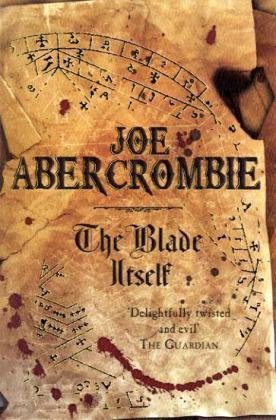
THE BLADE ITSELF

The Blade Itself (The First Law, #1)
I’m going to do something that's a little disrespectful and start this review by talking about another fantasy series that I’ve enjoyed: A Song of Ice and Fire. That series rules. It has everything I’ve wanted in a series since Tolkien but there’s one thing to be said about it, neither good or bad, that is a big part of its impact: it is dark, very very dark. The darkness comes, as it should in all quality fiction, not necessarily from the actual bad things that happen to good people, but from the depth of the characterizations themselves. Bad things happen to very real, very well-characterized, and truly understandable people, and so those bad things are made all the more upsetting, all the more hard to read.

So that’s where The Blade Itself comes in. It is a funny thing for me, reading the reviews. Everyone goes on about how bloody it is, how graphic and hardcore, etc etc. How it is a part of the “George R.R. Martin tradition”. Of course there is truth to that: much blood is spilled, incredibly tragic things happen, and hell, one of its central characters (in fact, its best character) is a torturer with an awfully painful past. But what I rarely see mentioned is the wonderful lightness of tone that makes the novel such a pleasure to read. For all its tragedies and darkness, the tone is amusing, light-hearted, comic, and never in awe of the various mysteries depicted. I laughed out loud many times. It is also a surprisingly tender novel. That comment may be hard for lovers of this book to read. But The Blade does not demonize any of its characters, it allows all of them (even Black Dow!) their moments of decency and kindness, it views all of them in such a cheerful, upbeat way, that never did I feel a sense of bleak heaviness at the tragedies displayed. Those tragedies are shown to be a part of life, for some, and although they are impactful, the characters are not beaten completely down by their pasts. It is not a sentimental novel, but it is a very sweet-tempered one. The down side to this is that, at times, the characters and situations have a vibe to them that is almost close to being a sitcom. The upside is that it is wall-to-wall pleasure and at the end of the novel, I felt uplifted, rather than weighted down. It is a wonderful antidote to the compelling but grueling Song of Ice and Fire. A kind of tonic.

Oh yeah, almost forgot to mention: the author knows how to write action sequences.  They were truly exciting, even cinematic in the clarity of what was happening. Often fights are confusing affairs in fantasy, but that is not the case here. The whole novel had a brisk yet cinematic feel to it. I choose Matthew MacFayden to play Inquisitor Glotka!

***

BEFORE THEY ARE HANGED

i read a lot about the supposed dearth of likeable characters in this series. bah! what we have here are:

(1) a barbarian with a heart of gold. sure, he can turn into a mass murdering psychopath when pressed, but my gosh, that doesn't happen too often!

(2) an ex-slave who lives to destroy her former abusers. yes, she's grouchy & savage & suspicious of everyone, particularly white people. do you blame her? she was a former slave, abused and raped repeatedly. come on!

(3) a centuries-old sorceror, also very grouchy. hey, he's been alive for centuries. he's seen the rise and fall of men. he's trying to stop the world from ending. give him a break!

(4) a spoiled nobleman. he doesn't stay spoiled for long! the reader clearly sees him grow and discover new-found empathy, freshly-discovered understanding of the world and the people around him. a person can change, can't they?

Before They Are Hanged (The First Law, #2)these are all completely loveable and endearing creations; i understood their bitterness and suspicious nature and off-putting high-handedness, but i also cheered their slow movements towards understanding each other, towards kindness (of a sort), towards decency. their courage has always been obvious, but with this novel, they become much more recognizably human. reading about their journey was pure pleasure. and the end of that journey? a great bit of dark, dark irony. it is a rather a brave and surprising thing for Abercrombie to pull off. although i am confident more will come out of that journey.

also pure pleasure: the continuing misadventures of the torturer Glotka. i was pleased to see a decrease of his italicized snarkiness. it is still there, of course, but it is not everywhere and no longer functions as a kind of shorthand for actual characterization - it is just a part of who he is. was anyone reminded of Tyrion at King's Landing when reading about him seeing to the city of Dagoska? i was. Glotka remains a wonderful and unusual character. as do West and Dogman and all the rest. sure these are all some bitter folks, but they barely even qualify as anti-heroes. to me, they are heroes.

Before They Are Hanged is a great middle book. unlike many second novels in a series, it does not feel at all like it is treading water. if anything, this is where the action of the series truly begins. the description of the various travels, battles, and siege are all riveting and Abercrombie retains his status as a writer who truly knows how to describe action. the depiction of magic and of mythology remain compelling. the mysteries remain mysterious - but not in a confounding way; we learn more but just enough to keep things tantalizing. and the writing remains "muscular". i usually hate seeing that word to describe prose because i'm often not sure what it even means, but in this case, the word fits. the writing is tight, sardonic, self-aware, and muscular. this was more than a good read, it was a wonderful experience and i am really stoked to see how it all turns out in the third book.

***

LAST ARGUMENT OF KINGS

and so the excellent First Law trilogy concludes. this was a splendid experience and certainly a hearty one as well. many things to consider and many enjoyments to be had. a full meal! and quite a bitter feast at that.

and here is the Last Argument of the title, succinctly delivered by the ferocious sorceror Bayaz:

Last Argument of Kings (The First Law, #3)"Power makes all things right. That is my first law, and my last. That is the only law that I acknowledge."

SPOILERS FOLLOW

this is a really marvelous series. bold in intent, clear in purpose, both a strikingly rigorous critique of the systems of power and a fun, fast-paced adventure that turns expectations around narrative & characterization upside down. it is not perfect; the most egregious fault is a certain shallowness in the dialogue - many lines read as if they are coming from a particularly snarky tv sitcom. i do not like. but that fault, and other minor ones, pales in comparison to all the positives of the trilogy.

the first book basically functions as a a prologue. indeed, in other books, the entirety of the action in that book would probably have been dispensed with in a chapter or two. but The Blade Itself sees the building of character and the constructing of a strong foundation for its overarching narrative as key to its design, and so The Blade Itself sticks in the memory as one of the most in-depth introductions to the action that i've experienced. a bold move; i like. the second book is where all the action is at. but man does Abercrombie fuck with reader expectations in Before They Are Hanged. there are two primary narrative threads in the second book: a Quest for a Band of Adventurers and the Defense of a City Under Siege. for such a contrastingly (to the first book) action-packed novel, the decisions of how to end these two adventures is rooted in the need to illustrate failure - so much so that the novel functions as a sardonic critique and attack on the use of Quests and City Sieges in fantasy. the Quest goes nowhere; nothing is gained and the whole thing is pointless. the Defense of a City fails; good people are slain, a city is taken, and then the 'hero' is rewarded for doing a good job in drawing out the Siege - his actual failure being preordained by his loathsome masters. truly a a kind of rough justice in terms of reader expectations for classic narrative pleasures; i like.

Last Argument is likewise determined to smack the reader upside the head with their own complacent desires. this happens in two distinct ways: (1) showing the true darkness at the heart of its sometimes rather loveable characters and (2) giving the novel's various narrative threads some of the bitterest versions of happy endings that i've experienced.

to the first goal, it is important to point out what Abercrombie did in the second book: he made his characters highly appealing. their courage & loyalty & cleverness are highlighted and they are given amusing character traits to make them charmingly down-to-earth. they grow and they do brave things and the novel shows that they can be better human beings, if given the opportunity. the third book is counting on the reader to remember those positive little bits - all the better to sting that reader when they are reminded of these characters' true natures. the only person who escapes unscathed is the most unloveable character of all - the savage and bloodthirsty Ferro, who is my own favorite character.
other characters do not make it out with their loveability intact. Logan the berserker barbarian's stomach-turning past is actually explored (with an emphasis on his various mindless atrocities) and, most importantly, we are given a scene where we witness Logan's terrifying alter ego do truly horrible things. my God, he cuts a child in half! he becomes distinctly un-loveable after that little bit. and the same goes for the rest: anti-heroes who Abercrombie set up to be surprisingly sympathetic are given their chance... not to shine, but to molder. Glokta tortures innocent people that he knows are innocent, simply because he is following orders. Jezal overindulges his tendency towards frustrating ditheriness. Ardee becomes a self-pitying, self-loathing lush. Black Dow, Frost, and Severard betray those who have given them trust. Quai is shown to be a foul imposter. and most stark at all, Bayaz the Eccentric Magician is shown to have the true colors of a classic megalomaniac, uncaring of who he hurts & kills, primarily interested in maintaining his authority, a liar and a bully and a murderer, contemptuous of all who do not share his goals, and willing to do literally anything to further those goals and gain more power. Bayaz the Eccentric Magician - the only character who seeks to truly protect a kingdom against the powers of darkness - turns out to be the darkest monster of them all. i like.

to the second goal... well, i don't want to do what i did above, and list the viciously ironic happy endings delivered on all the remaining characters. one example will suffice: a Happy Marriage for a king and his new bride. a happy ending where a lesbian is forced to pretend to be deliriously happy to bed her man night after night - or else her lover, a stalwart lady-in-waiting, will be tortured and killed. a happy ending where the naive new king is so pleased with his wife's change of heart that he never questions how that radical change of heart occurred. he finds her crying at the window each night after a session of lovemaking... well, it must be because she is homesick!

the cumulative effect of all of Abercrombie's bleakly sardonic decisions is one that gave me a hollow, depressed feeling. and yet i was thoroughly engaged and challenged by each of his decisions. i felt attacked; i felt like the rug was pulled out from under me; i felt as if all that i held to be important and meaningful were simply false constructs based on lazy thinking and a complacency with what i have automatically considered as "good", as "right". being challenged like that is a rare thing. i like.

The Forbes Reviewers - #15 Nataliya

Today's guest is Nataliya.


How did you discover Goodreads?
Back in 2010, I was reading a discussion on Patrick Rothfuss's blog, and somebody mentioned something about him being a 'Goodreads author'. The name sounded curious, so I googled the site and 20 minutes later was hooked. I used it for a while for nothing other than cataloging my books until one day I thought - why not just write something about a book I read? And ever since then I got hooked on writing reviews.

What have been your most memorable Goodreads experiences?
I'm unoriginal - it would have to be the cumulative experience of meeting so many fellow book-lovers here and finally being able to experience the amazing community of people who share my love for books.

Name one reviewer not in the Forbes 25 that people should be aware of.
Kris. She writes very well-researched, enlightening reviews of excellent books. There quite a few wonderful books I read that I would not have come across if it wasn't for her.

I want to give another mention to Catie who reviews a lot of excellent middle grade and young adult books - in addition to fueling my addiction to China Miéville! - and therefore is able to point me in the direction of good quality books in those categories.

What was your initial reaction to Amazon buying Goodreads?
Unease. After all, the public 'divorce' between Amazon and Goodreads just last year seemed quite ugly. I love the environment Goodreads created here, and I was feeling apprehensive about possible changes under new ownership. Dislike buttons that exist on Amazon and (hopefully) will never find their way here, commercialized reviews aimed at pushing/promoting the product above all, the possibility that the content we create is now the property of a retail giant.

How many books do you own?
About 100 e-books, and probably 80-100 'dead tree' books. I get many books from the library, and I give my books away easily - I believe in the power of sharing what you love. I have moved several times in the last few years, and so I scaled back on my book collection every time - which is okay since every trip to a thrift store usually leads to several newly adopted books joining my collection.

Who is your favorite author?
I can't name just one - here's the whole 'favorite authors gang':

Just the last 3-4 years I have discovered the books by Terry Pratchett, and he immediately topped my favorite authors list with his dry intelligent wit and the ability to see anything through the prism of his humor-borders-on-extreme-and-occasionally-angry-seriousness fueled imagination and turn it on its head, making me think - and the ability of books to make me think is what I really treasure about reading.

Ever since my teenage years, I have unconditionally loved the works by Mikhail Bulgakov, the author of my favorite book of all time "The Master and Margarita".

Stephen King has been on my pedestal for a decade and a half, too.

And, finally, my most recent discovery (only last year) is China Miéville, the British socialist academic writer of the 'New Weird' whose writing has enriched my vocabulary and whose ability to write in so many different genre never stops amazing me.

What is your favorite book of all time?
Can I give you my top three? Ok, top four?
(1) 'The Master and Margarita' by Mikhail Bulgakov
(2) 'Good Omens' by Terry Pratchett and Neil Gaiman
(3) 'Night Watch' by Terry Pratchett
(4) 'The Scar' by China Miéville

What are your thoughts on ebooks?
I love them. They make it easy for me to read in bed with the lights turned off, or sneak quick peaks at the pages during slow work moments, and I love the portability they provide.

What are your thoughts on self-publishing?
I think that it's the double-edged sword. On the bright side, there's the easier way for good authors to get noticed, to get their work out there and make it accessible to the public without having to jump through the endless hoops. On the other hand, it also led to heaps of horrible dreck that readers need to sort through in order to get to the gems. I had good and bad experiences with books by self-published authors, but overall I stick to the traditionally published books since there seems to be a bit more quality control there than in the free-for-all self-published world.

Any literary aspirations?
None. Zero. Zilch. I know my limitations and I know I would not make a good writer. I will leave those who are more talented than I am to do the job.

Angel Double Dares You - Two from Christa Faust

Christa Faust has written two hard-hitting crime novels featuring former pornstar Angel Dare.  Will there be a third?  Only time will tell...


Money Shot (Hard Case Crime, #40)Money Shot by Christa Faust
My rating: 3 of 5 stars

When you shoot a woman and leave her in the trunk of a car, you'd better make sure she's dead...

Former porn star and current talent agency owner Angel Dare is duped into meeting an old friend, beaten, raped, shot, and left for dead in the trunk of a Honda Civic, all because of some missing money she knows nothing about. But Angel doesn't die and, with the help of an ex-cop named Malloy, goes looking for those responsible...

Money Shot is a quick read, full of action and suspense, as befits its place in the Hard Case Crime series. Angel's quest for vengeance leads her through the underbelly of the porn industry and the seedy world of sex slavery. Her feeling that her life was stolen from her is completely understandable. The action is quick and brutal. Christa Faust is a fairly capable writer. Money Shot reads like an action movie. I suspect porn enthusiasts would enjoy it even more than I did.

The big payoff at the end was worth all of the bumps in the road along the way.


Choke Hold (Hard Case Crime, #104)Choke Hold by Christa Faust
My rating: 4 of 5 stars

Working in a diner, Angel Dare thought she left her past behind her, both her former career as a porn star and as a vigilante taking down the men that left her for dead. All that changed when a former co-worker, Thick Vic Ventura, walked into her diner to meet his son, an up and coming MMA fighter, for the first time. Seconds later, Vic is mortally wounded by gunmen and asks Angel to take care of his son. Can Angel protect Cody and keep one step ahead of the men that want both of them dead?

This time out, Angel Dare's path intersects with the seedy underbelly of the mixed martial arts world. Much like the porn industry, there's a lot of unsavory elements lurking in the shadows and Cody is caught in the middle.

Angel is much as she was in the previous book: tough, crass, and more than a little randy. The dynamic between her, Cody, and Cody's trainer, Hank, was well done, as was Angel's conflicting feelings about Cody. The main characters went from the frying pan to the fire so many times it was almost like reading one of Norvell Page's old Spider pulps. The action was fast and frequently brutal.

Since Choke Hold takes place around the MMA world, you might think it has less smut than the previous Faust offering, Money Shot. You'd be wrong. Angel has needs, after all. (view spoiler)[One of my favorite parts near the end of the book is when Angel and company wander into an adult film convention while on the run from the bad guys. (hide spoiler)]

The ending was shocking and more than a little abrupt. If I had a complaint, that would be it. Then again, it's a Hard Case so you know things will likely not end well.

I'm going to go out on a limb here and say I enjoyed this even more than Money Shot.

Monday, June 10, 2013

If It Weren't For Those Meddling Kids....

Joyland
Stephen King
Hard Case Crime

Reviewed by Kemper
3 out of 5 spooky stars.

There’s a ghost that appears in the haunted house ride of an amusement park in the 1970s?  Jinkies!  Is this a Hard Case Crime book or an episode of Scooby-Doo

Actually, it’s a Stephen King novel.  And as we found out the last time Uncle Steve wrote a book for the HCC line, he doesn’t have a problem with blurring the line between crime and supernatural.  Since HCC needs all the help it can get, I’m pretty sure nobody bitched too much when he turned this one in.

Devin Jones is a struggling college kid looking for a summer job in 1973, and he lands a position at Joyland, a third rate amusement part in North Carolina.  Poor Devin gets dumped by his first love shortly after starting work, and he spends a good part of the summer brooding over his broken heart.  But it’s not all bad.  Devin enjoys the atmosphere at Joyland which is populated with colorful carnies who show him the ropes, and he manages to make some friends as well as develop a talent for entertaining kids.  The park has a dark side in its haunted house where a young woman was once murdered, and her killer was never caught.  Some claim to have seen her ghostly form. Zoinks!

As a Stephen King story, this is pretty good.  It’s told from the perspective of older Devin looking back to a summer of his younger days and King has the melancholy tone of faded youth down cold.  Devin’s a likeable character and the ghost in the spook house thing isn’t overdone.  It mostly hangs in the background as Devin tries to get over being dumped and learning the carnie trade.  It’s obvious that the behind-the-scenes stuff at the amusement park is the idea that King really got into and he even goes so far as to create a whole bunch of carnie lingo on top of the actual stuff he used. 

The early ‘70s setting gives the whole thing a bit of vintage charm although there are more than a few seemingly anachronistic tidbits.  Were microwave ovens available and affordable enough then that a kindly landlady would have one?  Were fruit smoothies a regular breakfast beverage back then? Wikipedia tells me that it’s possible, but it really doesn’t feel like they’d be commonplace.  Plus, I really had a hard time believing that the owner is so forward thinking as to ban smoking in his amusement park.

Devoted Hard Case Crime fans might grumble that this isn’t really a crime story.  While Devin is fascinated by the ghost story and has a friend dig up some research on the murder for him, there’s really no active effort by him to try and solve the case.  It’s really more of a bittersweet coming of age story with a little murder and spooky happenings around the edges and providing a wrap-up.

Still, it’s an entertaining tale in an off-beat setting with one of the most famous story tellers of our time.  It’d be a great diversion to read while you’re standing in line to get on a roller-coaster.

Also posted at Goodreads.