Lark
by Tracey Porter
Four out of five stars
Reviewed by Sesana
Publisher Summary:
When sixteen-year-old
Lark Austin is kidnapped from her Virginia hometown and left to die in a
snowy forest, she leaves behind two friends who are stunned by the
loss. As Lark's former best friend, Eve can't shake the guilt that this
tragedy was somehow her fault. Meanwhile, Nyetta is haunted each night
by Lark's ghost, who comes through the bedroom window and begs Nyetta to
set her soul free. Eve and Nyetta realize that Lark is trapped in
limbo, and only by coming together to heal themselves will they discover
why.
My Review:
This is a small book, and I read it very quickly, but I think it's going to stay with me for awhile. It's risky, especially in such a short book, to use three POVs. Porter was able to juggle them quite well, enough to make each of the three voices distinct. The fantasy elements are quietly integrated into the book, without entirely taking over until the end.
But what made this book most effective for me was the way that Porter confronts rape culture, using thoughts that make sense for a teen girl to have, especially when using Eve's POV. When she wonders why nobody seems to be trying to keep girls from getting murdered, when she gets angry that all she and her friends are being told is what <i>they</i> should do to avoid being victims, when she notes (sadly? bitterly? both) that girls getting raped and murdered is normal... They're honest, painful reactions to the reality that Eve is being confronted with. I wouldn't call this a Message book, but it definitely has something to say.
But there is a certain flatness to the book, mostly in the peripheral characters. This is probably a side effect of how short the book is, and how internal all three POVs are. I got absorbed enough in the three girls' interlocking stories that I hardly noticed until I was thinking about the book later. But I did read this very quickly, in one sitting without major interruption, which probably helped the flow.
Lark is beautifully written, which makes it bearable to read. Because otherwise it's painful, without solutions or answers to the larger issues. Which is, I'm sorry to say, terribly realistic. Maybe what Porter is saying is that, unless evil is confronted, nothing can be done to stop it. The answer isn't telling girls to wear modest clothing and take self defense, it's creating a world where wearing a leotard after gymnastics class isn't a justification.
Sunday, May 18, 2014
Friday, May 16, 2014
Coffee Will Make You Black
April Sinclair
Harper Perennial
Reviewed by Nancy
5 out of 5 stars
Summary
Set on Chicago's Southside in the mid-to-late 60s, Coffee Will Make You Black is the moving and entertaining tale of Jean "Stevie" Stevenson, a young black woman growing up through the Civil Rights and Black Power movements. The novel opens at a time when, for black families, seeing a black person on television was an event; when expressions like "I don't want nothing black but a Cadillac" and "Coffee will make you black" were handed down from one generation to the next without comment. Stevie is a bookworm, yet she longs to fit in with the cool crowd. Fighting her mother every step of the way, she begins to experiment with talkin' trash, "kicking butt, " and boys. With the assassination of Dr. King she gains a new political awareness, which makes her decide to wear her hair in a 'fro instead of straightened, to refuse to use skin bleach, and to confront the prejudice she observes in blacks as well as whites. April Sinclair writes frankly about a young black woman's sexuality, and about the confusion Stevie faces when she realizes she's more attracted to the school nurse - who is white - than her teenage boyfriend. As readers follow Stevie's at times harrowing, at times hilarious story, they will learn what it was like to be black before black was beautiful.
My Review
I couldn’t resist the title. When I was little, my mom used to give me my own mug with a little bit of CafĂ© Bustelo and a lot of sugar. It made me feel pretty grown up that I was drinking coffee with my parents. My grandmother would look at me disapprovingly and say, “coffee will make you black.” Well, obviously it wasn’t working, so I would hand my empty mug back to my mom and ask for a refill. Then she would tell me that too much coffee is no good for you. But if it makes me black, how can that be a bad thing?
I was tired of being white. Most of the white kids in my neighborhood were Jewish and came from far wealthier families than my own. The Puerto Rican kids all spoke Spanish and were various shades of brown. Though my dad was born in Puerto Rico, he had a very pale complexion. My mom, on the other hand, has that rich brown shade I so desired. Looking more like my dad than my mom made it difficult for me to fit in. My closest friend was Jewish, but I enjoyed hanging out with the black girls. They were the best at Double Dutch jump rope and tried to teach klutzy me, but all I ever got to be was a turner. My friend Penny sometimes asked me to braid her hair. Oh, what fun! It was so unexpectedly fine and easy to style. Some days, she would wear it loose with a plastic headband. Other days she would come to school in cornrows with colorful beads on the ends. Penny stuck up for me when a couple of girls harassed me on the school bus. I loved her colorful clothes and no-nonsense attitude. Whenever I was with her, no one would mess with me. One day I wanted to bring her home. My mom said it was OK, since my dad was working and wouldn’t be home until evening. While Penny was visiting, my dad shows up unexpectedly and spouts racial invective, causing poor Penny to run out of the apartment in tears. That was the end of our friendship. She eventually moved out of the neighborhood and so did I.
After Penny, I developed a crush on Joanne Chesimard when I saw her on TV passionately speaking about revolution. She was beautiful, eloquent, and wanted to change the world. I wanted to be just like her when I grew up and refused to believe she had anything to do with bank robberies and killing police officers.
Life is a series of disappointments, but black is beautiful.
All big cities have similarities. Even though Jean Stevenson “Stevie” grew up in Chicago, many of her experiences triggered sweet and painful childhood memories of growing up in the Bronx. This is not only a story about the problems of growing up and gaining independence. There is a lot here about family relationships, friendships, race relations, the feminist movement, standards of beauty, discovering one’s sexuality, and the turmoil of life in the 1960’s.
Stevie sometimes hangs out with the wrong crowd. She defies her mother’s attempts to make her “white” by resisting hair straighteners and skin lighteners. Stevie just wants to be herself and embraces her life with passion.
This was a funny, moving and heartwarming story about growing up. I’m looking forward to Stevie’s college years in the sequel, Ain't Gonna Be the Same Fool Twice.
Also posted at Goodreads
Harper Perennial
Reviewed by Nancy
5 out of 5 stars
Summary
Set on Chicago's Southside in the mid-to-late 60s, Coffee Will Make You Black is the moving and entertaining tale of Jean "Stevie" Stevenson, a young black woman growing up through the Civil Rights and Black Power movements. The novel opens at a time when, for black families, seeing a black person on television was an event; when expressions like "I don't want nothing black but a Cadillac" and "Coffee will make you black" were handed down from one generation to the next without comment. Stevie is a bookworm, yet she longs to fit in with the cool crowd. Fighting her mother every step of the way, she begins to experiment with talkin' trash, "kicking butt, " and boys. With the assassination of Dr. King she gains a new political awareness, which makes her decide to wear her hair in a 'fro instead of straightened, to refuse to use skin bleach, and to confront the prejudice she observes in blacks as well as whites. April Sinclair writes frankly about a young black woman's sexuality, and about the confusion Stevie faces when she realizes she's more attracted to the school nurse - who is white - than her teenage boyfriend. As readers follow Stevie's at times harrowing, at times hilarious story, they will learn what it was like to be black before black was beautiful.
My Review
I couldn’t resist the title. When I was little, my mom used to give me my own mug with a little bit of CafĂ© Bustelo and a lot of sugar. It made me feel pretty grown up that I was drinking coffee with my parents. My grandmother would look at me disapprovingly and say, “coffee will make you black.” Well, obviously it wasn’t working, so I would hand my empty mug back to my mom and ask for a refill. Then she would tell me that too much coffee is no good for you. But if it makes me black, how can that be a bad thing?
I was tired of being white. Most of the white kids in my neighborhood were Jewish and came from far wealthier families than my own. The Puerto Rican kids all spoke Spanish and were various shades of brown. Though my dad was born in Puerto Rico, he had a very pale complexion. My mom, on the other hand, has that rich brown shade I so desired. Looking more like my dad than my mom made it difficult for me to fit in. My closest friend was Jewish, but I enjoyed hanging out with the black girls. They were the best at Double Dutch jump rope and tried to teach klutzy me, but all I ever got to be was a turner. My friend Penny sometimes asked me to braid her hair. Oh, what fun! It was so unexpectedly fine and easy to style. Some days, she would wear it loose with a plastic headband. Other days she would come to school in cornrows with colorful beads on the ends. Penny stuck up for me when a couple of girls harassed me on the school bus. I loved her colorful clothes and no-nonsense attitude. Whenever I was with her, no one would mess with me. One day I wanted to bring her home. My mom said it was OK, since my dad was working and wouldn’t be home until evening. While Penny was visiting, my dad shows up unexpectedly and spouts racial invective, causing poor Penny to run out of the apartment in tears. That was the end of our friendship. She eventually moved out of the neighborhood and so did I.
After Penny, I developed a crush on Joanne Chesimard when I saw her on TV passionately speaking about revolution. She was beautiful, eloquent, and wanted to change the world. I wanted to be just like her when I grew up and refused to believe she had anything to do with bank robberies and killing police officers.
Life is a series of disappointments, but black is beautiful.
All big cities have similarities. Even though Jean Stevenson “Stevie” grew up in Chicago, many of her experiences triggered sweet and painful childhood memories of growing up in the Bronx. This is not only a story about the problems of growing up and gaining independence. There is a lot here about family relationships, friendships, race relations, the feminist movement, standards of beauty, discovering one’s sexuality, and the turmoil of life in the 1960’s.
Stevie sometimes hangs out with the wrong crowd. She defies her mother’s attempts to make her “white” by resisting hair straighteners and skin lighteners. Stevie just wants to be herself and embraces her life with passion.
This was a funny, moving and heartwarming story about growing up. I’m looking forward to Stevie’s college years in the sequel, Ain't Gonna Be the Same Fool Twice.
Also posted at Goodreads
Wednesday, May 14, 2014
The Serpent of Venice by Christopher Moore
The Serpent of Venice: A Novel by Christopher MooreMy rating: 3 of 5 stars
CHORUS
Gondola knifes through vasty night
Past dying stars of lantern light
And distant cries of tart’s delight
Ride drunken songs to bawdy heights.
Beneath a bridge doth stand the fool,
Crafting plans to free young Drool.
By stealth or guile or cutting throats,
No plots commence without a boat.
We find Pocket at the beginning of this novel in a bit of a pickle. He is shackled and chained in a room that is so close to the sea that when the tide comes in water rises to his armpits. His enemies have left him there to die much the same way enemies always seem to leave James Bond in a precarious situation, but never stick around to actually see the hero eviscerated, drowned, crushed, impaled or sliced by a laser.

If Pocket were a foot taller and not so much the fool he’d be Bond, James Bond.
Do you expect me to talk Brabantio?
NO, Mr. Pocket, I expect you to die.
wahaha
Before Pocket can manufacture his magnificent escape he has a wee bit of problem with a sea creature, a serpent, a black dragon in fact, who has a powerful lust for Pocket’s knob. Pocket is potentially one of the horniest fools in existence, but even he finds the claws and the rough foreplay exhausting. It goes on for night after night. It will turn out to be the least he can do because this black serpent turns out to be the instrument of his revenge on those that are trying to kill him. He also has an issue in true Shakespearean style with a less than helpful chorus who is filling his ears with doom and gloom.
CHORUS:
And so, chained in the dark, naked and bedeviled by a hellish creature unknown, after five changings of the tides, the fool went mad.
I am not mad!
CHORUS:
Fear did twist the jester’s tiny mind--stretch it past the limits of sanity until it snapped--and shivering and pale, he went mad.
I am not mad!
CHORUS:
Stark, raving mad. Bonkers. Drooling, frothing, barking mad.
I am not bloody mad, you berk!
CHORUS:
You’re shouting at a disembodied voice in the dark.
Oh fuckstockings. Good point. Well, a bit knackered, perhaps, but not bloody mad.

The Bloody Chorus is trying to drive poor Pocket MAD!!!
Did I mention that Pocket is a FOOL? Not a fool in the same sense as most people you may know, but really truly a King’s fool. He is temporarily out of work, but then it seems everyone has a job for him. All he wants to do is mourn the loss of the great love of his life Cordelia, maybe shag something other than a sea serpent, drink copious amounts of alcohol, and stuff his gullet with a buffet of rich foods.
First he has to liberate his friend Drool, a mountain of a man, from captivity. Pocket meets a pretty Jewish girl who has exactly what he needs, or rather her father Shylock has exactly what he needs...a big bag of gold. Now Drool is a special case who asks every woman he meets if he can see her tits and is constantly needed to relieve the strain that his breeches can barely contain. He does have some strange skills more in line with Rainman.
”It’s a gift, nature’s way of compensating him for being an enormous, beef-brained child. He can remember whole conversations, hours long, and recite them back word for word, in the voice from which they sprouted, and not have a fluttering notion of what he’s been saying.”
To make the duo a trio there is also a monkey named Jeff who has a special predilection for humping headwear. It is very disconcerting for the person wearing a hat. As an afterthought Pocket liberates a young man by the name of Marco Polo.
There are also plenty of women populating this novel who are performing the world’s oldest profession.
”Shag a virgin, five shillings. Sail you off the edge of the world* for six,” she called by routine, bored.
*It’s AD 1299. “Around the World” hasn’t been invented yet.
Pocket doesn’t usually hang out with the best class of citizen, but as dangerous as that might seem it isn’t half as dangerous when he becomes caught up in the schemes surrounding Othello and the wicked man named Iago whispering in his ear. It wasn’t Pocket’s idea, but the bloody ghost finally showed up, and she happened to be his lost love Cordelia who knows perfectly well the right sentiments to motivate Pocket into being helpful. As usual Pocket, through the dint of his unusual skills (pissing everyone off), will have to figure out a way to save the world once again and more importantly keep himself alive in the process.

Christopher Moore attired properly to tell this tale.
Christopher Moore has taken the plays The Merchant of Venice and Othello added a dash of The Cask of Amontillado by Edgar Allan Poe and produced another adventure for the most unlikely of heroes The Fool Pocket. As Carl Hiaasen says on the front cover: ”Shakespeare and Poe might be rolling in their graves, but they’re rolling with laughter. Moore is one of the cleverest, naughtiest writers alive.” I enjoyed this book, but it suffered in comparison to the first book with Pocket titled Fool. I certainly caught myself chuckling reading this one, but when I was reading Fool I would occasionally have put the book down because I was laughing too hard to hold it. Certainly read Fool first and if you enjoy that one you won’t be able to resist this one.
View all my reviews
Tuesday, May 13, 2014
Funny Lady
Bossypants by Tina Fey
2011
Reviewed by Diane K. M.
My rating: 4 out of 5 stars
Listening to Tina Fey perform this book was much more enjoyable than reading it in print. I first read this back in 2011, and I liked it OK, but after hearing a friend rave about how much fun the audio was, I decided to give the CD a chance.
It was hilarious! Some mornings I was laughing so hard while driving to work that other drivers would stare at me. Tina Fey performs different voices and really sells the stories. One of my favorite chapters was about her father, Don Fey: "He's just a badass. He was a code breaker in Korea. He was a fireman in Philadelphia. He's a skilled watercolorist. He's written two mystery novels. He taught himself Greek so well that when he went to buy tickets to the Acropolis once, the docent told him, 'It's free for Greek citizens.'"
The story that had me guffawing to the point of being noticed by other motorists was about a weekend when Don Fey decided to rent a rug shampooer, but the machine seemed to be defective: "'Defective' was a big word in our house. Many things were labeled 'defective' only to miraculously turn functional once the directions had been read more thoroughly. If I had to name the two words I most associate with my dad between 1970 and 1990, they would be 'defective' and 'inexcusable.' Leaving your baseball glove in a neighbor's car? Inexcusable. Not knowing that 'a lot' was two words? Inexcusable. The seltzer machine that we were going to use to make homemade soda? Defective. The misspelled sign at the Beach Boys Fourth of July concert that read 'From Sea to Shinning Sea'? Inexcusable. Richie Ashburn not being in the baseball hall of fame yet? Bullshit. (Don Fey had a large rubber stamp that said 'bullshit,' which was and is awesome)."
The stories about her dad were part of Tina's larger narrative about how to raise an "achievement-oriented, obedient, drug-free, virgin adult." She lists Calamity, Praise, Local Theater, flat fleet, and Strong Father Figure/Fear Thereof. Tina also had great stories about her youthful adventures in a summer theater program, her experience with the Second City improv group in Chicago, and how she got her start on Saturday Night Live.
Tina is good at making fun of herself and her accidental celebrity status. There is an interesting chapter about the 2008 presidential election, when she famously portrayed Sarah Palin on several SNL sketches. Meanwhile, she was busy working on her show 30 Rock, and there was one particularly hectic week that Oprah Winfrey was going to appear on 30 Rock, which was the same day of Tina's first Palin skit.
"Saturday, September 13, I got up at 6 a.m. and filmed my scenes with Oprah at Silvercup Studios in Queens. She was great. She really does smell nice. And I got to hug her a lot in the scenes ... Between setups I sat with my daughter on my lap and watched Governor Palin on YouTube and tried to improve my accent. Oprah seemed genuinely concerned for me. 'How much rehearsal time are you going to get?' 'Do you have tapes of her to listen to?' 'You're going there right after this?!' (By the way, when Oprah Winfrey is suggesting you may have overextended yourself, you need to examine your fucking life.)"
Another favorite section of the book is when Tina shares her theory that the Rules of Improvisation can change your life. Put simply, the rules are that you should agree with your partner, and then build on it. This is known as YES, AND. "In real life you're not always going to agree with everything everyone says. But the Rule of Agreement reminds you to 'respect what your partner has created' and to at least start from an open-minded place. Start with a YES and see where that takes you... To me, YES, AND means don't be afraid to contribute. It's your responsibility to contribute. Always make sure you're adding something to the discussion."
Speaking of good discussions, I liked how Tina addressed the issue of women in comedy, and how she has dealt with various forms of sexism and ignorance in her career. She talked about how much things have changed since she first started at Second City and SNL, in that more women are getting roles on comedy shows.
One chapter that dragged was about her sitcom 30 Rock. Tina talks about her favorite jokes and episodes, and I think it would be boring for a reader who has never seen the show. The chapter was even boring for me, and I watched several seasons of 30 Rock.
But overall, this was a very enjoyable book to listen to. It is rare for me to recommend listening to a book rather than reading it, but in this case, I think the performance is better than the print.
2011
Reviewed by Diane K. M.
My rating: 4 out of 5 stars
Listening to Tina Fey perform this book was much more enjoyable than reading it in print. I first read this back in 2011, and I liked it OK, but after hearing a friend rave about how much fun the audio was, I decided to give the CD a chance.
It was hilarious! Some mornings I was laughing so hard while driving to work that other drivers would stare at me. Tina Fey performs different voices and really sells the stories. One of my favorite chapters was about her father, Don Fey: "He's just a badass. He was a code breaker in Korea. He was a fireman in Philadelphia. He's a skilled watercolorist. He's written two mystery novels. He taught himself Greek so well that when he went to buy tickets to the Acropolis once, the docent told him, 'It's free for Greek citizens.'"
The story that had me guffawing to the point of being noticed by other motorists was about a weekend when Don Fey decided to rent a rug shampooer, but the machine seemed to be defective: "'Defective' was a big word in our house. Many things were labeled 'defective' only to miraculously turn functional once the directions had been read more thoroughly. If I had to name the two words I most associate with my dad between 1970 and 1990, they would be 'defective' and 'inexcusable.' Leaving your baseball glove in a neighbor's car? Inexcusable. Not knowing that 'a lot' was two words? Inexcusable. The seltzer machine that we were going to use to make homemade soda? Defective. The misspelled sign at the Beach Boys Fourth of July concert that read 'From Sea to Shinning Sea'? Inexcusable. Richie Ashburn not being in the baseball hall of fame yet? Bullshit. (Don Fey had a large rubber stamp that said 'bullshit,' which was and is awesome)."
The stories about her dad were part of Tina's larger narrative about how to raise an "achievement-oriented, obedient, drug-free, virgin adult." She lists Calamity, Praise, Local Theater, flat fleet, and Strong Father Figure/Fear Thereof. Tina also had great stories about her youthful adventures in a summer theater program, her experience with the Second City improv group in Chicago, and how she got her start on Saturday Night Live.
Tina is good at making fun of herself and her accidental celebrity status. There is an interesting chapter about the 2008 presidential election, when she famously portrayed Sarah Palin on several SNL sketches. Meanwhile, she was busy working on her show 30 Rock, and there was one particularly hectic week that Oprah Winfrey was going to appear on 30 Rock, which was the same day of Tina's first Palin skit.
"Saturday, September 13, I got up at 6 a.m. and filmed my scenes with Oprah at Silvercup Studios in Queens. She was great. She really does smell nice. And I got to hug her a lot in the scenes ... Between setups I sat with my daughter on my lap and watched Governor Palin on YouTube and tried to improve my accent. Oprah seemed genuinely concerned for me. 'How much rehearsal time are you going to get?' 'Do you have tapes of her to listen to?' 'You're going there right after this?!' (By the way, when Oprah Winfrey is suggesting you may have overextended yourself, you need to examine your fucking life.)"
Another favorite section of the book is when Tina shares her theory that the Rules of Improvisation can change your life. Put simply, the rules are that you should agree with your partner, and then build on it. This is known as YES, AND. "In real life you're not always going to agree with everything everyone says. But the Rule of Agreement reminds you to 'respect what your partner has created' and to at least start from an open-minded place. Start with a YES and see where that takes you... To me, YES, AND means don't be afraid to contribute. It's your responsibility to contribute. Always make sure you're adding something to the discussion."
Speaking of good discussions, I liked how Tina addressed the issue of women in comedy, and how she has dealt with various forms of sexism and ignorance in her career. She talked about how much things have changed since she first started at Second City and SNL, in that more women are getting roles on comedy shows.
One chapter that dragged was about her sitcom 30 Rock. Tina talks about her favorite jokes and episodes, and I think it would be boring for a reader who has never seen the show. The chapter was even boring for me, and I watched several seasons of 30 Rock.
But overall, this was a very enjoyable book to listen to. It is rare for me to recommend listening to a book rather than reading it, but in this case, I think the performance is better than the print.
Doctor Who: Nothing O'Clock
Nothing O'Clock by Neil GaimanMy rating: 5 of 5 stars
Now that the Time Lords are dead, the menace of the Kin is unleashed on the universe and has its sights set on Earth. Can the last Time Lord stop the Kin and put them back in their prison? Of course he can! He's the Doctor!
I've got a few Doctor Who stories under my belt and most of them are either on the low end of the good range or mediocre as hell. This one blows them all away.
Neil Gaiman, perhaps you've heard of him, has written a couple Doctor Who episodes over the years and is a lifelong fan. He's also written a few other things. In Nothing O'Clock, he crafts a story that's not only a very good Doctor Who short, it's a good story period.
The Kin is a creepy menace, born out of Gaiman's childhood of watching Doctor Who while hiding behind the couch. An animal mask-wearing time-traveling creature that's buying earth and rendering humanity extinct? Pretty creepy, especially if you ask him what time it is.
The Doctor and Amy Pond are true to form. It's not very often I find quotable lines in Doctor Who stories but I loved this exchange between the Doctor and Amy:
"Have you always been like this?"
"Like what?"
"A madman with a time machine."
"No. It took me ages to get the time machine."
Neil Gaiman goes a long way toward redeeming the authors of lackluster Doctor Who stories before him. Five out of five timey-wimey stars.
View all my reviews
Doctor Who: Devil in the Smoke
Doctor Who: Devil in the Smoke by Justin RichardsMy rating: 4 of 5 stars
When two boys find a body inside their snowman, unwittingly uncovering a fiendish plot, they run for their lives. One of them, Harry, has the fortune to encounter Madame Vastra, Jenny Flint, and Strax, the Paternoster Gang. Can The Great Detective and her cohorts uncover the mystery of how the woman ended up inside the snowman and who killed her?
This short story features three of my favorite Doctor Who supporting cast members, Madame Vastra, Jenny, and Strax, in an adventure in Victorian London. They are well-written and true to their TV counterparts. Strax is just as unintentionally hilarious as he is on television.
The story proves to be much more complicated than originally suspected but the Great Detective is up to the challenge. More than once, I wished the powers that be would devote a Doctor Who special solely to the Paternoster Gang.
The only fault I can find with Devil in the Smoke is that it was very short. I'd gladly fork over some quid for a full length adventure featuring Madame Vastra and company.
Sontar-Ha! Four out of five stars.
View all my reviews
Monday, May 12, 2014
Raylan Givens Is on the Job
Reviewed by James L. Thane
Three out of five stars
I've long been a huge fan of the books of Elmore Leonard, and I've also really enjoyed the television series, "Justified," which is based on Leonard's excellent short story, "Fire in the Hole." Given that, I was really anxious to finally have the chance to pull Raylan off my giant stack of Books-to-Read and have at it. I'm sorry to say, though, that the book did not live up to my (perhaps exaggerated) expectations of it.
Reading the book, it felt to me like Leonard might have decided to sit down over a long weekend and sketch out a few plot ideas that the writers could then use in the TV show or, less charitably, that he might have just decided to whip out a quick book and capitalize on the popularity of the show.
While I've not read a lot of his westerns, I've read every one of Leonard's crime novels and, strange at it might seem to say, this book did not feel to me like a real Elmore Leonard novel. Most of the characters who populate the book are drawn from the television show, but they seem thin, without the usual depth of Leonard's characters. Instead of seeming genuinely quirky, the way so many of Leonard's great characters do, these characters often feel like they're straining for quirky but falling short of liftoff. And perhaps most disappointing of all, the dialogue, which has always been one of the great entertaining strengths of an EL novel, here seems labored and not nearly as sharp as usual.
The book itself involves several subplots, all taking place in Kentucky and revolving around U.S. Marshal Raylan Givens. In one, two dope-dealing Crowe brothers step up their game and hook up with a transplant nurse to steal human kidneys and sell them off. Another involves the efforts of a murderous female mining executive to clear the path for the destruction of a mountain allegedly full of coal, in spite of the environmental and human consequences of the action. In yet another, Raylan crosses paths with an attractive young college student who is attempting to make her fortune by playing high stakes poker.
Inevitably all of the women are bright and sexy and anxious to get it on with Raylan. Raylan, in turn, is quick on the draw and the body count in the book is fairly high. Upon completing the book, Leonard told the people involved with the TV show to strip out of it anything that they might like to use, and a couple of these plot lines did ultimately turn up in the show.
All of this is not to say that this is a bad book; in fact, it's a perfectly pleasant way to while away an evening, and if anyone else's name had been on the cover, one might put it down thinking it was a pretty damn good read. But when the name on the cover is Elmore Leonard, his long-time readers might have legitimately expected something a bit better. Readers who have not yet discovered Leonard's work might be better advised to begin with some of his earlier books like Get Shorty, or even Pronto, the book that first introduced Marshall Raylan Givens.
Jeeves & Wooster With A James Bond Twist
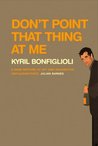
Don't Point that Thing at Me by Kyril BonfiglioliReviewed by Jason Koivu
My rating: 4 of 5 stars
Not only was Kyril Bonfiglioli a fan of PG Wodehouse, he flat out references Wodehouse through out Don't Point That Thing At Me. It's a level of sycophancy that I wasn't 100% comfortable with. But I guess if you're going to ape a writer's style, why not go full monty and let it all hang out? I mean, Bonfiglioli's writing style is sooo similar to Wodehouse's that it wasn't going to take the British public long to sniff it out, so hell, drop in a mention of Jeeves and Wooster into the text right off the bat and get it over with.
That said, Bonfiglioli does not quite have Wodehouse's wit and his characters are not quite as charmingly lovable as Wodehouse's. The first part is a tough one for anyone, save the odd Oscar Wildes and Mark Twains of the world. The second part is unavoidable considering Bonfiglioli is writing about characters involved in grand theft and murder. He's taken Wodehouse's stock plot - Wooster being forced into petty crime - and gone big and mean with it. Consequently it becomes hard to love or even side with his main characters. They do wrong and when wrong is done to them the best I could muster was an, "oh well mate, you had it coming" kind of sympathy. However, like James Bond - who kills a chap or two before he's even had his kippers - there is a certain amount of acceptance for all the wrong doing. This is entertainment. This is comedy. Since these aren't real people getting bumped off we can remain lighthearted and aloof, and so the characters we're supposed to be rooting for aren't completely tarnished.
Humor, man, it's so violent!
Rating: 3.5 stars
Adventure During The French Revolution
In the Reign of Terror: The Adventures of a Westminster Boy by G.A. HentyReviewed by Jason Koivu
My rating: 3 of 5 stars
The bloody guillotine...The slaughter of fatted nobles...The bloodlust massacre of innocents. G.A. Henty gives us the sour taste of these images from the French Revolution in his adventure story, In the Reign of Terror.
The tale follows Harry Sandwith, an English youth on the cusp of adulthood, as he tries to find a place in life for himself in France in the late 18th century. While there, the rumors of populous unrest explodes into the most unimaginable of horrors. Henty places his hero in the very center of history, even rubbing elbows with Revolutionary icons such as Robespierre. Where the politics of the times are concerned, the novel takes a decidedly antagonistic view of the Revolution. The plight of the people is not ignored, however, the acts of violence against the noble class are to be abhorred, if the novel's tone is the measuring stick to go by.
Adventure novels rely upon action to draw in the readers. Here the action comes in spurts and leaves much to be desired. Modern readers, accustomed to the pulse-racing nonstop action of today's highly-polished books and movies, may be frustrated by Henty's style. Too many static scenes drag on, too many words are wasted in describing plans instead of just enacting them, and too many insignificant actions are pondered upon. Once I even scared myself into thinking I'd accidentally started reading a James Fenimore Cooper!
The dialogue has issues too. A good deal of almost absurdly detailed exposition is delivered via dialogue, stilting it unnaturally. Emotional and psychological character transformations come at the flip of a switch: I see you are right and I am wrong. I will adjust my values. There, I have adjusted my values.
But before I finish, I don't want you to walk away from this review thinking poorly of this book. No, I actually enjoyed it for the most part, and if you can forgive the writing style, this less than perfect novel can be a fun read.
Sunday, May 11, 2014
Gulp.
Gulp. Adventures on the Alimentary Canal
Mary Roach
W.W. Norton & Company 2013
Reviewed by carol
Recommended for fans of digesting and laughing
★ ★ ★ for humor, ★ ★ 1/2 for information
While reading, I was reminded of long-ago biology studies, and the simplest members of Animalia that are little more than a gastric tube composed of cells. It’s astonishing, really, those primitive forms of waterborne life, and it emphasizes an interesting thing about animal anatomy, that we aren’t a solid, discrete, bounded organism: the environment moves through us as much as it moves around us. We like to think of “inside” and “outside” our bodies when in fact, it’s much more complicated. Those familiar with the gastrointestinal system (“the GI tract” in medical slang) understand that as a system rather continuous with the “outside,” it is one of the least sterile parts of our anatomy (the case could probably be made for skin as well). Perhaps that is why there are so many taboos surrounding what we eat, how we eat, vomiting, farting, defecation and such–all those different ways we process and exchange with our environment. Gulp. Adventures on the Alimentary Canal explores the GI tract and its unmentionables in an engaging way that is somewhat limited by basic scholarship.
One of her early paragraphs best explains her topic:
“Yes, men and women eat meals. But they also ingest nutrients. They grind and sculpt them into a moistened bolus that is delivered, via a stadium wave of sequential contractions, into a self-kneading sack of hydrochloric acid and then dumped into a tubular leach field, where is is converted into the most powerful taboo in human history. Lunch is an opening act.“
That both captures the strength and weakness of her writing; while good general information is buried in her text, it is largely hidden by metaphor and humor.
Divided into 17 chapters, the story loosely follows the physiological structure of the gastrointestinal tract, beginning with the sensations of smell and taste, then examining a variety of topics including ‘organ meats,’ chewing, stomach acid, saliva, swallowing, being eaten alive, overfilling stomachs, intestinal gases and flamability, colonic direction and stool. It didn’t take me very long to understand that this was the Trivial Pursuit version of the “adventures on the alimentary canal,” not the informative, organized tour designed to give insight in an entertaining way. As a nurse, I was rather hoping for a tour that taught in an engaging, non-professional style, not this collection of anecdotes, historical studies and titillating tidbits of taboos.
Content is largely based on a wide variety of scientific studies, both historical and current, and covering both human and animal. For those that may have little background in the topic, this could likely prove confusing. For example, the chapter on chewing jumps in time from 1947 to 1817, to 1979 to 1825. The continuity jumps challenge the lay understanding of historical developments and lack the feeling of developing a professional discipline. Also distracting were strange asides about the scientists/ food professionals themselves. Perhaps in an effort to humanize the science for the average reader, she also describes appearance and personality of a number of the people she interviews. (Personally, I found this the most distracting and least informative. If I want to read People, I would. But I don’t.) The nose section (“Nose Job”), for instance, is largely about a professional sensory analyst named Langstaff and Roach’s own experience trying out as an olive oil taster. The chapter on taste (“I’ll Have the Putrescine”) is primarily about engineering pet foods that appeal to dog, cat and owner, and talks about various personalities at the organizations she interviews.
Structurally, I found it was less coherently written than Packing for Mars. There’s copious footnotes, but not for intellectual background as much as parenthetical anecdotes or commentary. As the text content was just as engaging and digressive, I found myself wondering why she bothered with the footnotes? Amusement? Trendiness? They seem to be a mix of further text detail or opportunities for her to hilariously comment on her own writing. I won’t deny they were often funny; I laughed out loud at her exploration of whether a human could survive inside a whale’s stomach:
“While a seaman might survive the suction and swallow, his arrival in a sperm whale’s stomach would seem to present a new set of problems (1).
(1)I challenge you to find a more innocuous sentence containing the words sperm, suction, swallow and any homophone of seaman. And then call me up on the homophone and read it to me.“
Content concerns aside, Roach has a strong storytelling gift. Her voice is engaging and humorous, and is generally accessible. I found that she touched on a number of tantalizing issues in the field, such as our preference for sweets (mentioned in the taste tests for dogs), dyspepsia (hidden in a story about professional eaters and stomach size) and the growing interesting in how gut bacteria contributes to overall health (couched in a story about fecal transplants). Perhaps that is where some of my disappointment comes from, that she can be aware of some fascinating, topical issues in the GI field with enormous implications for people’s health, but then instead chooses to focus on the shock-studies of boa constrictor stomachs and dissolving live foods. Recommended for those in the mood for giggles and Science-Lite.
cross-posted at http://clsiewert.wordpress.com/2014/04/20/gulp-by-mary-roach-adventurous-in-a-bumper-car-kind-of-way/
Mary Roach
W.W. Norton & Company 2013
Reviewed by carol
Recommended for fans of digesting and laughing
★ ★ ★ for humor, ★ ★ 1/2 for information
While reading, I was reminded of long-ago biology studies, and the simplest members of Animalia that are little more than a gastric tube composed of cells. It’s astonishing, really, those primitive forms of waterborne life, and it emphasizes an interesting thing about animal anatomy, that we aren’t a solid, discrete, bounded organism: the environment moves through us as much as it moves around us. We like to think of “inside” and “outside” our bodies when in fact, it’s much more complicated. Those familiar with the gastrointestinal system (“the GI tract” in medical slang) understand that as a system rather continuous with the “outside,” it is one of the least sterile parts of our anatomy (the case could probably be made for skin as well). Perhaps that is why there are so many taboos surrounding what we eat, how we eat, vomiting, farting, defecation and such–all those different ways we process and exchange with our environment. Gulp. Adventures on the Alimentary Canal explores the GI tract and its unmentionables in an engaging way that is somewhat limited by basic scholarship.
One of her early paragraphs best explains her topic:
“Yes, men and women eat meals. But they also ingest nutrients. They grind and sculpt them into a moistened bolus that is delivered, via a stadium wave of sequential contractions, into a self-kneading sack of hydrochloric acid and then dumped into a tubular leach field, where is is converted into the most powerful taboo in human history. Lunch is an opening act.“
That both captures the strength and weakness of her writing; while good general information is buried in her text, it is largely hidden by metaphor and humor.
Divided into 17 chapters, the story loosely follows the physiological structure of the gastrointestinal tract, beginning with the sensations of smell and taste, then examining a variety of topics including ‘organ meats,’ chewing, stomach acid, saliva, swallowing, being eaten alive, overfilling stomachs, intestinal gases and flamability, colonic direction and stool. It didn’t take me very long to understand that this was the Trivial Pursuit version of the “adventures on the alimentary canal,” not the informative, organized tour designed to give insight in an entertaining way. As a nurse, I was rather hoping for a tour that taught in an engaging, non-professional style, not this collection of anecdotes, historical studies and titillating tidbits of taboos.
Content is largely based on a wide variety of scientific studies, both historical and current, and covering both human and animal. For those that may have little background in the topic, this could likely prove confusing. For example, the chapter on chewing jumps in time from 1947 to 1817, to 1979 to 1825. The continuity jumps challenge the lay understanding of historical developments and lack the feeling of developing a professional discipline. Also distracting were strange asides about the scientists/ food professionals themselves. Perhaps in an effort to humanize the science for the average reader, she also describes appearance and personality of a number of the people she interviews. (Personally, I found this the most distracting and least informative. If I want to read People, I would. But I don’t.) The nose section (“Nose Job”), for instance, is largely about a professional sensory analyst named Langstaff and Roach’s own experience trying out as an olive oil taster. The chapter on taste (“I’ll Have the Putrescine”) is primarily about engineering pet foods that appeal to dog, cat and owner, and talks about various personalities at the organizations she interviews.
Structurally, I found it was less coherently written than Packing for Mars. There’s copious footnotes, but not for intellectual background as much as parenthetical anecdotes or commentary. As the text content was just as engaging and digressive, I found myself wondering why she bothered with the footnotes? Amusement? Trendiness? They seem to be a mix of further text detail or opportunities for her to hilariously comment on her own writing. I won’t deny they were often funny; I laughed out loud at her exploration of whether a human could survive inside a whale’s stomach:
“While a seaman might survive the suction and swallow, his arrival in a sperm whale’s stomach would seem to present a new set of problems (1).
(1)I challenge you to find a more innocuous sentence containing the words sperm, suction, swallow and any homophone of seaman. And then call me up on the homophone and read it to me.“
Content concerns aside, Roach has a strong storytelling gift. Her voice is engaging and humorous, and is generally accessible. I found that she touched on a number of tantalizing issues in the field, such as our preference for sweets (mentioned in the taste tests for dogs), dyspepsia (hidden in a story about professional eaters and stomach size) and the growing interesting in how gut bacteria contributes to overall health (couched in a story about fecal transplants). Perhaps that is where some of my disappointment comes from, that she can be aware of some fascinating, topical issues in the GI field with enormous implications for people’s health, but then instead chooses to focus on the shock-studies of boa constrictor stomachs and dissolving live foods. Recommended for those in the mood for giggles and Science-Lite.
cross-posted at http://clsiewert.wordpress.com/2014/04/20/gulp-by-mary-roach-adventurous-in-a-bumper-car-kind-of-way/
Subscribe to:
Posts (Atom)