Monday, August 12, 2013
Reviewed by James L. Thane
Five out of five stars
Homicide 69 is another excellent book from Sam Reaves, an author who doesn't have nearly the following nor the reputation that he deserves.
The book is set in the summer of 1969. Richard Nixon is in the White House; war is raging in Vietnam; Neal Armstrong is walking on the moon; the Manson family is on its murderous rampage, and American society is in the process of being torn apart.
Against that backdrop, Mike Dooley, a solid, decent homicide detective, is doing what he can to redress the injustices committed by his fellow Chicago residents against each other. He's also trying, with marginal success, to navigate the treacherous waters of his own personal life. And a veteran of World War II, Dooley worries day and night about the safety of his son Kevin, a Marine who has been deployed to Vietnam.
Late one night, Dooley and his partner are called to the scene of an especially horrific homicide. A young woman, Sally Kotowski, has been brutally tortured and murdered. Kotowski was a former Playboy Bunny who hung out with mobsters, and Dooley quickly concludes that her death was mob-related.
A solution to the murder appears almost magically, and Dooley's bosses are happy to sign off on the case and declare it closed. Dooley is not. He believes that the solution is too neat and tidy and that the real killers are still at large. Through a long and difficult summer, he pursues the case relentlessly, often on his own time and at the risk of destroying his own career. And his journey takes him deep into the dark side of Chicago life in the late 1960s.
Homicide 69 is much more than a conventional crime novel. The reader knows fairly early on who the guilty parties are and so this is not a "mystery" novel in the traditional sense. It is, at heart, the story of one lone man, struggling against seemingly impossible odds, to do the right thing and to achieve one very small measure of justice in a world gone mad.
It's a story brilliantly told. Reaves has captured perfectly the tenor of the time in which the story is set and he has created an absolutely riveting protagonist in Mike Dooley. Even at nearly 600 pages, the story is way too short, and one closes the book wishing that you could follow Dooley's career indefinitely.
After being hard to find for some time, Homicide 69 is now available in a new e-book edition. It's hard to imagine any fan of crime fiction who would not enjoy it.
Sunday, August 11, 2013
Jay Lake Pre-Mortem Read-a-thon, Lucky Seventh Review

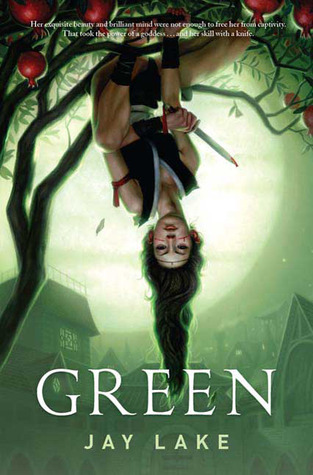
GREEN (Green Universe #1)
JAY LAKE
Tor Books
$15.99 trade paper, available now
Rating: 3.6* of five
The Publisher Says: Her exquisite beauty and brilliant mind were not enough to free her from captivity. That took her skills with a knife, plus the power of a goddess.
She was born in poverty, in a dusty village under the equatorial sun. She does not remember her mother, she does not remember her own name--her earliest clear memory is of the day her father sold her to the tall pale man. In the Court of the Pomegranate Tree, where she was taught the ways of a courtesan…and the skills of an assassin…she was named Emerald, the precious jewel of the Undying Duke’s collection of beauties. She calls herself Green.
The world she inhabits is one of political power and magic, where Gods meddle in the affairs of mortals. At the center of it is the immortal Duke’s city of Copper Downs, which controls all the trade on the Storm Sea. Green has made many enemies, and some secret friends, and she has become a very dangerous woman indeed.
Acclaimed author Jay Lake has created a remarkable character in Green, and evokes a remarkable world in this novel. Green and her struggle to survive and find her own past will live in the reader’s mind a long time after the book is closed.
My Review: And here we have the proof that no author can match one's tastes perfectly. Green is about an adolescent girl whose birth makes her Special.
My very least favorite trope featuring my very least favorite PoV character.
Emerald, aka Green, is an orphan whose father sold her into life as a thing. Females are always things in these stories. She's a well-made thing, in that she's trained in all the arts a woman needs training in...including murder...and she's got the attitude to prove she's as good as any boy.
She lacks ambition.
Her voyage around her world fetches her up in Kalimpura under Mother Jaivai, where her honing is completed. Her return to Selistan, to confront the pale wraith of her past, is a foregone conclusion. Her actions are inevitable. Their outcome is too much to pack in to the confines of one novel, so....
This sounds like something that would be ripe for a hatchet-job from the likes of me. But, as always, it's the way it's done that makes it or breaks it. The story as it's told here is made of small, lovely moments. Green telling us her story directly gives the discovery of the various parts of her world she inhabits a personal immediacy for the reader. The sensory world, while circumscribed, is that much more intense for being personal.
Where that works less well is in the overarching story of what happened to make this world Green inhabits the way it is. A bit like trying to infer the Constitutional Convention of 1787 from what a fourteen-year-old twenty-first century Canadian kid knows and sees.
In the end, with any book introducing a series, the important question is: Do you care about what comes next? Do you want to buy the next book?
To my surprise, yes, I do. Quite a job to make me want to, given my natural disinclination to read books about adolescents as well as fantasy novels.

This work is licensed under a Creative Commons Attribution-NonCommercial-ShareAlike 3.0 Unported License.
A Fortunate Read
DIVINE MISFORTUNE
A. Lee Martinez Reviewed by Carol Recommended for: people who almost liked John Dies at the End, people who like humorous fantasy Read from July 17 to 19, 2013 ★ ★ ★ 1/2
Divine was the perfect little quickie, a fast irreverent read at a time when I couldn’t give a book quality attention. You know how it is–some books deserve contemplation (Claire DeWitt, I’m talking to you), some require intellectual engagement (China is notorious for this), some insist you immerse in their world (Sanderson, you’re so demanding), some want your emotional commitment (I usually avoid the needy ones). But Divine doesn’t require any more than availability.
Based in a current version of America populated by the gods, Divine doesn’t break any new ground, but does have fun playing with old myths. Phil, the main character, was recently denied a promotion and discovers his competitor’s edge is his supportive divinity. On the way home, he’s in a minor fender bender (“The other driver pulled out a special knife and ran it across his palm, drawing some blood to offer to his god as he incanted, “Blessed by Marduk, who keeps my insurance premiums down”) and pulls into his driveway only to discover his neighbor now has the only perfect lawn in the subdivision, courtesy of a lawn service that worships Demeter. Phil decides he needs a god of his own and convinces his reluctant wife to choose a deity from Pantheon.com.
What they select is an amenable raccoon-headed god of minor good fortune. What they get is a raccoon version of You, Me and Dupree, a Hawaiian shirt wearing food hound, throwing parties for the gods and inviting his Mayan god friend Quetzalcoatl to crash on the couch (“Y’know, he was only joking about the alter thing,’ said Quick. ‘I was never into human sacrifice, even when it was legal.’ ‘Oh, I know. Conquistador propaganda.’”). Adjusting to life with a couple of gods isn’t easy for the straight-and-narrow Phil and Teri, and it’s even harder when strange things start happening.
Truly, it’s just simple fun. The plot is decent and the countering evil actually seems evil. There is an interesting parallel storyline with a former goddess of love spreading gloom and despair ever since being dumped–her discovering a new line of work was amusing. There’s a multitude of small bits like that, little common twists on deification that entertained me with their absurdity. Something about Charion bringing a dead potted plant as a house-warming gift and a Fury enforcing subdivision covenants entertains me. It does get a little absurd by the end, but it never veers so far out of control that it verges on acid fantasy, ala John Dies at the End.
Leave an offering of a worn copy of the Hitchhiker’s Guide and a homemade bookmark and the god of quick reads will oblige.
A. Lee Martinez Reviewed by Carol Recommended for: people who almost liked John Dies at the End, people who like humorous fantasy Read from July 17 to 19, 2013 ★ ★ ★ 1/2
Divine was the perfect little quickie, a fast irreverent read at a time when I couldn’t give a book quality attention. You know how it is–some books deserve contemplation (Claire DeWitt, I’m talking to you), some require intellectual engagement (China is notorious for this), some insist you immerse in their world (Sanderson, you’re so demanding), some want your emotional commitment (I usually avoid the needy ones). But Divine doesn’t require any more than availability.
Based in a current version of America populated by the gods, Divine doesn’t break any new ground, but does have fun playing with old myths. Phil, the main character, was recently denied a promotion and discovers his competitor’s edge is his supportive divinity. On the way home, he’s in a minor fender bender (“The other driver pulled out a special knife and ran it across his palm, drawing some blood to offer to his god as he incanted, “Blessed by Marduk, who keeps my insurance premiums down”) and pulls into his driveway only to discover his neighbor now has the only perfect lawn in the subdivision, courtesy of a lawn service that worships Demeter. Phil decides he needs a god of his own and convinces his reluctant wife to choose a deity from Pantheon.com.
What they select is an amenable raccoon-headed god of minor good fortune. What they get is a raccoon version of You, Me and Dupree, a Hawaiian shirt wearing food hound, throwing parties for the gods and inviting his Mayan god friend Quetzalcoatl to crash on the couch (“Y’know, he was only joking about the alter thing,’ said Quick. ‘I was never into human sacrifice, even when it was legal.’ ‘Oh, I know. Conquistador propaganda.’”). Adjusting to life with a couple of gods isn’t easy for the straight-and-narrow Phil and Teri, and it’s even harder when strange things start happening.
Truly, it’s just simple fun. The plot is decent and the countering evil actually seems evil. There is an interesting parallel storyline with a former goddess of love spreading gloom and despair ever since being dumped–her discovering a new line of work was amusing. There’s a multitude of small bits like that, little common twists on deification that entertained me with their absurdity. Something about Charion bringing a dead potted plant as a house-warming gift and a Fury enforcing subdivision covenants entertains me. It does get a little absurd by the end, but it never veers so far out of control that it verges on acid fantasy, ala John Dies at the End.
Leave an offering of a worn copy of the Hitchhiker’s Guide and a homemade bookmark and the god of quick reads will oblige.
Strange Maps
Strange Maps: An Atlas of Cartographic Curiosities
by Frank Jacobs
Three of five stars
Reviewed by Sesana
I love the look of maps, especially antique ones. They're so intricate and beautiful and exact. So naturally, this particular book really caught my interest. But what, exactly, is a strange map? Lots of things, really. Strange Maps started as a blog of the same name (<a href=http://bigthink.com/blogs/strange-maps>still going</a>, as it turns out) where Jacobs essentially posted any map that drew his attention and was out of the ordinary. This book is more than 100 of those maps, reproduced in full color and with a thorough explanation by Jacobs.
There's a huge variety here, everything from fictional lands to rejected border ideas to geographic oddities. I don't know if I'd call myself a map buff, but it was fascinating to me. Jacobs's commentaries were usually enlightening (he seems fairly knowledgeable, and he could point out some interesting details on the maps that I might have missed), though probably a pretty close match to what you could find on his blog. If you've been a regular reader of his blog, you probably won't get much extra out of the book version. But I'd never read his blog before, and don't think I'd even heard of it. I think I will be going through the archives now, though.
It isn't a perfect book, though. Not all of the maps are that interesting, and some of them are barely maps at all. And if I hadn't been taking my time and only reading one or two chapters at a sitting, I probably would have gotten bored of the maps eventually. That said, there were more than enough maps that were interesting enough for me to share, so I would say that this is worth a read, but only if you take it in chunks.
Also reviewed at Goodreads.
by Frank Jacobs
Three of five stars
Reviewed by Sesana
I love the look of maps, especially antique ones. They're so intricate and beautiful and exact. So naturally, this particular book really caught my interest. But what, exactly, is a strange map? Lots of things, really. Strange Maps started as a blog of the same name (<a href=http://bigthink.com/blogs/strange-maps>still going</a>, as it turns out) where Jacobs essentially posted any map that drew his attention and was out of the ordinary. This book is more than 100 of those maps, reproduced in full color and with a thorough explanation by Jacobs.
There's a huge variety here, everything from fictional lands to rejected border ideas to geographic oddities. I don't know if I'd call myself a map buff, but it was fascinating to me. Jacobs's commentaries were usually enlightening (he seems fairly knowledgeable, and he could point out some interesting details on the maps that I might have missed), though probably a pretty close match to what you could find on his blog. If you've been a regular reader of his blog, you probably won't get much extra out of the book version. But I'd never read his blog before, and don't think I'd even heard of it. I think I will be going through the archives now, though.
It isn't a perfect book, though. Not all of the maps are that interesting, and some of them are barely maps at all. And if I hadn't been taking my time and only reading one or two chapters at a sitting, I probably would have gotten bored of the maps eventually. That said, there were more than enough maps that were interesting enough for me to share, so I would say that this is worth a read, but only if you take it in chunks.
Also reviewed at Goodreads.
Friday, August 9, 2013
White Time
Margo Lanagan
Eos
Reviewed by: Nancy
4.5 out of 5 stars
Summary
Lose yourself in White Time
White Time is mind time, body time, soul time, heart time.
White Time is other worlds, other dimensions, other states of being.
White Time is out of time.
In this transcendent collection of short stories, Margo Lanagan, author of the award-winning story collection "Black Juice," deftly navigates a new set of worlds in which the boundaries between reality and possibility are paper-thin . . . and sometimes disappear altogether.
My Review
Anthologies are fun to read because they feature a wide variety of authors and styles. With their hit-or-miss qualities, however, they can also end up being disappointing. If I run into a real dud of a story, do I set the book aside and pick up something else or skip the story and continue reading? I have several partially read anthologies just because that dud was stuck somewhere in the middle.
Short stories by one author are a little different. At least I can expect more consistency in quality. With Margo Lanagan, especially, I know I won’t get a dud. This is the third collection of stories I’ve read by her and all three times I’ve read the stories consecutively with hardly a break in between. Her writing is exquisite, rich and lovely, and the stories imaginative, moving and unsettling. I hope she plans to write forever!
White Time
One of my favorite stories in this collection is the very first one, White Time. Sheneel gets a taste of work experience, called “occupation tasting”. Her friends get to do something fun and undemanding while Sheneel gets the more fascinating job of redirecting entities that got caught in “white time” that netherworld between time periods. It’s work, so there are boring duties like number crunching and there are hazards involved. A haunting, thought-provoking story. 5/5
Dedication
An engrossing little story that explores family relationships, death and grieving. 4/5
Tell and Kiss
In Evan’s world it is not food that makes you gain weight, it is all the thoughts and feelings kept inside. Now at the end of his program, he has reached his goal weight. Will he be able to keep it off? 5/5
The Queen’s Notice
A first-hand perspective of life in an ant colony. Will the queen get her mate? 3/5
Big Rage
Billie is married to a total jerk who belittles her constantly and has to have the last word. While relaxing at the beach, she meets a wounded man in armor who is badly in need of help and in turn, he helps her unleash her pent-up emotions and anger toward her husband. I love stories about powerful women! 5/5
“What comes out of me is fire. A roar of fire, a blast of fire, a curling, teeming, many-coloured chameleon-tongue of fire. It curves up the dune-side and scorches the scrub at the top. James’s spread hand, with the wedding ring on it, sticks out like a drowning man’s. He falls, he claws himself upright, he flounders flaming up over the dune-top and out of sight.”
The
Night Lily
A sad and moving story which shows the effects of war on a group of children.
4/5
The Boy Who Didn’t Yearn
Tess Maxwell can read people. Their weaknesses, pain, emotions that are so apparent to her are not to others. Then she meets Keenoy Ribson, seemingly so happy with his life. How does he do it? 5/5
Midsummer Mission
Cute, funny and full of love. 3/5
Welcome Blue
A quiet story about a girl who gets a job snipping flowers to welcome the arrival of a special visitor. Little about the visitor, but more about the town’s varying reactions. 4/5
Wealth
In this class-oriented world, it’s not about how much money you have, but how luxurious your hair is. Probably one of the most accessible stories in this collection, and I don’t mean that in a negative way. 5/5
Tess Maxwell can read people. Their weaknesses, pain, emotions that are so apparent to her are not to others. Then she meets Keenoy Ribson, seemingly so happy with his life. How does he do it? 5/5
Midsummer Mission
Cute, funny and full of love. 3/5
Welcome Blue
A quiet story about a girl who gets a job snipping flowers to welcome the arrival of a special visitor. Little about the visitor, but more about the town’s varying reactions. 4/5
Wealth
In this class-oriented world, it’s not about how much money you have, but how luxurious your hair is. Probably one of the most accessible stories in this collection, and I don’t mean that in a negative way. 5/5
Also posted at Goodreads.
Thursday, August 8, 2013
In Praise of Reading
Fahrenheit 451
by Ray Bradbury
Published by Ballantine Books
Reviewed by Amanda
3 Out of 5 Stars
Fahrenheit 451 is one of those books that I should have read by now. Occasionally, a student comes to me, eyes ablaze with indignation that anyone should ever burn books, and they want to talk about it. "Why would anyone do such a thing? This is impossible! Why would such a world exist?" And, more tremulously, "Could this world ever exist?" As shame and humiliation wash over me, I have to say, "Um, I haven't read it. But it's on my to-read list!" They look stricken, abashed, as though I have failed them. And maybe I have. If anyone should have read the book about burning books, it's the English teacher, right? Hell, I'm just excited that they get so pumped over it. In a world where student literacy scores are on the decline, where a teenager would rather pick up an iPod than a book, and most students only read 2-3 books a year (except for my room, where I must brag for a moment, we kick some reading ass), the fact that some of them still read Fahrenheit 451 and become incensed gives me hope for the future.
It is a shame that I haven't read Bradbury's novel until now. This is a book that calls out to the bibliophile. It reminds us what a simple and precious thing a book is; what a liberty it is to own them and have the privacy to read them and the right to think about them; what a privilege it is to not have our books censored. Reading is a simple freedom that so many take for granted because they see just the physical act: sitting in a chair and turning a page. What they don't realize is that, in that simple act, an entire person is formed: beliefs, opinions, and thoughts are constantly challenged, reassessed, and reshaped. Reading is the act of constantly taking our measure against the world and deciding if we're the type of person we want to be. Reading keeps us in check and it reminds us there are others out there in very different circumstances for whom we should feel empathy. In short, reading is the very act of maintaining our humanity.
In Fahrenheit 451, however, reading is a freedom that has been willingly renounced by the citizens. As more immediate forms of technological entertainment became available, people simply lost interest in reading. In Bradbury's world, the living room itself is a wall-to-wall tv, constantly droning on and offering pure entertainment with which the viewer can take an interactive role, but there is no substance. When you're not in the living room, you wear a Seashell in your ear that constantly broadcasts news and auditory entertainment. Silence and introspection are shunned. Perhaps most frightening is that this is eerily the world of today: flat screen televisions on every wall of the house; interactive technology such as video games and computers; iPods constantly delivering a steady stream of noise. In terms of technology, we are living in Fahrenheit 451. As Captain Beatty tells Guy Montag, "School is shortened, discipline relaxed, philosophies, histories, languages dropped, English and spelling gradually neglected, finally almost completely ignored. Life is immediate, the job counts, pleasure lies all about after work. Why learn anything save pressing buttons, pulling switches, fitting nuts and bolts?" If that doesn't sum up the general direction in which education is heading, then I don't know what does, unless it's when he tells Guy that the educational development can be summarized as "Out of the nursery, into the college and back to the nursery; there's your intellectual pattern."
The novel focuses on Guy Montag, a fireman whose job is to start fires instead of putting them out. Specifically, the firemen exist to burn houses where books are being kept by those few who still cling to the written word. Through a series of events, Guy becomes self-aware and begins to question the world around him--specifically, what threat is there in books and could books hold the key to curing the detachment, the ennui, and the hatred that permeate the world in which he lives. As Guy learns to think for himself, we're taken on a journey through the dystopian world in which he resides.
Now, after all this, you may wonder why I only gave the book a 3. In terms of Bradbury's stance on books and his presentation of what value books should have to humanity, I'd definitely give it a 4. However, in terms of the execution of his dystopian conceit, it isn't quite as powerful as I wanted it to be. This may be because I just finished reading Nineteen Eighty-Four and, compared to the elaborate lengths to which Orwell goes to describe every facet of Oceania's society, the dystopia here felt rather thin. I wanted more background and more history than Captain Beatty presents to Guy Montag, but perhaps that's the way it should be. In a world where thinking isn't valued and knowledge is condensed, it shouldn't be surprising that the characters know very little about their own history.
Wednesday, August 7, 2013
Dreams from the Mist
Clouds End
Sean Stewart
Ace
Reviewed by: Terry
3 - 3.5 out of 5 stars
I love Sean Stewart and I wish he hadn't given up on writing fantasy. His books are always a treat and pay back tenfold the effort put into them by the reader. _Clouds End_ was Stewart's "pure fantasy" novel, not the mixed urban fantasy with science fictional elements type of story that the majority of his works seem to fall into. I have to admit that the first time I tried to read this book I didn't like it. I still think that Stewart wasn't fully successful in realizing what he was attempting , but this novel still has some of Stewart's best writing, character development, and a truly marvellous vision of a magical world.
Stewart has said that he wanted to write an epic fantasy in the mould of Tolkien, but from his own agnostic perspective as opposed to the religiously infused one of Tolkien. The world he creates is truly magical. We start out on the island of Clouds End, a place that exists on the very edge of the magical otherworld known as the Mist. The Mist is the place from which mankind draws their myths and stories, both good and evil, and seems to interact with the human psyche in some sort of symbiotic way, bringing to life the unconscious dreams of those on its periphery. In this sense it is something like Ryhope Wood as seen in Robert Holdstock's classic _Mythago Wood_, though it seems to be creating the world around it in a much more concrete fashion even as it participates in the generation of myths and heroes; for the Mist produces gods and powers, giving physical substance to the folk heroes and villians of mankind. It also changes any humans who enter its depths, making them into Haunts, something akin to the preternatural fae of our more traditional mythologies. We see examples of the former in the world changing figures of the Gull Warrior and Sere, one apparently a folk hero of the island dwellers, the other a trickster god of fire and chaos; the latter comes directly into the story in the form of Jo, a human who had entered the Mist and became a shapeshifter who now longs to regain a human soul.
The main characters are a group of four young friends, all inhabitants of Clouds End, who are drawn into a quest when one of their number, Brook, is "twinned" by Jo and is now mystically bound to her. They decide to follow Jo in her quest to the mainland and become embroiled in a war undertaken by the Emperor of a far land under the malign influence of the fire-god Sere. As usual with Stewart each of these characters are fully realized and interesting people, from the uncertain and apprehensive Brook and solid and dependable Rope, to the adventure seeking and rash Shale and the mercurial and love-lorn Foam. As well, true to form, Stewart's depiction of magic is spot-on. Magic is seen as a numinous and capricious force that touches human lives in unexpected and usually dangerous ways. This is not simply science by another name, it is the unknown and the unknowable taking part in our everyday lives; our dreams and nightmares come to life.
The story is full of exceptional scenes and characters and I found it a joy to read simply for the sake of Stewart's prose, but I have to admit that I don't think it ultimately worked as an example of epic fantasy. The supposed reason for the overall quest, the war being waged by the empire of the forest dwellers against the islanders, seems to peter out without really requiring any intervention on the part of the main characters. It is actually their individual stories that hold more interest, and follow much more reasonable arcs, than the supposed meta-plot of the novel and I think Stewart would have been better served to have simply told their stories without attempting to force them into the context of an 'epic fantasy quest'. Still, I think Stewart has written a worthy book in _Clouds End_ and it is exceptional both for its similarities to his other work and, perhaps moreso, because of its differences.
Also posted at Goodreads
Tuesday, August 6, 2013
Jack Vance
Jack Vance is one of my all-time favorite authors. He is brilliance on the page. Here are reviews of three of his novels.
***
EMPHYRIO
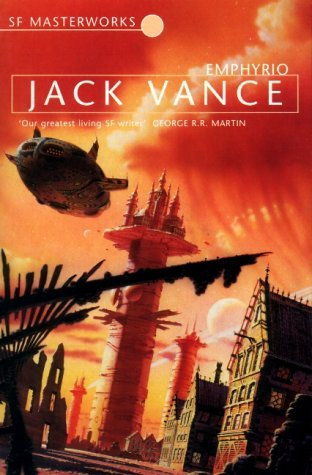
Ghyl Tarvok is the son of a kindly but distracted woodworker on Halma - a planet that is ruled by an aristocracy, tightly managed by its public welfare department (which incorrectly calls its governmental system a "Welfare State"), and exhibits traits of a dogmatic but not entirely authoritarian theocracy as well. 'Emphyrio' is a legend out of time: a heroic young man who calmly challenged invaders and who ushered in a period of peace for his people. young Ghyl dreams of many things: owning a 'space-yacht', traveling to far worlds, discovering the truth behind the legend of Emphyrio, making his home a better place. the novel Emphyrio is about Ghyl gradually understanding the mysteries in his life - his own dreams & desires, his father, the true history & rulers of his world. it is not a fast-paced tale of adventure (although there is a little of that)... its structure is more of a gently-paced Coming of Age tale.
I connected with this novel in a couple ways. who doesn't dream of leaving their mundane environs to see the world(s) beyond? what kid hasn't looked around and wondered if there were mysteries and wonders that they could somehow experience eventually, if only, if this happens, if they could do that, if only it were like this, etc? who hasn't had those stabs of jealous anger at the idea that many people are fully financial capable of casually jetting off to see whatever they want to see, while everyone else is stuck scrimping and saving just to have a one-week excursion to some banal place that everyone else is going to anyway? being inside Ghyl's curious and envious head was like being inside my own head, at different points in my life.
I also connected with Ghyl's quietly contemptuous, eventually seething reactions to all of the petty political, fiscal, and religious bullshit that ties people down into living their lives like mice in a maze, led by this bit of cheese, constrained by walls, forced to move in certain directions. innoculated against difference and individualism and thinking outside of all of our carefully constructed boxes. Vance's depiction of Halma's organized religion was a particularly ingenious and sardonic invention. all the hypocrisy, all the passive-aggresiveness, all the public shaming... placed adroitly within a faith that is concerned with literally Leaping onto various squares symbolizing Right Behavior and avoiding those Bad Squares. it was all so mordantly comic - and also frustrating, depressing, and sickeningly hollow. but amusing!
over half of the novel simply shows Ghyl growing up in this stifling but not exactly horrendous environment. besides a certain wizened puppetmaster, characters are not portrayed as hideously evil or malevolent. the biggest jerks are the rule-minders, the businessmen, and the aristocrats... and also the rule-breakers, the folks who reject society, who want to get away with rejecting that society but still live off of it. Vance has an even hand when it comes to disdain and critique.
the remaining part of the novel is the actual "adventure". here also Vance does not indulge the reader in wish-fulfillment. hijacking a space yacht can get truly ugly. exotic locations are not always pleasant. the answers to lifelong questions can be disappointing. sometimes trickery is the only way to get what you want, even if you are a person who prides himself on his honesty.
fortunately, and here's a kinda SPOILER... this is not a nihilistic book. there is a happy ending, although one that has its share of blood-soaked slaughter (or at least a couple sentences worth).
in Emphyrio, Vance strips down his often ornate writing style to fit his goals. he is writing about the banally prosaic nature of most lives and so lushness of language is understandably absent, for the most part. but this is still Jack Vance, so even when he streamlines his more baroque tendencies, the reader is still able to enjoy his expert turns of phrase, his constant irony, his wry characterization, and his supreme ability to distill the ethos of a certain tradition or city or culture or planet into a few carefully chosen and beautifully constructed sentences. will there ever be a genre wordsmith as accomplished and as stylish as this author?
***
THE GRAY PRINCE
"Except for a few special cases,
title to every parcel of real property derives from an act of violence, more or
less remote, and ownership is only as valid as the strength and will required
to maintain it. This is the lesson of history, whether you like or not.”
Jubal Droad is a high-caste Glint in the land of Thaery, on the planet Maske, on the outskirts of the Gaean Reach. unfortunately being a noble son of Glint means practically nothing in the big city of Wysrod, where his homeland of Glentlin is an embarrassing country cousin to more sophisticated family members. Jubal is instantly identified as redneck. he gets offended. Jubal gets offended quite a lot; he chafes frequently at any sign of snobbery or high-handedness. fortunately for Jubal, he is a lad with both connections and some very dear secrets, and he is quickly given a job as an "Inn Inspector". which is code for glamorous, jet-setting spy. Jubal barely cares. it's just another job and his main goals are making lots of cash, getting his revenge on with a noble who offended him, and then, well, he doesn't know. doing something. he'll figure it out. whatever. and so the Grand Adventure begins! ha.
***
EMPHYRIO
Ghyl Tarvok is the son of a kindly but distracted woodworker on Halma - a planet that is ruled by an aristocracy, tightly managed by its public welfare department (which incorrectly calls its governmental system a "Welfare State"), and exhibits traits of a dogmatic but not entirely authoritarian theocracy as well. 'Emphyrio' is a legend out of time: a heroic young man who calmly challenged invaders and who ushered in a period of peace for his people. young Ghyl dreams of many things: owning a 'space-yacht', traveling to far worlds, discovering the truth behind the legend of Emphyrio, making his home a better place. the novel Emphyrio is about Ghyl gradually understanding the mysteries in his life - his own dreams & desires, his father, the true history & rulers of his world. it is not a fast-paced tale of adventure (although there is a little of that)... its structure is more of a gently-paced Coming of Age tale.I connected with this novel in a couple ways. who doesn't dream of leaving their mundane environs to see the world(s) beyond? what kid hasn't looked around and wondered if there were mysteries and wonders that they could somehow experience eventually, if only, if this happens, if they could do that, if only it were like this, etc? who hasn't had those stabs of jealous anger at the idea that many people are fully financial capable of casually jetting off to see whatever they want to see, while everyone else is stuck scrimping and saving just to have a one-week excursion to some banal place that everyone else is going to anyway? being inside Ghyl's curious and envious head was like being inside my own head, at different points in my life.
I also connected with Ghyl's quietly contemptuous, eventually seething reactions to all of the petty political, fiscal, and religious bullshit that ties people down into living their lives like mice in a maze, led by this bit of cheese, constrained by walls, forced to move in certain directions. innoculated against difference and individualism and thinking outside of all of our carefully constructed boxes. Vance's depiction of Halma's organized religion was a particularly ingenious and sardonic invention. all the hypocrisy, all the passive-aggresiveness, all the public shaming... placed adroitly within a faith that is concerned with literally Leaping onto various squares symbolizing Right Behavior and avoiding those Bad Squares. it was all so mordantly comic - and also frustrating, depressing, and sickeningly hollow. but amusing!
over half of the novel simply shows Ghyl growing up in this stifling but not exactly horrendous environment. besides a certain wizened puppetmaster, characters are not portrayed as hideously evil or malevolent. the biggest jerks are the rule-minders, the businessmen, and the aristocrats... and also the rule-breakers, the folks who reject society, who want to get away with rejecting that society but still live off of it. Vance has an even hand when it comes to disdain and critique.
the remaining part of the novel is the actual "adventure". here also Vance does not indulge the reader in wish-fulfillment. hijacking a space yacht can get truly ugly. exotic locations are not always pleasant. the answers to lifelong questions can be disappointing. sometimes trickery is the only way to get what you want, even if you are a person who prides himself on his honesty.
fortunately, and here's a kinda SPOILER... this is not a nihilistic book. there is a happy ending, although one that has its share of blood-soaked slaughter (or at least a couple sentences worth).
in Emphyrio, Vance strips down his often ornate writing style to fit his goals. he is writing about the banally prosaic nature of most lives and so lushness of language is understandably absent, for the most part. but this is still Jack Vance, so even when he streamlines his more baroque tendencies, the reader is still able to enjoy his expert turns of phrase, his constant irony, his wry characterization, and his supreme ability to distill the ethos of a certain tradition or city or culture or planet into a few carefully chosen and beautifully constructed sentences. will there ever be a genre wordsmith as accomplished and as stylish as this author?
***
THE GRAY PRINCE
The Gray Prince – the novel – is reserved, dry, sly, a
streamlined adventure, a mystery box full of more mystery boxes, a meditation
on manifest destiny, a critical contemplation on colonialism that left me a
little disturbed. The Gray Prince – the character – is a fool, a clown, an
object of exploitation, an embittered revolutionary, a supporting character of
more importance as an objective of critical contemplation than as an actual
supporting character. I don’t know why the book is titled “The Gray Prince”. I
think it should be called “Might Is Right”. It is a very enjoyable novel with
some unnerving things to say about who can take what and why. Because it is
written by the masterful Jack Vance, these ideas are slowly, sardonically
unspooled with wit, subtlety, and a quiet, slowly building forcefulness. I
don’t agree with the points he is making but damn he knows how to drive a point
home.
"Except for a few special cases,
title to every parcel of real property derives from an act of violence, more or
less remote, and ownership is only as valid as the strength and will required
to maintain it. This is the lesson of history, whether you like or not.”
“The mourning of defeated peoples, while pathetic and
tragic, is usually futile,” said Kelse.
Well, okay
then.
Schaine Madduc returns to the world of
Koryphon after a stay abroad. She’s the child of a maverick ranching family –
one of many such families on the planet – whose ancestors seized their land on
the continent Uaia from the nomadic human-offshoot s who once held it. She’s
lightly liberal and hates the idea that others may suffer from her family’s
actions; she also really loves her land and has no interest in leaving it. The
Gray Prince is madly in love with her. Surprisingly, she is not the
protagonist. Erris Sammatzen is a decent man and gentle
progressive from the cosmopolitan continent of Szintarre, which also functions
as the de facto capital of Koryphon. He is an activist for the independence of
the colonized natives; despite this, he is falling in love with the land-owner
Schaine. Following her back to Uaia, he
gets tossed into adventure after adventure; each time he rises to the occasion
and each time his progressive viewpoint gets shaken a wee bit more.
Surprisingly, he is not the protagonist. Gerd Jemasze has
many mysteries to solve… Who are the true – and sentient - citizens of
Koryphon? What are their plans for the human and human off-shoots who hold
their planet? Who killed Schaine’s father? And what was that last ‘joke’ that
so impressed that taciturn land baron? Gerd is smart and sardonic, a quietly
humane man of few words who doesn’t think much on ideological matters and who
is excellent under pressure and in a fight. He is a classic Vance protagonist.
Surprisingly, he is not the protagonist of this novel.
The diversity of
perspective is one of the many pleasing things about this novel. The brisk and
deadpan tone, the high adventure done with a minimum of fuss, the elegant prose
and the expert word choice and sentence structure, the overall humorous
intelligence on display, the ingenious ability to define multiple cultures and
species, the lingering ambiguity, the tart and cynical commentary on human
nature… all Vance trademarks and all fully present. This is a lot of fun,
definitely, but it is also a rather deflating experience as well. Vance doesn’t
truck in wish fulfillment. But this one was a bit more deflating than usual.
Why you wanna punch me in the gut, Vance.
Erris
Sammatzen approached Jemasze.
“And this is Uther Madduc’s ‘wonderful joke’?”
“So I believe.”
“But what’s so funny?”
“The magnificent ability of the human race to delude itself.”
“That’s bathos, not humor,” said Sammatzen shortly.
“And this is Uther Madduc’s ‘wonderful joke’?”
“So I believe.”
“But what’s so funny?”
“The magnificent ability of the human race to delude itself.”
“That’s bathos, not humor,” said Sammatzen shortly.
Indeed.
***
MASKE: THAERY
quintessential Jack Vance adventure novel. swiftly-paced, drily witty, deeply ironic, byzantine in its layers of back-story and multiple displays of world-building yet happily trim and stripped-down in its actual verbiage, featuring a sardonic young hero, his icy love interest and various mysteries that he is only slightly interested in solving.
Jubal Droad is a high-caste Glint in the land of Thaery, on the planet Maske, on the outskirts of the Gaean Reach. unfortunately being a noble son of Glint means practically nothing in the big city of Wysrod, where his homeland of Glentlin is an embarrassing country cousin to more sophisticated family members. Jubal is instantly identified as redneck. he gets offended. Jubal gets offended quite a lot; he chafes frequently at any sign of snobbery or high-handedness. fortunately for Jubal, he is a lad with both connections and some very dear secrets, and he is quickly given a job as an "Inn Inspector". which is code for glamorous, jet-setting spy. Jubal barely cares. it's just another job and his main goals are making lots of cash, getting his revenge on with a noble who offended him, and then, well, he doesn't know. doing something. he'll figure it out. whatever. and so the Grand Adventure begins! ha.
that 'whatever' is one of the wonderful qualities of this novel. this may be a novel featuring a spy tracking down a nefarious villain across three worlds, while getting embroiled in the affairs of the aristocracy and dealing with a violent regime change back home, but the tone of the whole thing is so charmingly nonchalant. Jubal may be seething with fury and resentment in general, gnashing his teeth with frustration at the cold treatment he receives from a lady who turns him on with that cold treatment, and forever haggling with his boss over money... but he is also so nonchalant about it. most characters in Vance novels are this way: oh so sardonic. I love the elegant and stylishly low-key way that all the characters converse with each other. this may be a pulp novel of sorts, but it is also pure style. Jack Vance, as ever, has a skilled and delightful way with words. I read this all in one long afternoon in the park and it was pure enjoyment.
Masque: Thaery has a real economy of words and yet the various science fantasy ideas on display are well thought-out, wide-ranging, just brimming over with creativity. there is enough imaginative awesomeness in this book to fill a whole mega-series of science fantasy, and yet the novel clocks in at a slim 216 pages.
I found two things to be particularly enjoyable.
first HEY THIS WHOLE PARAGRAPH HAS A BIG SPOILER. at one point, Vance spends several pages detailing various luxury tours that are available on a vacation planet. the tours described are wonderful flights of the imagination and I loved reading about them. but I did wonder - why spend so much time on something that has nothing to do with the plot? and then I forgot that, and continued to enjoy the narrative. but at the end - with the surprise reveal of the villain's surprisingly banal motives being based on mercenary exploitation of natural places for luxury tourism - the lengthy descriptions of luxury tours elsewhere made quick sense. I reread them again and noticed the subtle things that had escaped me at first: native animals being exploited; natural places being transformed and prettified for tourist eyes; sex tourism; the drug trade; exploitation of natural resources; etc. I appreciated the subtlety of the foreshadowing, and I appreciated even more the secretly furious perspective of the author on such things. who would have guessed that Vance would be such an ardent progressive when it comes to environmentalism? the heinous and gruesome ending for the villain illustrates exactly how Vance feels about raping natural places. plus some fairly brutal irony in the actual mode of (slow, slow) death.
the second thing: a lot of odd footnotes and a really random glossary. here's one entry from the glossary, describing points an employer must consider when using the services of the human-ish Djan:
One Djan performs aimlessly unless supervised.
Two Djan become intense; they either quarrel or fondle each other.
Three Djan create a disequilibrium; they work with agitation and resentful energy.
Four Djan form a stable system. They respond equably to orders but exert themselves only moderately and indulge themselves in comfort.
Five Djan form an unstable and dangerous combination. Four will presently form a group; the fifth, ejected, becomes resentful and bitter. He may go "solitary."
Six Djan yield one stable set and a pair of defiant lovers.
Seven Djan create an unpredictable flux of shifting conditions and a turmoil of emotions.
Eight Djan, after considerable shifting, conniving, testing, plotting, backbiting, yield two stable groups.
Sharks & Rays
Sharks & Rays by Time-Life-BooksMy rating: 3 of 5 stars
In Honor of Shark Week!:
I found this on the bargain table at Barnes and Noble eons ago. I bought it for two reason. Firstly, I bought it as a writing resource. What better inspiration for monsters than these cartilaginous horrors from the deep? The second reason is that inside I'm still a kid and enjoy reading about bugs, dinosaurs, and sea creatures.
As the title of the book indicates, it's about Sharks & Rays. The book is packed with short articles about many facets of their lives. There are articles about the different species and subspecies of sharks and rays, their habitats, mating practices, behavior, encounters with man, etc. Related species such as the ratfish are also covered, as are evolution, common ancestors, anatomy, and biology.
The best part is the field guide which occupies about half the book. Because of it, I can now tell the difference between an Atlantic short tailed ray and it's cousin, the electric torpedo. I have to say that the weirdest shark in the book is the Wobbegong shark. It's a freaky looking thing that looks like a piece of coral.
I'd recommend this to anyone who's a shark enthusiast or lives with one. It's a very interesting read and could be invaluable if a shark bites you and you need to tell which kind it was.
Also on Goodreads
The Finest Flintlock Fantasy
Promise of Blood by Brian McClellanMy rating: 5 of 5 stars
In the aftermath of a bloody coup against the monarchy, Field Marshal Tamas struggles to hold the country together while trying to figure out who among his trusted allies is a traitor. Meanwhile, his estranged son goes into the mountains to kill a friend and stumbles upon a plot to summon a god...
As I've said in other reviews, there are certain times when a reader stumbles upon a book that hits all the sweet spots. For me, one of those special books was Promise of Blood.
I've read a fair amount of fantasy over the years but I find myself tiring of quest stories set in worlds resembling medieval Europe, frequently with a heaping helping of medieval stasis thrown in. A lot of fantasy seems to be rehashes and brings very little new to the party. Not only does Promise of Blood bring a lot of new things to the party, it brings the party with it.
The book opens with Tamas making an effort to finish the coup and clean up his mess. Meanwhile, his son Taniel returns from foreign lands with a big reputation and a chip on his shoulder. Things are quickly ratcheted up a notch and things never let up.
The setting is similar to the era of the French revolution, complete with gun powder and guillotines. That was enough to interest me, along with the tagline "The Age of Kings is dead and I have killed it," which hints at how innovative this book is compared to most fantasy on the racks. Throw in the magic system and I didn't stand a chance.
In addition to the Privileged, the usual wizardly types, we have the Knacked, who have one or two small magical talents, and the Marked, who are a bit more powerful and possessed of a mystical third eye. Some of the Marked become Powder Mages, spellcasters who can use gun powder to do some pretty cool things.
Another thing that kept me reading well into the wee hours was the shifting points of view, from Tamas to his son Taniel to Adamat, the investigator Tamas tasked with finding the traitor, who happens to have some secrets as well.
The characters are an interesting mix, from Tamas with his stubborn streak to Adamat and his conflict over his duty vs. his family, to Taniel and his growing powder addiction. Taniel Two-Shot snorting lines of gun powder and the resulting nosebleeds will stick with me for a while.
It's quite a bit more complicated than my summary has indicated. This is one book I wouldn't want to spoil for anyone. It has everything I look for in a fantasy novel: grit, action, intrigue, surprises, and new ideas rather than rehashing old ones. Five powder-burned stars! Now if I could just snag an ARC of the sequel...
Subscribe to:
Posts (Atom)