Sunday, August 31, 2014

The Secret Place by Tana French


The Secret Place
Tana French
Viking Adult, 2014


Reviewed by carol

★    ★    ★    ★    ★


Here’s how I imagine it went down:

French and her besties are at their high school reunion weekend. They’re sitting around drinking wine and reminiscing when someone decides to pull out the old ouija board from the attic storage. Much to their surprise, they channel Agatha Christie’s voice from Cat Among the Pigeons. Flush with success, they try again, and discover Ray Bradbury’s Something Wicked This Way Comes (review here). 

Alright; maybe I just have my own upcoming reunion on my mind. But I was captivated by the way The Secret Place integrated the turbulent days of youth at a girls’ boarding school with a murder investigation by Dublin’s finest, proving again that French has talent in spades. If there is one thing her prior four books in the Murder Squad series have made clear, French is great at character creation. And atmosphere. Oh, and dialogue. Okay, fine; she’s good at all the components that make a book enjoyable. This time she’s also nailed the police procedural aspects of the case. 

The story begins with Holly and her three friends hanging at a playground, musing on the end of summer and their upcoming year together at boarding school. Fast forward to Detective Stephen Moran at the Cold Cases Unit. Holly appears at the police station requesting a meeting with him, six years after when they last met in events covered by The Faithful Place. The exclusive boarding school she resides at has a noticeboard where students can put up anonymous confessions. Holly has found a postcard with an old picture of murder victim Chris Harper.  The words “I know who killed him” are pasted across in cut-out letters. Moran seizes the opportunity to wedge his foot in the door of the Murder Squad, and personally takes the note to the case’s lead detective, Antoinette Conway. As she is currently without a partner, he offers her the benefit of his disarming interview skills when she returns to the school to re-interview the students. What follows is an exploration of what led to the death and how the detectives retroactively piece the story together.


The plot timeline is unusual, as it combines the current investigation with viewpoints from the girls and from Chris during the prior year. The investigation takes place within one incredibly busy day, while the events in the girls’ lives cover the entire previous year at school. It’s an interesting kind of time shifting for a murder mystery, but I came to enjoy it. Instead of learning about the prior relationships and circumstances through flashbacks, we live it with four of the girls and the victim, bringing a heightened sense of doom to their daily lives.


Characterization is stellar. The introduction to Murder Squad Detective Conway:

Antoinette Conway came in with a handful of paper, slammed the door with her elbow. Headed for her desk. Still that stride, keep up or fuck off… Just crossing that squad room, she said You want to make something of it? half a dozen ways.

Or the (re-) introduction of Detective Frank Mackey:
I know Holly’s da, a bit. Frank Mackey, Undercover. You go at him straight, he’ll dodge and come in sideways; you go at him sideways, he’ll charge head down.

Marvelous, really; contrast that with the books that focus on the appearance of the character first, or contain long soliloquies where the character helpfully identifies their history and preferences. In the prior examples, French distills two very different personalities into brief thoughts, so that when we finally meet them, dialogue can be focused and snappy, but still shaded with the layers of meaning from knowing the character. It is a beautiful technique that mirrors real life; if you follow me through my day, I don’t muse on each person interact with; rather, our interactions are defined partially by our history and word choice describing it would reflect it. French’s writing captures that shading without huge, potentially distracting expository swathes. 

One of the aspects I enjoyed most was the delicate balance between Moran and Conway. As her fierce personality is evident from the start, I was fascinated by Conway’s attempt to develop a working relationship with her. Initially, Moran is ingratiating himself out of expedience, but it becomes clear Conway understands his intentions. French does a nice job of keeping both Moran and the reader off-balance, guessing at what Conway thinks while having a sense of where it is going.
The setting is immersive, bringing back memories of adolescence in all its insecurities:


Two years on, though, Becca still hates the Court. She hates the way you’re watched every second from every angle, eyes swarming over you like bugs, digging and gnawing, always a clutch of girls checking out your top or a huddle of guys checking out your whatever. No one ever stays still, at the Court, everyone’s constantly twisting and head-flicking, watching for the watchers, trying for the coolest pose.

and glories:

Darkness, and a million stars, and silence. The silence is too big for any of them to burst, so they don’t talk. They lie on the grass and feel their own moving breath and blood… Selena was right: this is nothing like the thrill of necking vodka or taking the piss out of Sister Ignatius… This is nothing to do with what anyone else in all the world would approve or forbid. This is all their own.

It is worth noting for those who are new to French that while The Dublin Murder Squad is nominally a series, the connection is through the web of relationships in the police department. Each story tends to focus on a particular member of the squad and their emotional entanglement to the case at hand. Although they may reference events in a prior story, they usually aren’t spoilerish, nor is reading them in order needful. In this case, French seems to draw back from a detective’s emotional dissolution and instead focus on a more positive resolution.


I found The Secret Place to be a complex, satisfying story, delicately balanced between mystery and character story. There was no part that I was even considered skimming, as the flashbacks held as much interest as the police procedural. In fact, reviewing was a challenge, as I kept thumbing through my notes, tempted by my saved passages to re-read. Though I read an advance copy, I suspect this is one I’ll have to add to the paper library.


Many thanks to NetGalley and Viking for providing me an advance copy to review. Quotes are taken from a galley copy and are subject to change in the published edition. Still, I think it gives a flavor of the excellent writing.

The Iron King

The Iron King
by Julie Kagowa

Review by Sesana
Three out of five stars

Publisher Summary:

Something has always felt slightly off in Meghan's life, ever since her father disappeared before her eyes when she was six. She has never quite fit in at school or at home.

When a dark stranger begins watching her from afar, and her prankster best friend becomes strangely protective of her, Meghan senses that everything she's known is about to change.

But she could never have guessed the truth - that she is the daughter of a mythical faery king and is a pawn in a deadly war. Now Meghan will learn just how far she'll go to save someone she cares about, to stop a mysterious evil, no faery creature dare face; and to find love with a young prince who might rather see her dead than let her touch his icy heart.


My Review:

I really did want to like this book. I'd be very happy to find a YA book/series about the Fair Folk that really hit the mark with me. It may be out there, but this wasn't it.

Kagawa definitely knows a few things about fairies, and that's kind of a drawback. There was just so much stuff that she wanted to include, and it meant that many things were given really short coverage. Early in the book, a kelpie shows up just long enough to be menacing, and is never mentioned again. It makes for a repetitive book. Fairy creature shows up, is described, vanishes from the story. Over and over.

By the same token, most of the book can be described as "Meghan gets herself into trouble, gets immediately rescued by somebody else". It's very Perils of Pauline after awhile, and it loses any and all dramatic tension. I also didn't appreciate that I was over 60% done with the book before Meghan first made a positive contribution to her own survival. And I just can't connect with a lead character who doesn't do any leading.

And there's a lot of borrowing. I don't mind an author taking bits and pieces from legends, folklore, and myth. That's what they're there for, in my opinion. I'd never criticize an author for using established bits of fairy lore, like the Summer and Winter Courts. Sure, they're verging on cliche, but it works. But I'm not comfortable with a book taking a lot of elements from a single source that isn't mythic. I'd bet good money that Kagawa has seen Labyrinth at least as many times as I have, because she takes a lot of elements from that movie, including at least one major plot element. I love that movie, too, but I would have much rather seen a lot less of it.

But in Kagawa's defense, the writing is actually fairly good. The general thrust of the plot makes sense, and I believe Meghan's motivations. And although it's obvious from very early on that there will be a love triangle in the series, romance is kept firmly on the sidelines for the vast majority of the book, and there's no instalove in evidence. I've seen far worse. And then there's the iron fey themselves, a really great concept to build a fairy series around. There's definitely promise for the series.

But I don't think I'll be sticking around. While Meghan isn't exactly unlikeable, she still doesn't get enough agency. That might improve in later books, but this one just wasn't enough to make me need to keep reading.

Friday, August 29, 2014

Zombielicious

Timothy McGivney
MLR Press
Reviewed by Nancy
5 out of 5 stars


Summary


Amidst a zombie outbreak, Walt, athletic and confident, meets shy and quiet Joey, the attraction between them both instant and electric. With strength in numbers, they band together alongside fellow survivors; Jill, an ex-porn star turned nurse who's made a startling discovery about her past; Ace, a disgruntled security guard who just can't live up to certain short comings; and Molly, the fiery redhead unwilling to give up on her dreams of stardom. In this apocalyptic new world of the dead, an anything-goes attitude has become the law of the land and lust, betrayal, true love and redemption are all just a gunshot away.


My Review


OK, I'll admit I have a weakness for zombie novels. Not that all of them are good, of course. Some move along at a breakneck pace, but the characters are so one-dimensional that it doesn't matter if they all die at the end. Others contain way too many boring, pseudo-scientific details about what caused the zombie contagion in the first place, and others contain zombies that are just not scary enough.

I'm happy to report that Zombielicious succeeded on all counts. The blurb and the cheesy cover art that reminds of B-horror films made me grin and I knew I was going to be in for a wild, action-packed, fun and lusty ride. I read the story in two sittings and loved the fast-paced and suspenseful action scenes, the suitably creepy zombies, the sad and touching moments, and the sizzling sex that was in turns tender, desperate, angry, and downright hilarious.

This story is told in the first person from the perspectives of five main characters, one character per chapter. This style worked well for me, as it made their stories more personal and made it easy for me to connect with them. It also worked well later on in the story, when the characters were together much of the time. It was nice getting differing individual perspectives on the same events.

There's Jill, an ex-porn star once known as Katie "Killer" Cummings who is now working as a nurse. There's Joey, who is a lab rat at a drug-testing facility in order to save enough money to get a place with his transgender friend, Ever. There's Ace, an ex-cop now working as a security guard who knows about Jill's past and harasses her every chance he gets. Then there's Walt and Molly, who are twins, and as different as night and day.

I enjoyed the easy interaction between the characters and though a couple of them were very unlikable, I was invested enough to care what happens to them. They live in a messed-up world where zombies are not the only danger.

In most of the zombie stories I've read, all the characters have died. The good news here is that Zombielicious ended with a glimmer of hope for the remaining survivors. I'm very much looking forward to the sequel.

If you're looking for a good time, great sex (gay and straight), a few good laughs, and lots of chills and thrills, then look no further.

Wednesday, August 27, 2014

Middle of the Road Dystopian

The Girl in the Road
by Monica Byrne
Published by Crown


Reviewed by Amanda
2 Out of 5 Stars

Set in the not-too-distant future, The Girl in the Road focuses on the brutal journey of two women fleeing from violence in patriarchal cultures: Meena, a young woman from India, and Mariama, a girl enslaved in Africa. Told in alternating first person narratives, their stories converge by the end in not entirely surprising ways due to the symbolic overlap we see in each of their tales. Both have been attacked by snakes, both show signs of mental illness, both have suffered tremendous loss, both encounter words and images that have a spiritual significance to them alone, both are journeying toward a future they hope will be better.

In Mariama's story, she flees her home after finding a light blue snake in her bed. Heeding her mother's advice, she decides to flee and becomes a stowaway in a caravan transporting oil to Ethiopia. During this time, a beautiful woman named Yemaya joins the caravan and Mariama adopts her in her mind as a mother/lover/goddess figure. Born into a life of poverty and subservience, and bearing witness to her mother's repeated rape by their owner, Mariama is a surprisingly driven, courageous character, but her childlike naivete and bluntly sexualized view of the world are a dangerous combination in one so young.

In Meena's story, she awakens to find that a snake placed in her bed has bitten her; she immediately assumes someone is trying to kill her and flees India for Ethiopia, the place where her Indian parents were brutally murdered before her birth. She undertakes the dangerous journey across "The Trail," a bridge consisting of "scales" that runs from India to Djibouti. The bridge is intended to harvest wave energy and to cross it is an illegal, dangerous act. As Meena's trek goes on, she begins shedding that which is inessential and facing the truth from which her traumatized mind has been shielding her.

There is a lot to like about The Girl in the Road. The futuristic setting is at once recognizable and alien, but doesn't overshadow what is essentially an emotional and spiritual story about violence and healing. The world of Meena (which is set a few decades after the story of Mariama) is a racial, cultural, and sexual melting pot, and reading a book with characters from diverse backgrounds was a pleasure. Byrne's prose is lovely and minimalist, and her inclusion of Indian and Ethiopian cultures is seamless.

However, there was a lot that I did not enjoy. First off, the persistent phallic imagery, both the snakes in the bed and The Trail itself, is fraught with psychological and symbolic implications that had me expecting the big reveals in the end. I'm not a prude faulting an author's use of phallic imagery; rather, my complaint is that it lessened the suspense toward the novel's end because it seemed a little heavy handed. I was also disappointed that, in a novel that initially challenged the stereotypical view of transsexuals, it ultimately bolsters that stereotype.

And then there was THE SCENE, a scene that has apparently generated a lot of debate. **Since discussing the scene in question involves spoilers, I'll post it for interested parties in the comments section below.  Be forewarned.

I do want to make it clear that this scene is not responsible for my 2 star review. The disappointment I feel stems from the book blurbs leading me to believe that this is a sci-fi action/thriller. This is certainly a very different reading experience than the one I thought I signed up for. In addition to my misguided expectations, this is a novel of unlikable characters that engendered my sympathy, but not my empathy.

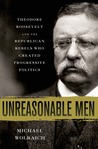
UNREASONABLE MEN BY MICHAEL WOLRAICH

Unreasonable Men: Theodore Roosevelt and the Republican Rebels Who Created Progressive PoliticsUnreasonable Men: Theodore Roosevelt and the Republican Rebels Who Created Progressive Politics by Michael Wolraich
My rating: 4 of 5 stars

”Here is the thing you must bear in mind,” Roosevelt retorted indignantly, “I do not represent public opinion: I represent the public. There is a wide difference between the two, between the real interests of the public and the public’s opinion of those interests.”

 photo 6386e134-3716-4606-ba67-986298ad5fbd_zps87dc0afc.gif
The Standpatters were relieved to discover that Teddy’s Big Stick talk was mostly just a lot of swinging and missing.

Theodore Roosevelt made a promise, hand raised, that he would not run for another term after he won election in a landslide, in his own right, in 1904. It wasn’t long before he was wishing he could cut off that offending hand of promise and run anyway. He liked being president. He was an ebullient, bellicose, expansive personality who couldn’t stop talking and flashing those large brilliant white chompers that could be interpreted as a friendly gesture or as a menacing, clownish show of aggression.

”Theodore Roosevelt tended to dominate whatever he participated in. His children joked that when he went to a wedding, he thought he was the bride, and when he went to a funeral, he thought he was the corpse.”

The Republican party didn’t really know what to do with Roosevelt. He was a problem from the beginning because of his charge ahead attitude, but also because he was so popular with their constituency. To satisfy his ambition, and to get him out of the way they put him on the ticket with William McKinley. When McKinley is assassinated “The Problem” is elevated to the highest position in the land. If you believe in fate or destiny than Roosevelt’s rise to the presidency is certainly a good example of predestination.

The Stalwarts who were also called the Standpatters dominated congress. As their name implies they were perfectly happy with the state of affairs and were not interested in phrases containing words like change or progression. They girded their loins expecting a fight with the progressive talking Roosevelt.

”But the blows they anticipated never arrived. For all his talk of big sticks, Roosevelt proved more agreeable than they’d anticipated. ‘With the first year of administration the uneasiness was relieved,’ Cannon reflected. ‘Roosevelt, business found, had a bark that was considerably worse than his bite, although often his bark was annoying enough.’”

They could afford to allow him to rail against the establishment all he wanted as long as he didn’t do anything about it.

 photo TaftSmile_zpsc21d681a.jpg
The public found Taft’s smile almost as endearing as Teddy’s.

William Howard Taft was Roosevelt’s chosen successor. The Problem With Taft, which became a constant refrain during his administration, is that he wasn’t Roosevelt. He didn’t even want to be President. He had his eye on the Supreme Court even before he was President. His main strength during his administration was bringing antitrust suits against monopolies. The billionaires like J. P. Morgan found monopolies to be very profitable. ”They offered economies of scale and avoided the chaos of ‘ruinous competition’.”

I do have to give a tentative nod to Morgan for shoring up the banks with his own money and strong arming others to help as well during the Panic of 1907. The US was short of cash, the stock market went to pieces, there was a run on banks for what limited cash there was available, and if not for Morgan and his friends the United States would have seen some really dark days.

Roosevelt decided to escape to Africa to let Taft find his political legs, and give himself a much needed vacation. A vacation for Roosevelt generally involved shooting as many animals as he could track down. He shot nine Rhinoceros of a nearly extinct (then...now extinct) breed of the species on this one trip. How many Rhinos does one need to shoot to prove one’s manhood? It would make me a little queasy to build a mental mound of all the animals Roosevelt shot in his lifetime. To balance the scales he did expand the National Parks service exponentially as President. If he had not done this certainly a lot more natural wonders of this country would be bristling with oil wells, be littered with scrap heaps left over from strip mining, and be grazed to desert conditions.

See even when I want to talk about Taft I end up talking about Roosevelt.

Roosevelt returns to America still chafing over his promise not to run for president again. While he is struggling with how to break his promise to the American people a man from Wisconsin by the name of Robert Marion “Fighting Bob” La Follette has been starting to make waves not only in congress, but also within the Republican party. He is credited with being the first to use the term PROGRESSIVE. The press loves him, for a while, he is a quote machine and he is a natural at stirring a crowd into a frenzy not unlike his fellow Republican Roosevelt. There were a lot of changes that still need to happen in this country leading up to 1912, so there was plenty of issues to rouse the public to action.

--Women still need the right to vote. By 1912 only three states allowed women to vote: Wyoming, Idaho, and Colorado. The West was quickest to adopt the suffrage movement for several good reasons beyond it just being the right thing to do. The most interesting reason was that they were short on women. They wanted to attract more women from the East to the West. A much more creative way to steal women than gunnysacking them and running for the hills.

--Child labor laws still needed to be addressed. Albert Beveridge from Indiana thought it might take five years to fix this problem. It took thirty. States that wanted to address this problem could not unless other states around them also agreed to adopt the laws. If they set child labor laws without compliance from their neighboring states industry would simply move across the state line.

--The railroads were steadily raises prices because they were controlled by a handful of billionaires. It was proving to be a hardship for people who needed to use that mode of travel.

--A set work week for labor. ”He (Roosevelt) believed the industrialist had brought enmity upon themselves by ignoring and mistreating the workers. The only way to protect the rich from the violent impulses of the mob was for the government to gently correct society’s imbalances.”

Talk about meaty (The Jungle (1906) by Upton Sinclair forced President Roosevelt to investigate the meat packing industry.) issues for a much needed progressive movement. Roosevelt had some of these ideas in his head, but it was La Follette who brought most of them to the forefront of the public consciousness and gave the issues urgency. With his old friend and now most despised enemy, Taft, allied with the Standpatters it only made sense for Roosevelt to embrace the fever and excitement surrounding the Progressive movement. When he loses the nomination for the Republican party he forms his own Bull Moose party; and in the process, tears the Republican party to shreds.

 photo 6c67e85e-0cfc-401a-b590-c23490a0da20_zps22b8e4bd.gif
Fighting Joe relegated to the bench after Roosevelt enters the race.

La Follette is the man on the outside looking in. His quest to achieve the Presidency is shattered by the popularity of Theodore Roosevelt. On the other side of the aisle it takes 46 ballot initiatives for Woodrow Wilson to win the Democratic Nomination for President. By splitting the Republican party vote Roosevelt assured Wilson of victory.

The Progressive movement of the Republican Party splintered the party. The people who stayed were the stalwart conservatives. Democrats embraced many of the Progressive ideas and suddenly the old Standpatters were finding it difficult to quell the uprisings. Unfortunately it took until after another Roosevelt is elected president before most of the progressive changes that insure most of us a certain standard of living were enacted. This book was a fascinating read that crystallized a lot of scattered thoughts I had about this era in American politics.

 photo JoeCannon_zps8ecc3148.jpg
”Uncle” Joe Cannon

The dominance of the Speaker of the House Joe Cannon (1903-1911) starts to erode as more and more of these progressives are sent to Washington demanding that the power be shared. I’m sure he had many of the same gaseous looks on his face as does our current Speaker as he deals with the recalcitrant Tea Baggers. There are certainly parallels with the politics of the early 20th century with the politics of the early 21st century. It is interesting to me that the Republican party splintered to the left in the early 1900s and has splintered to the right in the early 2000s. Either way it is going to be very difficult for them to nominate a moderate enough candidate that satisfies the base and can attract enough votes from the middle to win a presidential election. In talking with some of the fervent members of the far right they are content with holding congress and feel if they can do that they don’t care who is president.

There is some logic to their thinking, but Presidents build parties and the natives become restless if your only goal is to block not to enact. It only makes sense to me that the Republican party will have to splinter again in the near future forming a party with a more moderate agenda. This new movement, a matter of when rather than if, would also provide a home to all those Republican leaning politicians that want to have aims beyond just obstructionism. As always I will be watching from the sidelines saying...here we go again.


View all my reviews

Tuesday, August 26, 2014

Another Wild Ride With Coben


Missing You by Harlan Coben
2014
Reviewed by Diane K.M.
My rating: 4 out of 5 stars


I have a weakness for Harlan Coben thrillers. Every time I pick up a Coben novel, I get gripped by the story and race through the book, ignoring everything around me.

"Missing You" was no different. It follows Kat Donovan, an NYPD detective, who is investigating the case of a missing woman, but she's also secretly trying to figure out who murdered her father almost 20 years ago. (Yes, yes, the proliferation of crime TV shows means it's become a cop trope that an officer is haunted by a parent's homicide, but just roll with it.)

Anyway, Kat is working multiple leads, one of which involves her ex-boyfriend, Jeff, who might be mixed up in something illegal. 

The plot sprints along, and I gobbled up half the book in one sitting. Three-fourths of the way through I texted my Coben-reading buddy and asked WHAT THE HELL IS GOING ON?? But I should have known that everything comes together in the end. Wowser.

Sorry this review is so light on details, but to give more would take all the fun out of it. If this is your first Coben, you're in for a wild ride. 

Favorite Quote:
"We all have our demons. But men? They have them much worse. The world tells them that they are the leaders and great and macho and have to be big and brave and make a lot of money and lead these glamorous lives. But they don't, do they? Look at the men in this neighborhood. They all worked too many hours. They came home to noisy, demanding homes. Something was always broken they needed to fix. They were always behind on the house payments. Women, we get it. Life is about a certain kind of drudgery. We are taught not to hope or want too much. Men? They never get that."

Ask the Bloggers - Greg from 2 Book Lovers

Today's guest is Greg from 2 Book Lovers.

What made you want to be a book blogger?
That’s easy, taxes, now the $1,000.00 per year we spent on books is a business expense and non-taxable income. Actually, my wife and I are both avid readers. We both love our books, but not each other’s. We were talking to each other all of the time about our books and not really being able to share the experience. We decided to start the blog so that we could share our book experiences with people who actually share the same book interests.

What have been your best book blogging experiences?
I have a couple. One of the first was after we set up our blog and we decided we needed to do some networking. We decided that it would be fun to do on a weekend evening. We set up our Facebook pages and our Goodreads users and then went following and friending our favorite authors. The Goodreads friend requests came back fast enough, but not much happened on Facebook. Then Monday morning when I was at work she sent me an e-mail, my Facebook page had gotten a like. One of my favorite authors, David Moody, had liked my Facebook page. We have had many good experiences since then, but that one has stuck with me.

What has been your worst book blogging experience?
That would have to have been an R4R (read for review) that I had done early on. The premise looked good, the author had very few reviews. I decided to read it, it was awful! I could not make it past 10%. I looked at my Kindle and I had another 9 hours to go. I could not invest another 9 hours of my life into something so bad. The worst part, and I am ashamed of myself for this, is I never got back to the author. I could not find a way to say how bad it was and to tear apart all of the hard work that author had done. I have since changed my tactics and have let them (not that there are many) know in a constructive and polite way. It’s a learning and growing experience.

How many books do you own?
On my Kindle 344. On our bookshelves, too many to count.

Who is your favorite author?
That is a loaded question. It really depends on my mood. George R.R. Martin is near the top of the list, but he frustrates me with how long I have to wait for the next book. Recently, I have taken a liking to Jussi Adler-Olsen. There are a couple of indie authors I have read this year and I am always looking for their next books: Tracey Ward, I was hooked on her Survival Series (it’s YA/PA), and Jason Brant’s Hunger Series, I ate it up.

What is your favorite book of all time?
The Odyssey, by Homer (not Simpson). There is a reason why that one survived over three thousand years.

What are your thoughts on ebooks?
I love ebooks. I read almost exclusively on my Kindle now. It allows more access to books for more people. Anything that gets people reading is a good thing.

What are your thoughts on self-publishing?
Some of my favorite authors are self-published. I would compare indie authors to cable television. They can do things and say things that the published authors cannot, self-published authors can push the envelope without the worry of offending someone and not appealing to the masses. And just like we have seen with cable TV, you get better quality when it is not vanilla.

Any literary aspirations?
Do I think that I have a story that I could tell? Yes. Do I think that I can tell it as good as the authors that I like to read? No way. I do not have the guts that it takes to give up the day job and put my 100% into it. With 2-3 hours in the car each day and 8 hours at work, I just do not have the time necessary to put out a quality product.

What's your favorite joke of all time?
If you run a family friendly blog and can’t put this on I’ll come up with a replacement, so here it goes.
Two fleas who had gone south for the winter were on the beach in Florida. The one flea noticed that the other was shaking and staggering around.
He asked his friend, “What’s the problem?”
The other flea replied, “Well, this year I was having trouble finding a ride down. So finally, I snuck into a man’s mustache and he came here by motorcycle. It was a bumpy ride and the wind tossed me all over his mustache. I had to hang on for my life.”
The first flea offered a solution, “You will have to try what I do. I go to the airport and find a flight attendant. I crawl up her leg and find a nice cozy spot, then curl up for a nap. Before I know it we are getting off of the plane and I’m here for the winter.”
“That’s a great idea! Next year, that is exactly what I will do!”
The two fleas meet again on the beach the following winter. The same flea was still staggering around the beach.
His friend asked him, “What happened? Didn’t you take my advice?”
“I did exactly what you said. I went to the airport, found a flight attendant, crawled up her leg and took a nap. The next thing I knew I was in a guy’s mustache, on a motorcycle headed to Florida.”

Ask the Bloggers - Nikki from Bibliophibian

Today's guest is Nikki from Bibliophibian.

What made you want to be a book blogger? 
Talking to people after my visit to Angry Robot HQ! Before that, I just stuck to Goodreads, and it was half just to keep control of my library. Now I spend more time on my blog than on GR or LT; it's nice to have a space that's my own, and to feel free from the need to catalogue everything there. Now I can just post selected reviews, and there's room for other bookish content as well.

What have been your best book blogging experiences? 
I don't think there's any one thing I could put my finger on, so far. I just love the sense of community, the fact that every week something I post will connect me to dozens of other people who want to talk about the same things. Pretty revolutionary stuff to the kind of person who was bullied in school partly because of their love of books!

What has been your worst book blogging experience? 
When I hosted an author for a Q&A and some troll who didn't like me came to comment on it, and said some awful things about her. I knew she'd see them, because she's a friend and reads my blog anyway, but I didn't want to delete them because I wanted my response to be right there, like, 'you don't bother me'. Ugh.

How many books do you own? 
Uh. Well, I know I own 600 on Kindle, and I own 20 or so on Kobo. (I'm trying to diversify, now. A lot of the Kindle ones were free ones, though.) Then there's Baen and Weightless Books, which are the bane of my reading list. Then add my print books... I know I've got at least another 500 here where I'm living now, and probably way more than that at home. Despite my obsessive GR cataloguing, I don't really know the answer, because I also catalogue library books, books I give away, etc. It's easier for me to say how many I've read: approximately 2,600, though that misses out tons of series I read as a kid like Animorphs (does anyone else remember Animorphs?!) and, uh, well. Sabrina the Teenage Witch books.

Who is your favorite author?
Probably Jo Walton, but I might be biased because I know she's a great person too. I've enjoyed everything she's written, or at least appreciated it. Of course, I could always say Tolkien, because I could read The Lord of the Rings over and over again -- as a medievalist to MA level, I think it's pure genius -- and his academic work was astonishing too. And then there's Dorothy L. Sayers, because Lord Peter more or less saved my life, or -- I'll stop now.

What is your favorite book of all time?
sfksbgkjskfb I plead the fifth. I'm not American, can I still plead the fifth? But no, I think maybe Susan Cooper's The Dark is Rising sequence has to go here, and if I chose just one of those, it'd be The Grey King. Bran bowled me over and I was so proud of my Welsh heritage and all the Welsh connections to King Arthur, etc.

What are your thoughts on ebooks?
Love 'em. As you can guess from my answer to number four. I like both ebooks and dead tree books, for myself; I don't see it as a dichotomy. And I've posted a couple of times about the benefits of ereaders when it comes to accessibility too: my mother has macular degeneration, and I volunteer in the local eye clinic, so I'm very conscious of how much people love books. It's often the major concern people raise with me when they're upset at the clinic: "But how am I going to read?" Thank goodness there's answers for that now.

What are your thoughts on self-publishing?
I think it's a model that works for some people and not others. Authors have to be ready to get behind their books and really push when they self-publish, and some of them end up doing that in a really obnoxious way. It's a learning curve, I think, too, so I tend to be pretty tolerant of people putting out their first books. The thing I can't abide is sloppy editing: self-publishing is a way to get your book to people to read and enjoy in the way that suits you, but that doesn't and shouldn't mean avoiding everything about traditional publishing, including professional editing.

Any literary aspirations?
Sometimes. It comes and goes! I'd love to write and contribute to the amazing amount of diversity that's out there in the book market, someday. But the fact that I say 'someday' does show that I'm really not in a hurry about that...

What's your favorite joke of all time?
Hm. I'm not actually very good with jokes. I'll leave you with a pithy piece of advice from my dad that's almost like a joke, back when I first went to university and had to live with people I didn't know well. "If two people live together and claim they never argue, either a) they're lying or b) one of them has a gun."

I hasten to add, my parents argue."

Monday, August 25, 2014

George Sueno, Super Spy (Or Not)


Reviewed by James L. Thane
Three out of five stars


This is the eighth entry in Martin Limon's series featuring U.S. Army Sergeants Sueno and Bascom, and the first of the books that left me only lukewarm.

The series is set in South Korea in the 1970s. Sueno and Bascom are army detectives; their job is to investigate crimes involving American soldiers and also to ensure that the American forces in South Korea are never embarrassed. For the army brass, the second half of the job description is much the more important, but Sueno and Bascom are always much more interested in finding the truth, irrespective of how the army might look when their investigation is concluded.

Sueno and Bascom are great characters; Sueno is more cerebral while Bascom is more physical and so they make a terrific team. Their investigations area always great fun to follow, especially when they run afoul of their army bosses and their counterparts in the Korean police forces. Most important is the setting, which Limon brilliantly re-creates in book after book. The reader always feels as though he or she had been dropped down in the middle of South Korea to watch the events unfold first hand.

For whatever reason, though, this book deviates from the pattern established in the series in a number of ways, none of them for the better. To begin with, Sueno carries the story alone, and Bascom makes only a very brief token appearance. The interaction between the two is one of the great strengths of these books and it's missing altogether here.

Beyond that, this isn't even a crime novel; rather it's a spy thriller and only a moderately successful one at that. The premise of the book is the belief that the Great Leader, Kim Il-Sung, is determined to launch a military offensive against the South to unite the two halves of Korea before he hands control over to his son, the Dear Leader, Kim Jong-Il (and, as David Letterman would say, his brother, Menta Li-Il).

Rumors are circulating that there is an ancient map depicting a series of tunnels that run beneath the DMZ and that could be used as a secret passage through which the army might move men and equipment into the North behind the front lines established by the North Koreans. Sueno is sent on a secret mission into North Korea to find the map, check out the tunnel route, and report back.

The story that follows is completely implausible. Sueno, who speaks no Romanian, is smuggled into North Korea disguised as a Romanian military officer. His job is to infiltrate the North Korean military as an officer of a fellow Warsaw Pact nation. He faces one complication after another, and manages to barely escape each only by the skin of his teeth. After about the fifth or sixth time this happens, the reader is simply left shaking his or her head in disbelief, which simply cannot be suspended.

The book is saved to some extent by Limon's excellent rendering of the Korean Peninsula, it's people, society and culture. As always, this is very entertaining, but for me at least, this book lacked the charm, humor and believable intrigue that has characterized the series up to this point. I'll be very relieved to get on to the next book in the series wherein, I hope, Sueno and Bascom will be back on the job together, doing what they do best, policing the mean streets of Seoul.

Fear and Confusion

Fear ItselfFear Itself by Walter Mosley
Reviewed by Jason Koivu
My rating: 3 of 5 stars

I'm not a black man. Walter Mosley is, so I assume he's writing from experience and knows what he's talking about. As such, it's nice to read crime drama/detective stories with well-round portraits of black men and women, men and women that the reader can believe in.

Having said that, I didn't know what the hell was going on for half the time in Fear Itself. Now, part of that was intentional. Mosley held the old wool over my eyes for a while on purpose. On the other hand, there were times when the action and dialogue got somewhat muddied up, and I don't think that was intentional. This was not the strongest narrative story the author's ever composed, that's for sure.

It does have its strong points though. The Southern California setting description is enjoyable for someone like myself who's spent some time there. The eccentrics that pop up are delightful distractions.

Here's a point which I'm not sure falls under strong or weak point: the main character. The diminutive and mild-mannered Paris Minton, a bookshop owner, is no hero. In fact, at times he's a coward. However, when the chips are down, the man stands up. The anti-hero is all the rage in literature these days, but the Paris character doesn't feel like a bandwagoner. He seems like the genuine article underdog. He feels realistic. He doesn't always do the right thing. He wants to do the right thing, but he's generally more concerned for himself. I'm kind of disgusted by him at times. All that may have even lessened my overall enjoyment of the book, but by god, I respect Mosley for that!

If you haven't figured it out by now, I like Walter Mosley. From what I've read, his books may not go down amongst the great literary works of our time. They should, however, be considered as valuable in their own right.


View all my reviews