Showing posts with label science. Show all posts

Sunday, May 12, 2019

Mapping Fate: A Memoir of Family, Risk, and Genetic Research


Alice Wexler
University of California Press
Reviewed by Nancy
4 out of 5 stars


Summary


In Mapping Fate, Alice Wexler tells the story of a family at risk for a hereditary, incurable, fatal disorder: Huntington's disease, once called Huntington's chorea. That her mother died of the disease, that her own chance of inheriting it was fifty-fifty, that her sister and father directed much of the extraordinary biomedical research to find the gene and a cure, make Wexler's story both astonishingly intimate and scientifically compelling.

Alice Wexler's graceful and eloquent account goes beyond the specifics of Huntington's disease to explore the dynamics of family secrets, of living at risk, and the drama and limits of biomedical research. Mapping Fate will be a touchstone for anyone with questions about genetic illness and the possibilities and perils of genetic testing.


My Review


“The ambiguous condition of 50% risk is extremely difficult to maintain in one’s mind, if not impossible. In practice, a 50-50 risk translates to a 100% certainty that one will or will not develop the disease.”
― Nancy Wexler, Genetic Russian Roulette

Before reading this book, I was aware that singer-songwriter Woody Guthrie died of Huntington’s disease in 1967. What I didn’t realize until after I read this book was how cruel this disease is. Symptoms usually develop between 30 and 50 years of age. In the early stages, patients may experience mild cognitive symptoms and psychiatric changes. Later on, they experience chorea, or abnormal involuntary movements, in different areas of the body. In later stages of the disease, individuals may have difficulty walking, speaking, and swallowing. Pneumonia and heart disease are the leading causes of death for people with Huntington’s disease.

Daniel Mundy’s (1976-2014) battle with Huntington’s disease:
https://www.youtube.com/watch?v=JzAPh...

This scientific memoir is utterly fascinating, despite the fact that some of the science went over my head. Still, I feel that Alice Wexler did an admirable job writing a compelling story about family, living with the risk of disease, and the innovation and efforts by her father, her sister, Nancy, and the scientific community that led to the discovery of a genetic marker for Huntington’s in 1983.

Alice’s mother, Leonore Sabin, was 53 in 1968 when she was diagnosed with the disease. Her father and three brothers had already died. Her husband, Milton, started the Hereditary Disease Foundation, and dedicated his efforts to inspiring researchers and caring for his sick ex-wife.

Nancy’s work with the foundation took her to the fishing villages near Lake Maracaibo in Venezuela, where about 1 in 10 people have Huntington’s disease.

Despite the grim subject matter, I found this very hopeful and optimistic. Even though there is still no cure for Huntington’s disease, there are drugs that can help alleviate certain symptoms and the option for those at risk to undergo genetic testing to find out whether they will develop HD in the future.

Monday, November 13, 2017

The Flattening of the Earth

The World Is Flat: A Brief History of the Twenty-first CenturyThe World Is Flat: A Brief History of the Twenty-first Century by Thomas L. Friedman
My rating: 4 of 5 stars

"Fucking flat-earthers...Oh wait, that's not what he means? All right, maybe I'll read it."

That was me about five or so years ago when friends kept insisting I read The World Is Flat by Thomas Friedman. Finally, when my wife recently bought tickets to a local Friedman talk, I resolved to read the damn thing.

I'm glad I did. It's really good. I'm not saying it's prefect (I'll get to that in a minute), but this is a must read at least for a certain few people with their heads in the clouds. For one, it's a great book for folks who don't understand what has happened since the advent of the internet. Give this as a gift to your dad or gramps. If they don't use it as a doorstop, they'll get a hell of an education on the modern ways of business and sociability.

The other group of people that need to read this, or really any book like this, are those cretins who troll, lurk and spew upon the comment section of "news" articles online. Everybody seems to have an indisputable, unshakable opinion that they take for fact and which they feel the need to spray all over the internet. They are the modern version of every family's uncle from the good ol' days who would show up at family events and holidays seemingly for the sole purpose of annoying everyone else while starting an argument with another alpha male about politics, religion, economics and any other myriad of topics that most sane people know is off-limits around family and friends you wish to retain as such. The real crime in all this is that they don't usually know what the fuck they're talking about. They have one biased, uninformed talking point on whatever the subject is they'll let you hear it.

So yes, I do feel like a book like this is helpful for a segment of the population, especially in these particularly stupid days in the American dark ages. The problem is, at 600+ pages, this book is 300 pages longer than it needs to be.

description

The World Is Flat: A Brief History of the Twenty-first Century is not brief. That's because it's written as a journalist would write a book. This is a book-length feature article. Friedman makes a statement, maybe backs it up with data, and then gives an example via a full-blown biography on a business or entrepreneur. It's all good stuff. Some of it's even enjoyable. But it's more than necessary for what's actually being said. He could've done more with less. I honestly doubt I would've gotten through this if I hadn't gone with the audiobook version and had a cubic buttload of yard work to do.

Now, that's not to say didn't enjoy this or that I didn't get something out of it. I did. I am getting old and so some of these whippersnappers with their new fangled gadgets befuddle me. However, I did grow up in the age when personal computers were first coming into the home. I even had a Commodore 64, baby! So I'm not at a total loss in the computer age. On the other hand, I am a bit of a recluse and I'm not big into global politics and the economy, so sadly I am having to catch up on that and a book like this taught me a thing or two. So, let's call it a good stepping stone for the uninitiated.


View all my reviews

Monday, September 11, 2017

"S-M-R-T!"

A Brief History of TimeA Brief History of Time by Stephen Hawking
Reviewed by Jason Koivu
My rating: 5 of 5 stars

Isn't it amazing that a person can read a book like A Brief History of Time by Stephen Hawking and come away feeling both smarter and dumber than before he started? What a universe we live in!

It's quite short and generally a quick read. Not every page is filled with mind-numbing theories and brain-busting equations. Some of it is just history, say on Newton and such. However, there were a few pages worth of passages where my wee brain felt like it was getting sucked into a black hole...mainly during the black hole segment.

I've forgotten so much since I left school, and since school was such a long time ago, some of what was taught back then is now outdated, so it was nice to read this refresher/cleanser.

I came away with a better understanding of the Big Bang theory and why it's plausible. I'm trying to sort out the time/space quantifiability thing. That's going to require a reread...and probably further study elsewhere.

Surprisingly, I also came away with the idea that God and science can coexist. I didn't expect that. I figured someone like Hawking would be like, "God? Pssh, whatever." But that's not his take at all, or at least that not the impression this book left me with.

A Brief History of Time was written with accessibility in mind, knowing full well idiots like me wouldn't buy it, read it or recommend it if it were impossibly dense. Hawking's sense of humor even comes through on occasion, which is always appreciated in these sciencey texty thingies. So, I'll probably move on to his Briefer History... next and I'd be quite willing to read others as well!


View all my reviews

Monday, January 5, 2015

A Whole Lotta Hormones

The Female BrainThe Female Brain by Louann Brizendine
Reviewed by Jason Koivu
My rating: 4 of 5 stars

The way some men talk about women I'd assumed they'd think The Female Brain was a work of fiction, "'Cuzzin' womens ain't got none brains, heeyuck, heeyuck!" It's too bad that most of those guys are illiterate, because they're the ones that need to read this the most.

In The Female Brain, neuropsychiatrist Dr. Louann Brizendine uses clinical research and the experience of counseling patients to examine how the many various hormones flowing through a woman's body may affect their actions and behavior. It covers the emotional development and brain processes of women through the various stages of their lives, beginning at the beginning with childhood, moving through the tumultuous teens and the horror that is puberty and progress through womanhood into old age.

The use of science to dissect human behavior is tricky since our moods, reactions, etc are slippery little fish. Brizendine's use of animal research raises validity questions (I.E. rats are not humans, so how can it apply?), however she is the first to admit that none of this is 100% pure, unadulterated fact. Just the same, there are some insights within The Female Brain that appear to be highly probable cause-effect truths, and even if they're not, this whole subject is still very fascinating!

I found the entire book entertaining and, admittedly, quite a bit of it to be enlightening, as I imagine it might be to most men. Even some women would do well to give this a read, because how often do you hear yourself say something like, "Sometimes I just don't understand my mother/daughter!"?

View all my reviews

Tuesday, September 9, 2014

Cell Everlasting

2010
Reviewed by Diane K.M.
My rating: 4 out of 5 stars


I am late to this book party, but let me explain.

I get twitchy about medical stuff. Earlier this year I had to abandon Rosemary Mahoney's book about the blind because it described an eye surgery. I have never been able to finish Dr. Atul Gawande's "Complications" because of its description of medical procedures. It was a small miracle that I was able to finish the first "Call the Midwife" book, because I hate childbirth scenes. 

When this Henrietta Lacks book started tearing up the bestseller lists a few years ago, I read a few reviews and thought, "Yeah, that can wait."

But I started a new library job recently, and the Lacks book was chosen as a Common Read for the campus. And guess who was volun-told to help lead upcoming book discussions? (Hint: it's me.)

So, with a deep sigh, I started reading. And then, oh happy day, my fears turned out to be unfounded because I ended up really liking the story. Rebecca Skloot wrote that she first heard about Henrietta Lacks and her immortal cells in a community college biology class. Lacks was a black woman who died in 1951 from cervical cancer. Before she died, a surgeon at Johns Hopkins Hospital took samples of her tumor and put them in a petri dish. A key part of this story is that Henrietta did not know her tissue had been taken, and doctors did not tell her family, either.

"Scientists had been trying to keep human cells alive in culture for decades, but they all eventually died. Henrietta's were different: they reproduced an entire generation every twenty-four hours, and they never stopped. They became the first immortal cells ever grown in a laboratory."

Henrietta's cells, nicknamed HeLa, were given to scientists and researchers around the world, and they helped develop drugs for treating herpes, leukemia, influenza, hemophilia, Parkinson's disease, and they helped with innumerable other medical studies over the decades. At first, the cells were given for free, but some companies were set up to sell vials of HeLa, which became a lucrative enterprise. 

"The reason Henrietta's cells were so precious was because they allowed scientists to perform experiments that would have been impossible with a living human. They cut HeLa cells apart and exposed them to endless toxins, radiation, and infections. They bombarded them with drugs, hoping to find one that would kill malignant cells without destroying normal ones. They studied immune suppression and cancer growth by injecting HeLa cells into immune-compromise rats, which developed malignant tumors much like Henrietta's. If the cells died in the process, it didn't matter -- scientists could just go back to their eternally growing HeLa stock and start over again."

Unfortunately, the Lacks family did not know about any of this until several decades after Henrietta had died, and some relatives became very upset and felt betrayed by the doctors at Hopkins. A few threatened to sue the hospital, but never did.

There is a lot of biology and medical discussion in this book, but Skloot also tried to learn more about Henrietta's life, and she was able to interview Lacks' relatives and children. Additionally, there is some good discussion on the ethics of taking tissue samples from patients without their consent, and on the problem of racism in health care.

"I always have thought it was strange, if our mother cells done so much for medicine, how come her family can't afford to see no doctors? Don't make no sense. People got rich off my mother without us even known about them takin her cells now we don't get a dime. I used to get so mad about that to where it made me sick and I had to take pills. But I don't got it in me no more to fight. I just want to know who my mother was." -- Deborath Lacks, who was very young when her mother died

My favorite parts of the book were the stories about Henrietta and the Lacks family, and the discussions on race and ethics in health care. 

"There's no indication that Henrietta questioned [her doctor]; like most patients in the 1950s, she deferred to anything her doctors said. This was a time when 'benevolent deception' was a common practice -- doctors often withheld even the most fundamental information from their patients, sometimes not giving them any diagnosis at all. They believed it was best not to confuse or upset patients with frightening terms they might not understand, like cancer. Doctors knew best, and most patients didn't question that. Especially black patients in public wards. This was 1951 in Baltimore, segregation was law, and it was understood that black people didn't question white people's professional judgment. Many black patients were just glad to be getting treatment, since discrimination in hospitals was widespread."

Skloot worked on the book for more than a decade, paying for research trips with student loans and credit card debt. I would highly recommend the book to anyone interested in medical ethics, biology, or just some good investigative reporting. 

Favorite quote:
"Like I'm always telling my brothers, if you gonna go into history, you can't do it with a hate attitude. You got to remember, times was different." -- Deborah Lacks

Sunday, July 27, 2014

The Martian


THE MARTIAN
Andy Weir
Crown 2014


Reviewed by Carol

★    ★    ★    ★    


Things didn’t go exactly as planned, but I’m not dead, so it’s a win.

 Mark Watney’s wry evaluation is essentially the summation of his attempts to survive on Mars. After a devastating and unexpected Martian hurricane-force storm wrecks havoc on the Martian crew, NASA calls for an ‘abort mission.’ As Mark is heading to the vehicle that will provide escape from Mars and return the crew to earth, he’s impaled by flying debris, loses consciousness and is presumed dead as the object impaled his suit bio-computer. Ironically, his injury was caused by a piece of antenna that would have enabled him to let his team–or Earth–know he was still alive. What follows is Mark’s log entry of his strategies to survive on Mars and signal Earth that he is still alive. 

I tend to avoid most ‘serious’ Hollywood movies because the emotional manipulation is so overt. For similar reasons, I was hesitant to pick up The Martian. A man abandoned on Mars? Cue scenes of astronaut training, sobbing family, distance camera shots of the Earth marble from Mars. But Weir did something interesting, and instead of heading for the maudlin center of a man’s isolation, he focused on the technical problem-solving by an intelligent, clever engineer with a juvenile sense of humor.
I was pleased to find that The Martian worked for me, despite a few story-telling bumps. The overall structure has a couple of rocky (get it?) moments, with jumps in time and place.  Although the primary story is taken from Mark’s mission logs, there are scenes centered on NASA as well as Mark’s crew members. One flashback of the crew felt particularly misplaced, but will undoubtedly fit right into the movie version. In terms of language, Mark’s voice is colloquial, and even when he’s talking science and engineering, his problem-solving relatively understandable for the reader. Mark’s skills and necessary solutions draw upon experience in botany, Morse code, computers, plumbing, chemistry, balancing loads, ramp-building–there’s likely something here most people can relate to:

Problem is (follow me closely here, the science is pretty complicated), if I cut a hole in the Hab, the air won’t stay inside anymore.

There’s even some science humor sprinkled in among the poop jokes:

All my brilliant plans foiled by thermodynamics. Damn you, Entropy.

What really sold me was Mark’s humor, as well as the focus on survival in an unusual environment. There’s a running joke regarding his attempts to entertain himself, only somewhat relieved after rooting through his crewmates’ possessions and discovering data discs filled with 70s memorabilia. Another ongoing gag centers on being the only human on Mars. Instead of despairing, Mark cracks jokes. It felt believable, an almost required personality trait for one of those daredevils we call ‘astronauts,’ and a very adaptive way of coping in small group situations. For some, the lack of overt emotional exploration might disappoint, but it worked well both to off-set the technical aspects, and to avoid the trope-ridden isolation angst. He does let a couple of moments of isolation and frustration shine through, more moving because of how rare they are.


It’s a solid four stars, and clearly headed towards movie status. An enjoyable, quick read instead of the emotional existential tear-jerker I was expecting, with a positive message about humanity.  However, when the movie version is finally made, I won’t need to see it–I’ve already seen Castaway and The Terminal. Adding Apollo 13 is unnecessary.


cross posted at carol's blog at  http://clsiewert.wordpress.com/

Tuesday, April 1, 2014

Cosmos and Stuff


A Short History of Nearly Everything by Bill Bryson
2003
Reviewed by Diane K. M.
My rating: 4 out of 5 stars


I must admit that science is not my strong suit -- I've always been more of a Humanities gal. In high school, I had to work harder in my biology and chemistry classes, whereas English, history and social studies always came more easily to me.

Bill Bryson's "A Short History of Nearly Everything" is a good overview of all the science classes I didn't take (or don't remember) in college. It's like Intro to Physics, Chemistry, Geology and Astronomy all in one wonderfully droll book. Since I read very few books about science, this was an enjoyable departure for me.

Here is how the book begins: "Welcome. And congratulations. I am delighted that you could make it. Getting here wasn't easy, I know. In fact, I suspect it was a little tougher than you realize. To begin with, for you to be here now trillions of drifting atoms had somehow to assemble in an intricate and curiously obliging manner to create you. It's an arrangement so specialized and particular that it has never been tried before and will only exist this once. For the next many years (we hope) these tiny particles will uncomplainingly engage in all the billions of deft, co-operative efforts necessary to keep you intact and let you experience this supremely agreeable but generally under-appreciated state known as existence."

Some of my favorite sections were about the Big Bang, the debate about the age of the universe, plate tectonics, Darwin's research, and the extinction of different species. After sharing various stories of how humans have killed off who-knows-how-many species, Bryson interjects: "I mention all this to make the point that if you were designing an organism to look after life in our lonely cosmos, to monitor where it is going and keep a record of where it has been, you wouldn't choose human beings for the job." Sadly true, but also worth a HA!

I listened to this on CD read by the author, and if you've been following my reviews for a while, you'll know that I have a brain crush on Bryson and his narration. Seriously, I wish I could invite him over for tea and scones and just listen to him read all afternoon. (Bryson is from my home state of Iowa, but he's lived in England for so long that he's adopted a charming accent. It's adorable.) I was also able to look through a copy of the special illustrated edition, which includes dozens of photographs and prints. If you can find it, I highly recommend reading the illustrated edition.

"A Short History" was first published in 2003, and at the time, it was a big change from Bryson's previous travelogues. Since then, Bryson seems to have abandoned travel books and has been writing on different topics in history, such as the wonderful "At Home", "Shakespeare" and "One Summer: America 1927." While I enjoy his wry, humorous takes on history, I do miss his travel writing. If you're reading this, Bryson, please, take a trip somewhere. Have an adventure. Take a few notes and write another whip-smart travel book. Your fans will love it.

Thursday, March 27, 2014

Serial Killer--Who? Me?

The Sixth Extinction:  An Unnatural History
by Elizabeth Kolbert
Published by Henry Holt and Co.

Reviewed by Amanda
4 Out of 5 Stars

Looking for a good horror novel that will keep you up late at night? One that features the most remorseless, inventive, and successful serial killer to ever stumble into the written word? One whose body count grows exponentially as his appetite becomes more ravenous, never sated? One who is so adept at killing that he does so without even seeming to try? Well, I have just the ticket: The Sixth Extinction by Elizabeth Kolbert. This is as frightening as it gets, people, and the villain here is us: me, you, and everyone else inhabiting this little blue marble called Earth.

Throughout history, there have been five mass extinction events: the Cretaceous-Paleogene, the Triassic-Jurassic, the Permian-Triassic, the Late Devonian, and the Ordovician-Silurian. All of these involve a cataclysmic shift in environmental conditions, some the result of an external impact. And now Kolbert reports that there may be a sixth extinction: the Anthropocene, caused by the impact of humanity on the environment. Many may believe that this is a byproduct of the Industrial Age, but Kolbert shows us how humans have always had a knack for wreaking wide scale environmental havoc. Always needing and wanting more from our natural resources, we, like kudzu, multiply rapidly, take over every inch of land available to us, and choke out the life that surrounds us.

Kolbert makes the case for recognizing the Anthropocene as a mass extinction event by exploring its casualties and its future victims. As she relates the extinction of the American mastodon, the great auk, and the Neanderthal, as well as the near extinction of the Panamanian golden frog, Hawaiian crow, Sumatran rhino, and several types of bats, one truth becomes increasingly clear: most of these extinctions began to take place when humans entered the environment.

Despite the disheartening nature of the topic, Kolbert writes with dry wit and gallows humor which (for me) always made an appearance at just the right time before things became too depressing. While there is a lot of science here, Kolbert keeps it accessible for those of us who don't while away our days reading scientific journals (you know, while our basic needs and consumer choices destroy everything around us), and her first person narrative keeps it from veering into textbook territory.

There's a lot here that I enjoyed, but three highlights stand out:

1) Kolbert's early chapters about men like Cuvier, Lyell, and Darwin, who were among the first to speculate on extinction and evolution. From our modern perspective, it's easy to forget that extinction, in particular, is a relatively new idea. There was a time when many scientists believed that nothing could become extinct over the natural progression of time; the discovery of fossils began to shift human understanding of the world and of creation. Reading as these men stumble in their understanding of the world, shifting and revising hypotheses, and ultimately discovering that there was a world that existed before mankind is fascinating.

2) The chapters on the sea and corals (which may eventually become extinct, taking with them several organisms that live symbiotically with corals) is particularly interesting for someone like myself who is happily landlocked. For those who don't live near or have a relationship with our seas and oceans, it's easy to see it as a vast nothingness and forget about the world teeming below our waters. The rate of ocean acidification is frightening.

3) The concept of a new Pangaea is an intriguing one. The ease with which we travel to other states, countries, and continents has, in a sense, reconstituted Pangaea in that we knowingly (and unknowingly) introduce new and often invasive plant and animal species into new environments. In doing so, these new host environments haven't developed nature's evolutionary safeguards to keep the balance between predator and prey, often with disastrous results.

While Kolbert makes all of this lucid and entertaining, as well as terrifying, I must admit to some fatigue when I got to the final chapters. Reading about mass extinction can really take a toll on someone whose worldview can basically be summed up as "people suck." Reading such incontrovertible evidence, and knowing that I myself cannot escape the guilt of this accusation, is, in the words of Kolbert on The Daily Show, "kind of a downer." However, we need more downers. We need to be more educated about what we're doing to our environment. Early man deserves a pass: you come into a place and think, "Damn. Look at all these mastodons. We can feast like kings!" So you settle in, live a life filled with mastodon hunts and mastodon meat, have several children, dress them in mastodon onesies, kill more mastodons, always assuming there will be more. After all, you've found the great all-you-can-eat mastodon buffet! You have no concept of the impact your consumption is having on the environment. You haven't seen Disney's The Lion King and therefore don't know of the majestic power of the circle of life (nor of the comedic gold of pairing a warthog with a meerkat). Such days of ignorance should be behind us. We know better, so we should do better.

Although, many of us are 4% Neanderthal because apparently early homo sapiens just couldn't resist the seductive power of a ridged brow. So maybe we're not so smart after all.  

Sunday, June 23, 2013

Science in graphic format

Reviews by Sesana

I feel like I see more and more nonfiction graphic novels every year. It can be a great format for anything that could use a visual as well as a written explanation. And that, for me, means science. Today, I'll be reviewing two very different graphic novels meant to explain scientific subjects to readers with little or no background.

How to Fake a Moon Landing: Lies, Hoaxes, Scams, and Other Science Tales
Darryl Cunningham

Four out of five stars
 
This was quite an unusual book by me. Cunningham uses the graphic novel format and science to refute some sadly common areas of severe misinformation. There's the moon landing hoax stuff that the title mentions, plus quite a few other things, including chiropractic, immunizations, evolution, and even fracking. I greatly appreciated the fracking article, because I felt like it did a good job of explaining exactly what the process is as well as any concerns about it. I hadn't known much at all about fracking beforehand. Now, I'm pretty up to date with most of the other topics here, so I can say that Cunningham has done his research and does a good job of presenting the facts clearly and succinctly. I'm not crazy about the art style, but I like the idea of doing this sort of book as a graphic novel. Let's face it, the people who really need to see this are slightly more likely to pick this up than another, similar book. You can get more and more in depth information on most of these subjects by reading conventional books and articles, but Cunningham's explanations are very clear, so I would recommend this as a good starting place for scientific debunking.

Journey by Starlight: A Time Traveler's Guide to Life, the Universe, and Everything
Written by Ian Flitcroft, illustrated by Britt Spencer

Four out of five stars

 Imagine that you're traveling at the speed of light from a distant star, with Albert Einstein as your guide. And along the way, he's going to explain the universe and how it works as completely and clearly as he can. It's a very (very) odd premise, and yet it works. The whole thing is based off of Flitcroft's blog, also called <a href=http://journeybystarlight.blogspot.com/>Journey by Starlight</a>. I've since read a few entries from the blog, and I think the graphic novel version stays quite true to the blog entries, and adds quite a bit of context with the visuals.

But this is not light reading. It may be "only" a 200 page graphic novel, but I can't remember ever working so hard for 200 pages in my life. The panels are, by necessity, full of text, which is often quite complicated text. But it's also quite clear. I understood this way better than I did when my high school physics teacher was trying to teach me. At least while I was reading it, I was able to follow Flitcroft's explanation, even if I had to read some panels very slowly or more than once before it clicked. Will it stick with me? I certainly hope so. I wouldn't have read this book if I didn't want to learn.

Both How to Fake a Moon Landing and Journey by Starlight were originally reviewed at Goodreads.

Monday, April 8, 2013


THE SWERVE: How the World Became Modern
Stephen Greenblatt

W.W. Norton
$26.95 hardcover, available now

Reviewed by Richard, 5* of five

The Publisher Says: One of the world's most celebrated scholars, Stephen Greenblatt has crafted both an innovative work of history and a thrilling story of discovery, in which one manuscript, plucked from a thousand years of neglect, changed the course of human thought and made possible the world as we know it.

Nearly six hundred years ago, a short, genial, cannily alert man in his late thirties took a very old manuscript off a library shelf, saw with excitement what he had discovered, and ordered that it be copied. That book was the last surviving manuscript of an ancient Roman philosophical epic, On the Nature of Things, by Lucretius—a beautiful poem of the most dangerous ideas: that the universe functioned without the aid of gods, that religious fear was damaging to human life, and that matter was made up of very small particles in eternal motion, colliding and swerving in new directions.

The copying and translation of this ancient book-the greatest discovery of the greatest book-hunter of his age-fueled the Renaissance, inspiring artists such as Botticelli and thinkers such as Giordano Bruno; shaped the thought of Galileo and Freud, Darwin and Einstein; and had a revolutionary influence on writers such as Montaigne and Shakespeare and even Thomas Jefferson.

My Review: De rerum natura was a long narrative poem expounding Epicurean philosophy that was written in the first century before the common era. I am told by those possessed of sufficient Latin fluency to appreciate it that it is beautiful. I am not possessed of that level of fluency, and to me it seemed agonizingly impenetrable and obscurantist.

But author Greenblatt, in this fascinating Pulitzer Prize-winning history and analysis of the poem and its influence on the world, focuses not on the merits of the poem but on the genesis, development, survival, and influence of De rerum natura, arguably the foundation text for the mental construct that you and I share, and that diverges widely from the mental construct of earlier times.

Why is this so? Because we accept a material explanation of the existence of things as our prevailing orthodoxy, even in the face of religious challenges to the primacy of logic and evidence and just plain good sense. It's down to Lucretius's poem's astounding clarity of thought, persuasiveness of rhetoric, and miraculous survival and rebirth.

What Greenblatt did was to provide a brief history of Epicurus, his actual philosophy, and the cultural currents that distorted and misrepresented his philosophy, together with the whys and wherefores of that misrepresentation. Then Lucretius, a shadowy figure whose biography is unknown to modern readers except for a calumny heaped on his memory by a man who did not know him and in fact lived centuries after his death, wrote in poetry...a form of expression not to Epicurus's taste or, in his opinion, a good and useful tool of communication, he preferring plain and simple and direct prose...broke down the Epicurean vision of the world, and argued in support of it. Greenblatt then traces the survival of manuscripts from antiquity to the Middle Ages, the resurgent interest in their contents during the run-up to the Renaissance, and the incalculably valuable role of obsessive individuals in hunting down, copying, and disseminating the surviving antique texts to a world then, as now, hungry for more and better and different views and experiences and thoughts and ideas.

I give this book one of my rare five-star ratings because it has solved a problem of identity for me: I am, as Thomas Jefferson said before me, an Epicurean. Not the debased view held of that noble philosophy thanks to “Saint” Jerome, who in the course of ramming his ignorance-celebrating religion down the throats of humanity, hit on the perfect misstatement of Epicurus's actual materialist philosophy: Hedonism! Hedonism and vice and licentiousness and gluttony! The pursuit of pleasure can only mean these things, shouted Jerome, and the chorus of baying dogs was off after the fox.

We all know how that ends.

Chapter eight of The Swerve, “”The Way Things Are,” breaks out the point-by-point reality of Epicureanism, and is the prime motivating factor for my five-star rating. (In fact, I dislike Poggio Bracciolini, the discoverer of De rerum natura, quite intensely, and suspect that had I met him in life, I would have been repulsed by him.) I list here the bullet points Greenblatt is at pains to provide with clear, concise, and satisfying explication:
--Everything is made of invisible particles. This is called “atomism.”
--The elementary particles of matter...are eternal.
--The elementary particles are infinite in number, but limited in shape and size.
--All particles are in motion in an infinite void.
--The universe has no creator or designer.
--Everything comes into being as a result of a swerve. (Another word for this is collision.)
--The swerve is the source of free will. If there is no preordained pattern, how can there be a preordained result?
--Nature ceaselessly experiments. Evolution by natural selection, anyone?
--The universe was not created for or about humans.
--Humans are not unique. We are animals, literally not figuratively, like all the others.
--Human society began, not in a Golden Age of tranquility and plenty, but in a primitive battle for survival.
--The soul dies. There is no afterlife.
--Death is nothing to us. It is merely a fact. There is no personal component to death.
--All organized religions are superstitious delusions. Religions are, invariably, cruel.
--There are no angels, demons, or ghosts.
--The highest goal of human life is the enhancement of pleasure and the reduction of pain.
--The greatest obstacle to pleasure is not pain, it is delusion.
--Understanding the true nature of things generates deep wonder.

I have never seen in print or heard with my ears a clearer, more concise, or more complete statement of my own personal worldview than this. It rang me like a bell. It sounds like Lucretius was sitting inside my head and copying down my responses to the world.

In the brief explications Greenblatt attaches to the bullet points, he makes it clear that these ideas, while they never wholly vanished from the world, were seen by the dominant world-view as a challenge to the idiotic legendary nonsense that had come to replace them, and were thus strongly condemned, to the point of burning people alive as a punishment and a warning to others inclined to think for themselves, to view the world as it is instead of through a warped fantasy construct that demonstrably causes harm and pain and facilitates much evil-doing.

So on that basis...five stars, and a ringing huzzah, to Gentile Signor Poggio Bracciolini; to Greenblatt for digging deeply enough in the humus of scholarly debate and historical records to make these connections for us, in a less scholarly age than the Renaissance, to find and use for ourselves as we see fit (ie, to exercise the free will we've got); and to WW Norton for publishing the resultant text as an under-$30 course in humanism. I am also grateful to the Pulitzer Prize board for awarding this book its non-fiction encomium, and to the Catholic News Agency for remaining consistently wrong by grousing about the book's anti-Catholicism and misinterpretation of the Church's anti-intellectualism. It's kind of hard to misinterpret burning people at the stake, guys. Own up: Your religion requires ignorance and prefers stupidity in its adherents.

Books such as this one do nothing to enhance religion's role in human affairs. It is best avoided by those of religious bent.

Friday, April 5, 2013


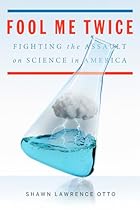
FOOL ME TWICE: Fighting the Assault on Science in America
Shawn Lawrence Otto

Rodale Books
$25.99 hardcover, available now

Reviewed by Richard, 4.9* of five

The Publisher Says: "Whenever the people are well informed,” Thomas Jefferson wrote, “they can be trusted with their own government.” But what happens in a world dominated by complex science? Are the people still well-enough informed to be trusted with their own government? And with less than 2 percent of Congress with any professional background in science, how can our government be trusted to lead us in the right direction?

Will the media save us? Don't count on it. In early 2008, of the 2,975 questions asked the candidates for president just six mentioned the words "global warming" or "climate change," the greatest policy challenge facing America. To put that in perspective, three questions mentioned UFOs.

Today the world’s major unsolved challenges all revolve around science. By the 2012 election cycle, at a time when science is influencing every aspect of modern life, antiscience views from climate-change denial to creationism to vaccine refusal have become mainstream.
Faced with the daunting challenges of an environment under siege, an exploding population, a falling economy and an education system slipping behind, our elected leaders are hard at work ... passing resolutions that say climate change is not real and astrology can control the weather.

Shawn Lawrence Otto has written a behind-the-scenes look at how the government, our politics, and the media prevent us from finding the real solutions we need. Fool Me Twice is the clever, outraged, and frightening account of America’s relationship with science—a relationship that is on the rocks at the very time we need it most.

My Review: The most unnerving reality in today's social, political, and educational reality is that science, which you are benefiting from this very second as you read this review on the Internet, is underfunded, undertaught, and underapprecitaed by the people of the USA and their political overlords. The reason for this is that an insane religious know-nothingism has infected the Body Politic with a conservative (in the worst possible meaning of that never good term) resistance to accepting reality as it is, instead of how one fancies it should be. This book quantifies the horrors on their way down the pike as this horrifying metastatic stupidity continues unchecked and even promoted by the small-souled fear-mongering Yahoos, in the original Swiftian sense, who shout and rail and spew on Fox "News" and the related echo chambers.

This book is exactly as tendentious as my book report is. If you don't already agree with its premise, then you're unlikely to consider picking it up. Which is a pity, in my view. For those of us who already agree, this acts either as a call to arms, or a horribly depressing reminder of how the New Dark Ages have already begun. For make no mistake: Stupidity has more gravity than intelligence, and hate has more than enlightenment. Science has proven too many times that gravity always wins for me to have any hope that Good will triumph over Willful Ignorance.

Please prove me wrong. Read this book and get energized to fight the Yahoos. Please.