Wednesday, July 30, 2014

FIRE SEASON BY PHILIP CONNORS

Fire SeasonFire Season by Philip Connors
My rating: 4 of 5 stars

”I do not so much seek anything as allow the world to come to me, allow the days to unfold as they will, the dramas of weather and wild creatures. I am most at peace not when I am thinking but when I am observing. There is so much to see, a pleasing diversity of landscapes, all of them always changing in new weather, new light, and all of them still and forever strange to a boy from the northern plains. I produce nothing but words; I consume nothing but food, a little propane, a little firewood. By being virtually useless in the calculations of the culture at large I become useful, at last, to myself.”

 photo ConnorsCabin_zps8b98fa66.jpg
The cabin and Lookout Tower that Philip Connors used.

I had a roommate in college who was a forest fire fighter. He was also a ballet dancer which may seem like two odd interests to put together, but both required strong legs. He earned enough money in the summer running all over the country digging line and operating a chainsaw to pay for his schooling during the winter. He eventually even commanded his own truck and crew. He had long, curly red hair which I often thought must have been a warren for errant sparks while out there in the smoke and roar of mother nature taking back what she had allowed to grow.

I couldn’t help but think about him as I read this book. I wondered if he is still out there fighting fires or if he has settled down to some form of domestication. You see he is off the grid. Not a big surprise. I can imagine that if he does get on a computer it is only to google himself and see if his name appears.

Philip Connors did what he was supposed to do. He went to college and afterwards landed a job in Manhattan working for one of the most prestige newspapers in the world...The Wall Street Journal. He grew up on a farm in Southern Minnesota. There is just something about farm kids that makes it hard to place us in a mold and hold us down long enough for us to be the same cookie as everyone else. Corporate cubicles are cages. I can picture him squirming in his seat.

I can tell he suffered from the same uneasiness that I felt living in San Francisco. It took me a while to figure it out, but one day I drove down to stare at the ocean. I could feel the tension leaving my body, not because of the ocean, but because for the first time in a long time I had a horizon stretching out before me. I could see for miles. I never feel as comfortable as when I have a lot of nothing stretching out around me for miles in every direction. People are optional, but only if they are quiet.

 photo PhilipConnors_zpsfcbc70f8.jpg
Philip Connors

Connors ran into a friend that changed his life. She was a fire lookout and something clicked for him. The next thing he knew he had quit his job, convinced his lovely wife to move to New Mexico (later), and took a job sitting around on a mountain top scanning the world for vestiges of smoke. Not everyone is fire lookout material. Let’s just say you better be almost phobia free.

”When you consider a person has to be free of a fear of fire (pyrophobia), a fear of confined spaces (claustrophobia), a fear of being alone (isolophobia), a fear of heights (acrophobia), a fear of steep slopes and stairs (bathmophobia), a fear of being forgotten or ignored (athazagoraphobia), a fear of the dark (nyctophobia), a fear of wild animals (agrizoophobia), a fear of birds (ornithophobia), a fear of thunder and lightening (brontophobia), a fear of forests (hylophobia), a fear of wind (anemophobia), a fear of clouds (nephophobia), a fear of fog (homichlophobia), a fear of rain (ombrophobia), a fear of stars (siderophobia), and a fear of the moon (selenophobia), then it’s little wonder most people aren’t meant to be lookouts.”

I think the one that will get most people is Isolophobia. We are so interdependent on each other that most of us have a hard time flying solo.

Give me a shelf full of the right kind of books and I can do without human interaction for a good long time. Longer yet if I can bring in a few baseballs games on the AM radio. The first time a hiker wandered up the trail I’d have to catch myself before I said something like “Greetings Human!”.

 photo DesolationPeakLookout_zpsb475c169.jpg
Desolation Peak, Washington a place that Jack Kerouac spent 63 days scanning the skies for smoke while creating a lot of smoke himself.

Connors talks about the connections with writers he likes and their time spent as fire lookouts. To a writer it seems like ideal conditions to expand the mind, focus the mind, and write the Great American Novel. Jack Kerouac discovered that he was willing to hike miles to pick up the makings for cigarettes during his 63 days on Desolation Peak. Connors discovered that Kerouac kept a diary during that time in shirt pocket sized notebooks. They were housed with his papers in the New York Public Library. Connors, with a number 2 pencil spent three days feverishly (Keetenesque) copying those diaries. They would prove to be a solace to him many times while pulling a long shift high above the treeline with nothing but sky between him and the next world.

 photo AbbeyFireTower_zpse14f10e8.jpg
Edward Abbey in the glass cage checking for smoke and pounding away on his typewriter.

There was also, famously, Edward Abbey who was teaching at the University of Arizona while I was in attendance there. He wrote two books: Black Sun and The Journey Home about his time in the Forest Service as well as at least one short story. It proved to be productive time for him sitting, watching, and thinking.

”The life of a lookout, then, is a blend of monotony, geometry, and poetry, with healthy dollops of frivolity and sloth. It’s a life that encourages thrift and self-sufficiency, intimacy with weather and wild creatures. We are paid to master the art of solitude, and we are about as free as working folk can be. To be solitary in such a place and such a way is not to be alone. Instead one feels a certain kind of dignity.”

There was the professor Norman MacLean.

”I was expected to sit still and watch mountains and long for company and something to do, like playing cribbage, I suppose. I was going to have to watch mountains for sure, that was my job, but I would not be without company. I already knew that mountains live and move.” Norman MacLean

 photo MacLeanLookoutTower_zps5a6e2ab6.jpg
The Norman MacLean fire lookout tower at Grave Peak, Idaho.

Don’t forget Gary Snyder and the poet Philip Whalen also spent time on lookout towers.

One of the benefits besides solitude, and having a million dollar view is the plethora of wildlife that is teaming right beneath Connors’s nose.

”One evening I’m cooking dinner over the stove’s blue flame when I look up and see, through the west-facing windows, two bull elk with their muzzles to the ground in the meadow. They are massive, majestic, the muscles in their hindquarters rippling as they shift their weight. One of them lifts his regal had and seems to look at me, his antler stark against the gray sky; he shakes his jowls and returns to his grazing. I slip out the door and sneak around the corner of the cabin. When they hear me coming they look up, crouch slightly, then bolt, their hooves thundering down the mountainside. My blood races. Their musk hangs heavy in the air.”

As you can probably tell this book produced a lot of fond memories for me, bringing a lot of my past forward into the future. Connors even mentions Dave Foreman, the progressive leader of Earth First!. When the FBI busted in his door, arresting him, and many others in his circle I was one of those people trying to decide how many rings of separation I was from having my own chat with the FBI. Connors talks about the devastation of Four-Legged Locusts overgrazing government lands and the negative effects of Aldo Leopold himself leading the charge to eradicate the wolf from New Mexico and Arizona to satisfying the fears of cattleman so proud of their historical heritage; and yet, so craven at the sound of a wolf howl. He gives us an overview of Victorio and his fight to remain free, using the Mexico border effectively, to prolong his ability to continue to be a thorn in the plans of the federal government.

 photo Victorio_zps4a741bae.jpg
Victorio, an Apache chief intent on not giving in.

We can only hope that fire lookouts will continue to be a refuge for a future generation of writers. Philip Connors feels he may be among the last to get this opportunity. We are in the age of technology eliminating jobs, corporations shipping American jobs overseas, and many of the rest of us being left with soulless jobs; jobs without dignity. Philip Connors for 240 pages gives you an opportunity to experience a job that it is simply amazing still exists. You too can be ”Caged by glass but caressed by sky.”


View all my reviews

Tuesday, July 29, 2014

More Stuff, More Problems

Everything That Remains by The Minimalists
2014
Reviewed by Diane K.M.
My rating: 4 (rounded up) stars out of 5

We have a love-hate relationship with stuff. We love wanting things -- it can be so satisfying to acquire and collect our treasures! But we also have to store all of that stuff. We have to clean it and organize it and maintain it. 

Minimalists argue that if we have less stuff, our lives will be richer and happier. We will spend less time cleaning and worrying about our things. We will have more satisfying relationships. We will not have to work as hard or have as much debt because we will be spending less money. Clearing out everything that is unnecessary will free up room in our lives to be more mindful of ourselves and of others. 

Joshua Fields Millburn and his friend, Ryan Nicodemus, run a blog called The Minimalists, and this book is a memoir about their journey to simplify their lives. (Minimalism seems to be the trendy new term that was just called Simple Living in the '90s. New century, new term!)

Joshua and Ryan both had high-paying jobs in the telecommunications industry. They worked long hours and had a lot of stress. After Joshua's mother died in 2009, he had to clean out her house and was shocked at how much stuff she had collected. His first thought was to box it all up and pay to have it stored somewhere, but then he realized how ridiculous and expensive it would be. So he hunkered down and sorted through all her rooms of stuff, getting rid of everything but a few photographs and mementos.* 

And then, his marriage ended. In a new apartment, Joshua decided to start paring down his stuff, too. 

"I started small, asked myself: What if you removed one material possession -- just one -- from your life each day for a month? What would happen? The result: I unloaded way more than thirty items in the first thirty days. Like way, way more. It became a kind of personal challenge, discovering what I could get rid of, what I could get out of my way, how many unneeded things I could remove from my hoard. I searched my rooms and closets, cabinets and hallways, car and office, rummaging around for items to part with, retaining only the things I needed."

It took several months, but Joshua whittled down his things to just the necessary items. He got rid of all of the "just in case" things that he had been saving. He digitized his photographs. He digitized his CDs and movies. He cleaned out his closet and kept only his favorite clothes. It was close to an "everything must go" project. He even changed his relationships, and ended up leaving the job that had been making him miserable.

"We hold on to jobs we dislike because we believe there's security in a paycheck. We stay in shitty relationships because we think there's security in not being alone. We hold on to stuff we don't need, just in case we might need it down the road in some nonexistent, more secure future. If such accoutrements are flooding our lives with discontent, they are not secure."

Ryan became inspired to minimize his things after he saw how much happier Joshua was. Ryan tried a slightly different project: He packed up all of his items in boxes as if he were moving, labeled everything, and stacked them in his living room. Then he spent 21 days unpacking only the items he needed. For example, the first things he unpacked were his toothbrush, his bed sheets, a few dishes, etc. At the end of the 21 days, he had only unpacked about 15 percent of his stuff. He got rid of everything that was still packed in the boxes. WOW.

"Imagine living a healthier life, one in which you don't just look better, you feel better. Imagine a life with higher standards. Imagine a life with less clutter, less stuff, fewer distractions. Imagine your life with less -- less stress, less debt, less discontent. Now imagine your life with more -- more time, more contribution, more elation ... What you're imagining is a meaningful life. Not a perfect life, not even an easy life, but a simple one."

This book was inspiring to read and even kicked me into serious decluttering mode. (I've already taken numerous bags of things to goodwill.) My complaint is with the writing; Joshua can be a bit florid, and the structure of the book was also frustrating. It's set up as a collection of essays, but Ryan was allowed footnotes; his comments are in the back of the book, which required a second bookmark. While Ryan had a few good points, such as his diary about his 21-day project, a lot of his interjections were unnecessary and I got annoyed flipping back and forth. 

However, I appreciated the thoughtfulness of the book and because it was so inspiring, I'm taking my 3.5 rating and rounding up to 4.

*This is just anecdotal evidence, but I have heard similar stories from friends about how the death of a parent or grandparent has jolted them into decluttering their own lives, because they had to sort through all of their relative's stuff. All of those "treasures" can end up being a burden for those left behind.


Exodus Lost

Exodus LostExodus Lost by S.C. Compton
My rating: 4 of 5 stars

When the Spaniards arrived in the New World, the Aztecs treated them like returning gods, mistaking them for Quetzalcoatl and handing over their empire. In Exodus Lost, S C Compton asks why.

In my younger days, I loved bits of possible history like this book so it was a no brainer when it popped up on my FreeBooksy email a couple weeks ago.

In Exodus Lost, S.C. Compton builds a convincing case that people from the Middle East visited the Olmecs and their descendants in what are now Central and South America. For instance, both cultures used the same laborious process to make purple dye from sea snails. Both the Quetzalcoatl and the Egyptian Pharaohs use the feathered serpent as a symbol. Throw in shared alphabetic characters and commonalities in language and mythology and it's off to the races.

But wait! There's more! Tobacco and cocaine, both substances native to the New World, has been found in Egyptian Mummies. Both the Egyptians and Mezoamericans used a calendar with the same amount of days. Both had dog headed gods of the Underworld. And architectural similarities! And similar religious practices!

Compton postulates that Quetzalcoatl was Egyptian and that both the Hyksos and the Nubians visited the new world in antiquity and does a pretty convincing job, in my opinion. There were so many similarities that I had a hard time discounting what he was saying as mere coincidence. Since Thor Heyerdahl crossed the Atlantic in the 1970's on a boat made of reeds, how hard is it to believe that other cultures did the same thing?

There are some lengthy digressions in the book but they eventually tie back into the main topic. There was probably more Hyksos talk than was necessary and there was a lot of things linking some Old Testament events to real world history but I found those fairly interesting. There's a meteor crater beneath the Indian Ocean miles across that Compton theorizes shot so much water vapor into the stratosphere that it caused the Bibical Flood, which I found intriguing.

One tidbit I learned that's not integral to the book but I found interesting/horrifying was that the Olmecs practiced penile bloodletting as part of religious ceremonies! That's not even the worst part. The worst part is that the chosen technique, using a stingray's barb, was hard to remove without extreme pain so it was easier just to push it all the way through and pull it out the other side. Try forgetting that image.

Four out of five stars. If you're interested in outside influences on Mezoamerican culture, I would highly recommend giving this a shot.


View all my reviews

Clerical Error

Clerical Error (Caverns and Creatures)Clerical Error by Robert Bevan
My rating: 3 of 5 stars

While adventuring, Dave the dwarven cleric displeases the gods and finds himself unable to use his holy abilities. Will he regain them in time to stop a goblin horde from killing Tim, Cooper, Julian, and himself?

The Caverns and Creatures gang is back for another short adventure, this one involving a mass of zombie goblins (gomblies) and a cleric who is having a rough patch of luck, what with having an unholy symbol on his forehead and being the target of endless rats and roaches.

Robert Bevan's vulgar brand of geek humor is present and keeps the story flowing. Dave figures out how to please the gods in a pretty novel way and everything is right with the world.

It's a pretty short story so that's about all I can say without blowing the best jokes. Three out of five stars.

View all my reviews

Monday, July 28, 2014

A Great New Protagonist from the Creator of Elvis Cole and Joe Pike


Reviewed by James L. Thane
Four out of Five Stars

MWD Maggie T415 is an eighty-five pound black and tan German shepherd; she's also a Marine halfway through her second deployment in Afghanistan. With her handler, Pete Gibbs, she works as part of a patrol and explosives detection team. The two are devoted to each other and then one morning, while out on patrol, Maggie is sniffing out IEDs, when the unit comes under enemy fire. Pete is killed; Maggie is badly wounded and when they are choppered out together, Maggie is left with no one.

Scott James is a patrolman on the LAPD. Late one night out of nowhere, he and his partner, Stephanie Anders, suddenly find themselves in the middle of a shooting war when a gang of masked men attacks a Bentley rolling down the street in front of them. Two victims in the Bentley are killed as is Stephanie Anders. Scott James is very badly wounded and the killers get away clean.

Ten months later, Scott is back on the job, if only barely. He's in therapy, attempting to deal with the trauma that still haunts him and hoping to recover memories of that night, no matter how small, that might somehow jumpstart the investigation and lead to the men who killed his partner.

Scott's goal in the LAPD had always been to join the elite SWAT team, but there's no chance of that now. Instead, he's assigned to the K-9 unit. After an initial training period, he'll be paired with a dog. His new "partner" is still to be determined, but while in training he bonds with Maggie who has now mostly recovered from her physical wounds and is being retrained to work as a police dog.

Both Scott and Maggie still bear the scars, physical and mental, of their traumatic experiences. The sergeant who leads the training unit doesn't have much faith either man or beast, but reluctantly agrees to give them a couple of weeks to prove themselves.

In the meantime, Scott has managed to insert himself into the ongoing investigation of the crime that took his first partner's life. In therapy, he remembers a small but vital clue that reinvigorates the investigation and from that point the story progresses as we watch the progress of the investigation and the developing relationship between Maggie and Scott.

It's a terrific story, which will come as no surprise to people who have read earlier books by Robert Crais. But what is astounding is the development of Maggie, who becomes perhaps the book's central character. Certainly, she's the most intriguing character and at several points, the story unfolds from her point of view. It sounds sappy, but Crais makes it work brilliantly.

This is not, by any stretch of the imagination, one of those dopey books where dogs and cats think like human beings and are almost always smarter than most of the humans in the book. Maggie thinks like a dog, and she's totally believable; her role in the story requires not the slightest suspension of disbelief. She's one of the most unique and interesting characters to come along in crime fiction in a long time, and we can only hope that this won't be the last time we see her.

Rough Country For Anyone

No Country for Old MenNo Country for Old Men by Cormac McCarthy
Reviewed by Jason Koivu
My rating: 5 of 5 stars

Wanting to give up...
Refusing to give up...
Not knowing the meaning of giving up.

When drugs and money come to a small Texas town, sheriff-about-to-retire trope Ed Tom Bell is tasked with solving a deal gone murderously wrong. This is indeed No Country for Old Men.

A psychopath of a hitman, Anton Chigurh (that last name being pronounced cheekily similar to "sugar,") is making Bell's last days as sheriff a living hell. Vietnam vet Llewelyn Moss isn't making things any easier. Moss happened upon the drug deal aftermath, grabbed the loot and dashed. Chigurh's been on his heels ever since. That leaves Bell trailing along behind them, picking up clues and wondering what in the heck they all mean.

I found myself actually pulling for all three men, yes, even the psycho killer and that scared the crap out of me. He was such a good "bad guy" that I didn't want to see him die. There are a multitude of colorful and carefully crafted characters herein, some as thorny as the landscape. How do I know the landscape is thorny? Cormac McCarthy made me feel it.

The book is set in 1980. Thankfully, McCarthy doesn't overplay it with product placement...Oh look at me in my Lee jeans and pornstar mustache drinking from a glass bottle of Coke while sitting on the hood of my '76 Camaro....He uses period-appropriate props only when they are necessary.

The plot is tight when it needs to be and breathes when it can. The action fluctuates from relaxed to tense and back again. Not-completely-necessary-but-still-enjoyable story asides (that you won't find in the movie) often contain pearls of homespun wisdom like "Every step you take is forever. You can't make it go away. None of it."

I saw the movie version of this awhile back and, although the book and movie are very similar, this was still an exciting read for me. McCarthy's austere style may not set well with all readers - he doesn't fuck around with flowery words much - however, the spartan prose marches soldierly ahead, pressing the story on, delivering to the reader a tale victoriously told.


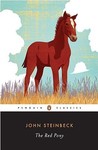
Is Ain't My Little Pony

The Red PonyThe Red Pony by John Steinbeck
Reviewed by Jason Koivu
My rating: 4 of 5 stars

A story about a pretty, pretty precious pony? Hurray! This is going to be giggly joyous laughy-good pony time!...What? It's written by John Steinbeck? Fuck. Sorry, pony, either you and/or everyone you love is going to end up dead.

Yes, these are tales of living on a ranch in the early days (well, early-ish) of California. But underneath, they are more of the same Steinbeck: the vignettes of the hardscrabble life of immigrant farmers.

Specifically it's 2nd and 3rd generation immigrants, such as seen in Tortilla Flat. The people are established. This is their land. It feels as if it's always been theirs, but there were others before them...ghosts now.

The Red Pony follows a boy, Jody, who is coming of age and given the responsibility of raising his own horse. Steinbeck captures well the emotions and perspective of a child feeling his way in a world that is changing for him, new understandings that come at young folks daily like minor revelations. Will he cope?

Thought I'd give this a read, what with my interest in animals being piqued by Goodreads' recent ads for All Creatures Great and Small. The Red Pony reads like a collection of related short stories. It definitely doesn't feel like a complete novel with a plot, climax and satisfying finish. There's just theme, like viewing a photo album. That can be enjoyable too, after all, every picture tells a story, don't it?

View all my reviews

Sunday, July 27, 2014

The Martian


THE MARTIAN
Andy Weir
Crown 2014


Reviewed by Carol

★    ★    ★    ★    


Things didn’t go exactly as planned, but I’m not dead, so it’s a win.

 Mark Watney’s wry evaluation is essentially the summation of his attempts to survive on Mars. After a devastating and unexpected Martian hurricane-force storm wrecks havoc on the Martian crew, NASA calls for an ‘abort mission.’ As Mark is heading to the vehicle that will provide escape from Mars and return the crew to earth, he’s impaled by flying debris, loses consciousness and is presumed dead as the object impaled his suit bio-computer. Ironically, his injury was caused by a piece of antenna that would have enabled him to let his team–or Earth–know he was still alive. What follows is Mark’s log entry of his strategies to survive on Mars and signal Earth that he is still alive. 

I tend to avoid most ‘serious’ Hollywood movies because the emotional manipulation is so overt. For similar reasons, I was hesitant to pick up The Martian. A man abandoned on Mars? Cue scenes of astronaut training, sobbing family, distance camera shots of the Earth marble from Mars. But Weir did something interesting, and instead of heading for the maudlin center of a man’s isolation, he focused on the technical problem-solving by an intelligent, clever engineer with a juvenile sense of humor.
I was pleased to find that The Martian worked for me, despite a few story-telling bumps. The overall structure has a couple of rocky (get it?) moments, with jumps in time and place.  Although the primary story is taken from Mark’s mission logs, there are scenes centered on NASA as well as Mark’s crew members. One flashback of the crew felt particularly misplaced, but will undoubtedly fit right into the movie version. In terms of language, Mark’s voice is colloquial, and even when he’s talking science and engineering, his problem-solving relatively understandable for the reader. Mark’s skills and necessary solutions draw upon experience in botany, Morse code, computers, plumbing, chemistry, balancing loads, ramp-building–there’s likely something here most people can relate to:

Problem is (follow me closely here, the science is pretty complicated), if I cut a hole in the Hab, the air won’t stay inside anymore.

There’s even some science humor sprinkled in among the poop jokes:

All my brilliant plans foiled by thermodynamics. Damn you, Entropy.

What really sold me was Mark’s humor, as well as the focus on survival in an unusual environment. There’s a running joke regarding his attempts to entertain himself, only somewhat relieved after rooting through his crewmates’ possessions and discovering data discs filled with 70s memorabilia. Another ongoing gag centers on being the only human on Mars. Instead of despairing, Mark cracks jokes. It felt believable, an almost required personality trait for one of those daredevils we call ‘astronauts,’ and a very adaptive way of coping in small group situations. For some, the lack of overt emotional exploration might disappoint, but it worked well both to off-set the technical aspects, and to avoid the trope-ridden isolation angst. He does let a couple of moments of isolation and frustration shine through, more moving because of how rare they are.


It’s a solid four stars, and clearly headed towards movie status. An enjoyable, quick read instead of the emotional existential tear-jerker I was expecting, with a positive message about humanity.  However, when the movie version is finally made, I won’t need to see it–I’ve already seen Castaway and The Terminal. Adding Apollo 13 is unnecessary.


cross posted at carol's blog at  http://clsiewert.wordpress.com/

Friday, July 25, 2014

One Last Lie


Rob Kaufman
Self-Published
Reviewed by Nancy
3 out of 5 stars


Summary


Her name is Angela – beautiful and charismatic, she’s every man’s dream and every woman’s envy. But she wasn’t always like this and the secrets of her scarred past cling to her like a poisonous leech. Her beguilement has become the perfect disguise, hiding her silent rage and compulsive determination to get whatever she wants no matter who gets hurt, or killed, along the way.

And now she’s about to wreak havoc in the lives of her old college friend Philip and his life partner Jonathan, a loving couple whose most fervent dream of having a child has consistently eluded them. With a masterful performance, she convinces them that she’s not the person she once was and the three should have a child together through artificial insemination.

The agreement is made and from that moment on, Philip and Jonathan’s idyllic life begins to unravel. Like Alex Forrest (Glenn Close) in Fatal Attraction and Catherine Trammel (Sharon Stone) in Basic Instinct, Angela’s mask of deceit gradually disintegrates as her psychological demons claw to the surface, leaving Philip and Jonathan regretting the day they ever allowed her into their lives.

Filled with psychological suspense and pervasive foreboding, this page-turning thriller brings readers on a relentless rollercoaster ride, evoking emotional upheaval that remains long after this novel’s final word. Told from an elderly Jonathan’s hospital bed, the story quickly unfolds into a tale of legal, medical and psychological twists that turn into heartbreak, deception and ultimately murder.

One Last Lie is a timely and tension-filled novel with an ending that shocks even the most observant of readers.


My Review


Shortly after my 23rd birthday, a gay male friend asked me to marry him. We worked closely together for two years, our cubes separated by one flimsy wall. Our friendship started tentatively, gradually progressing from occasional lunches to spending quite a bit of time together outside of work. I learned he was deeply closeted and only out to me and one other gay man at work. Not even his parents knew. I also learned that despite being gay, his politics were very conservative. A few times he asked me to attend various Republican events with him as he was eventually planning to run for local office and didn’t want to be seen without a companion. So I put on my nice dress, smiled and shook hands, and tried to be a supportive friend.


Right after one of those events, he popped the question. I thought he was joking, but the intense gaze and firm set of his jaw said otherwise. I dared not laugh or tell him no, and instead asked for a few days to think about it. After thinking about it, getting married didn’t sound like such a bad idea. My friend made decent money and lived in a small house in a good neighborhood. I lived in a dumpy third-floor apartment in a bad neighborhood and my car was always in the repair shop. If we lived together, my quality of life would improve dramatically. The only thing required of me would be to attend more of those foolish Republican events and occasionally entertain other fledgling politicians. Of course, we could both date whomever we wanted, as long as we didn’t bring them home. He also promised that I could bank my salary since his was sufficient to take care of our necessities.

Lavender marriages have happened all throughout history. Could we make it work and live our independent lives? We were good friends, despite our political differences. What could possibly go wrong?

After thinking about it, I decided against marriage. Friends are not always forever. Over time, people’s needs and desires change. Good intentions could go horribly wrong. Promises are made that could easily be broken. Suddenly, that good friend becomes an enemy.

Reading One Last Lie reminds me that there are certain things you should never do with a close friend. Getting married is one. Having a baby is another.

If only Phil had listened to Jonathan…

I loved the chapters with old Jonathan. The decline of his advancing age, his lack of control and independence, and the sorrow permeating his entire being were heartrendingly authentic and his tale told masterfully.


“The old man was dying, and the worst part was, he knew it.
He could feel it in his brittle bones, popping and cracking with every move. He tasted it in his mouth – the bitter phlegm sitting on his tongue. He could even see it through the viscous film caught between his quivering eyelids.
But the telltale sign of approaching death was the feeling of surrender that had crept into his aching body – complete resignation to his current existence and to the life he’d led. The fight was just about gone.”

Flashback to when Jonathan and Phil were younger and ready to start a family. When Phil’s bout with testicular cancer and subsequent radiation treatments rendered him sterile, they looked to Phil’s old friend Angie who drops in their lives out of the blue after 15 years. Angie has successfully battled obesity, but her depression, rage and unpredictable moods are troublesome to everyone she comes in contact with.

It seems Jonathan has some problems of his own, an “irritated state of being”, according to his therapist. Things like a messy kitchen or nagging doubts and suspicion about Phil’s old friend disturb Jonathan’s neurotic sense of order.

Then there was Angie’s boyfriend, who also had trouble controlling his temper even with Zoloft and Clozapine.

My feelings about this story were all over the place. I couldn’t wait to get back to the old Jonathan, to feel his pain and share his grief. I was so close to having a good cry, when there were more flashbacks and eye-rolling moments with an over-the-top villainess, an idiot of a boyfriend who failed to see the most obvious warning signs, who dismissed Jonathan’s legitimate fears and concerns, and who disregarded the seriousness of mental illness by making ignorant and misogynistic comments like, “…first of all, she’s pregnant. We already know women are crazy before they get pregnant, and now the hormones are going haywire."

I liked the pace of the story, but found the clues heavy-handed, making the story very predictable. It would have been a lot better had the serious issues been explored more sensitively and the secondary characters were not so one-dimensional.

This is Rob Kaufman’s second novel, and he promises “this is only the beginning”. He is an extremely talented writer adept at twisty, psychological suspense. I know his next book will be even better and I’m looking forward to it.

Thursday, July 24, 2014

That Which Does Not Break Us

The Wake of Forgiveness
by Bruce Machart
Published by Houghton Mifflin Harcourt

Reviewed by Amanda
4 Out of 5 Stars

This was an impulse buy at Barnes and Noble. I ignored the book at first in favor of looking at the books around it, but then I caught the words “Tim O’Brien” during a cursory glance at a book blurb on the cover. One of my rules in life is to pick up anything with Tim O’Brien’s name on it and buy it immediately, no questions asked. To date, this rule has served me well and The Wake of Forgiveness by Bruce Machart is no exception.

Set in Texas at the dawn of the 20th century, the novel focuses on the Skala family, which consists of an immigrant father and his four motherless sons. Vaclav’s wife, Klara, dies while giving birth to their fourth son, Karel, and the book focuses on the physical and emotional marks these men carry as a result of her death. Despite her early death, the shadow of Klara haunts every page. In a cruel and unforgiving landscape, Klara would have served as the buffer between the physical and emotional demands of pioneer life, between the immigrant and his new homeland, between father and son, and between the sons themselves. Without her, these men throw themselves against each other, against the landscape, and against life itself with a brutal tenacity that can only be born of intense pain and loss.

After the loss of his wife, Vaclav Skala, an ascetic man by nature, becomes even harder and more unforgiving in his dealings with the world. To spare his fine racing horses the detrimental effects of fieldwork, he instead hitches his four sons to the plow. Their time in the harness has left the boys with a peculiar deformity: they all have twisted necks that symbolize their skewed view of the world inflicted upon them by their father. Of all the boys, none are as warped as Karel. Having never known his mother and carrying the burden of guilt for her death, Karel is nonetheless Vaclav’s pride as Karel is a gifted horseback rider whose skills have won his father many a high-stakes gamble. As the novel goes on, the narrative moves back and forth between the story of Karel as a young boy and Karel as a grown man, now alienated from his brothers. The circumstances leading to the severing of the connection with his siblings are revealed as the book goes on and heighten the suspense as the novel moves toward its satisfying resolution.

Machart has created a tragedy that is epic in scope and is often reminiscent of Cormac McCarthy’s best work (in particular, All the Pretty Horses comes to mind). The language is poetic and so frequently captures the heart of the moment or the quality of the landscape with such a perfect turn of phrase that I often went back and re-read certain lines just to savor them. Another point in Machart’s favor is that his characters are complex and never watered-down; these are hard, often cruel men, but that doesn’t mean they are completely devoid of kindness, poeticism, or intelligence. They are victims of a lifestyle and a landscape that naturally cripples the finest points of humanity to ensure survival in a merciless environment. That any of the characters retain even a shred of their capacity for forgiveness is the ultimate triumph.