Monday, December 22, 2014

Patrick Hoffman Delivers a Huge Load of Trouble in The White Van


Reviewed by James L. Thane
Four out of five stars


This is a very dark debut novel featuring druggies, loan sharks, Russian gangsters, bank robbers and crooked cops, all fighting desperately for turf on the very mean streets of contemporary San Francisco.

Emily Rosario is a lost soul who relies on booze and drugs to make it from one day to the next. One evening, she meets a Russian man in a seedy bar called the Kum Bak Club. After a few drinks, she accompanies him to a hotel for more booze and drugs, but once there, the Russian and his accomplices keep her drugged to the point of incoherence, paying her two hundred dollars a day for her help in what they insist will be an identity theft scheme.

Emily is so totally blitzed that she goes along for the ride, thinking of what she might do with her promised end of the money. Then one day she's loaded into a white van and sent into a bank, only to discover that she's been conned into what is really a bank robbery.

At that point, as it usually does in a noir novel like this, the excrement hits the proverbial fan and Emily finds herself on the run, trying to stay one step ahead of the Russians and the cops all of whom are searching for her desperately. In particular, a troubled cop who's deeply in debt named Leo Elias, sees a chance to grab the money from the bank for himself and solve all of his financial problems.

What results is a wild ride where anything can happen to anyone and everyone. Patrick Hoffman has created a number of interesting characters and placed them into motion against a very well-rendered depiction of San Francisco. There are any number of twists and turns that the reader will not see coming and in the end, it's a very satisfying book that fits brilliantly into the noir tradition.

Hatin' On Harry? Nah

Harry Potter and the Order of the Phoenix (Harry Potter, #5)Harry Potter and the Order of the Phoenix by J.K. Rowling
Reviewed by Jason Koivu
My rating: 3 of 5 stars

Why won't I let myself give this more than 3 stars?! I want to, I really do, but my cursor-moving finger won't budge! Let's investigate the whys!

Length - This is the longest book in the series. I love the Harry Potter series, so I should want more of it, right? I don't know, sometimes a lot is too much. Rowling did her best to pack a lot into this one and it feels too bulgy. If this was carry-on luggage, TSA would make her check it for going over the size limit.

Dolores Umbridge - What a great evil character she is, isn't she? Quite the bitch. And the kicker is she's supposed to be on the good side! I like a well-crafted, dual-natured character as much as the next reader, but I do not like when characters are made to be so blind to what's going on that it's beyond belief. Umbridge's absolute unwillingness to believe in the return of Voldemort is trying to say the least. She's Hitler-esque at times. That's fine, a little over the top, but fine. But she cares sooo very much for the Ministry of Magic and Hogwarts, or at least in her position there, that one would expect her to do her due diligence in investigating any threat to her own power and interests.

Sirius Black - Now, this one's on me. I LOVE Sirius Black and I really wanted to see the development of a strong bond between he and Harry. Since book three I'd been waiting for some Black/Potter tag team action. I wanted to see them hanging out, doing Uncle/Nephew kind of things. That's not quite how it played out. Oh well... It's nobody's fault but mine that I let this missing aspect get me down. Still, a book review is subjective and so I must admit a personal bias that affected my overall enjoyment.

Harry's Yellow Fever - That's so racist! Okay, now that I've got that out of the way... I was disappointed when Harry's love affair with Cho Chang went south. I liked the relationship. It was complicated. It was difficult for him. It could have made for a fine romance. But no, Rowling had other ideas - very British ideas, like "keeping it in the family". Frankly, Harry's eventual attachment to Ginny Weasley felt too close. I mean, Harry and her feel almost like brother and sister. Plus she's a ginger. Eeeewww.

I could give Harry Potter and the Order of the Phoenix four or even five stars and there are reasons I might drop it as low as two. So, let's give it a very strong three and be done with it!

View all my reviews

Audiobook Virgin No More

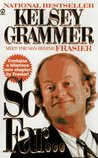
So Far...So Far... by Kelsey Grammer
Reviewed by Jason Koivu
My rating: 3 of 5 stars

Audiobooks have been a fantastic way for me to pass the time when stuck doing housework, yardwork and any other sort of long, dreary thing involving the word "work." They make it possible to muscle through a dry read and, because I'm able to get through so many more books than I otherwise would, audiobooks occasionally get me reading something outside of my comfort zone and I think that's a good thing.

The first audiobook I ever listened to was Kelsey Grammer's confessional So Far.... It was mom's and this was back in the mid '90s. It would be about 15 years before I picked up another audiobook, but that's on me, not this book's fault. Grammer's fans from his "Cheers" and "Fraiser" days who clamor for behind-the-scenes, personal details will find plenty. The man had drug problems. It wasn't pretty. But now you can read all about it!

In this, the Age of Rehab, So Far offers nothing new that hasn't been written a thousand times since. I gave it a good rating mainly because anyone willing to bare their faults to the world in such a revealing manner deserves a pat on the back, even if only out of pity.

View all my reviews

Saturday, December 20, 2014

Foxglove Summer. Read even if its winter.

Foxglove Summer
Ben Aaronovitch
2014 Gollancz

Reviewed by Carol
Recommended for fans of supernatural mysteries
 ★    ★    ★    ★    1/2


I haven’t yet been able to review a Peter Grant book immediately after finishing. I suppose I’m basking in book afterglow. Once again, Aaronovitch writes an engrossing, unpredictable urban fantasy, perhaps his best yet. A good story, a generous sprinkling of dark police humor, decent police procedural all combine for a read that fully occupied my Sunday afternoon. 
 
Chuckles as I started:

Sarcasm about family:
“I sighed–policing would be so much easier if people didn’t have concerned relatives. The murder rate would be much lower, for one thing.”

About procedure:
‘I’m fairly certain you’re violating our human rights here,’ she said.
‘No,’ I said with the absolute certainty of a man who’d taken a moment to look up the relevant legislation before leaving home.”


About official-speak:
“I made a mental note to wheedle the list of old codgers out of Nightengale and get it properly sorted into a database. Hugh’s ‘grapevine’ might be a useful source of information. If I’d been about four ranks higher up the heirarchy I’d have regarded it as an opportunity to realise additional intelligence assets through enhanced stakeholder engagement. But I’m just a constable so I didn’t.”

Okay, maybe that’s not that funny. I thought so, but then I’m the sort to read the corporate bulletins, marveling at the abuse of language and meaning.

What I really love about Aaronovich–srsly, now–is that he brings a much looked for but seldom found level of social commentary to his urban fantasy. Grant has dark skin, and is painfully obvious out in the posh suburbs. At one point, there’s a nice little aside when he notes the casual joking racism from an officer he’s just met. He considers his normal snide comment, half laughing, half calling it out but then decides to let it go with the assumption that the officer wouldn’t even recognize the rebuke. I’m always impressed the way Aaronovich weaves multiculturalism into his tales, in the most ideal of ways: acknowledging a different cultural experience, but not fetishizing it or diminutizing the truth of the experience. Grant understands the because he is a dark-skinned copper he will end up being ‘poster boy’ for the investigation. There’s a world of cynicism, weariness and acceptance in the role he plays for the suburban police. 

Grant has his own prejudices about the country, partly because he feels so out of his element, only going into the country when required on school trips.
The air was still fresh but the sun was already sucking up the moisture from the fields and you didn’t need to be chewing on a straw to know it was going to be another hot day.”

There’s also writing that is nicely balanced between description and action, occasionally even making a foray into lyricism:
The pack [of reporters] has swept back into the village less than ten minutes after they’d left, and come boiling up the cul-de-sac like the return of a tide, licking at my heels as I ran up the path and only stopping at the hedge line because it was held by a special constable called Sally Donnahyde who was a primary school teacher in her other job and so wasn’t going to take any lip from a bunch of journalists. The kitchen was at the back of the house, but I could still here them as a restless murmur, like surf on a pebble beach.”

Oh yes, I liked the mystery, one of the most coherent storylines yet. The supernatural take is interesting, even if it comes to a somewhat familiar ending, but I appreciate the modern twist. It did trouble me somewhat that this might be a plot point that comes back to bite Peter in the butt, which led to unpleasant echoes of Dresden. But again, that’s what fairy tales and mythology is about, putting the storyteller’s spin on a cultural archetype. 

Characterization is decent, with the majority of time spent on Peter. I don’t mind; he’s an interesting, thoughtful lead. I came to like his country partner. This time, Beverly Brook’s role seemed appropriate and a little more fleshed out, if still slightly incoherent (must she always speak in riddles? must we have weird watery dalliances?) 

In a rare moment for me, I would have liked a little more punctuation; at times it takes a minute to figure out the inflection (see above quote). But that’s a stylistic quibble.

The ending, perhaps, was almost the least satisfying part of the story. Oh, don’t worry; everything wraps up nicely with no nasty cliffhangers, except that giant multi-book arc that’s going on. No, it is that the ending seemed a little too cinematic, and meant to appeal to the current UF reader, instead of being more character consistent. But that’s me, and I’d be happy to discuss below with spoiler tags.
Still, Peter Grant remains one of the most consistently satisfying UF series out there, and I remain committed to reading whatever Aaronovitch releases.

Four and a half country stars


Friday, December 19, 2014

Black Girl in Paris


Shay Youngblood
Riverhead Trade
Reviewed by Nancy
3 out of 5 stars


Overview


Shay Youngblood's debut novel, Soul Kiss, received accolades from reviewers and writers alike. The Washington Post hailed it as "intelligent and erotic ... immensely engrossing and satisfying," while The Atlanta Journal-Constitution called it "exquisite." Tina McElroy Ansa described it as "extraordinary ... lyrical, intimate, funny, unsettling, enthralling." Now, in her second novel, Youngblood explores the endeavor of a creative coming-of-age, and infuses her story with the same mesmerizing, lush language and impressionistic style that won her so many fans the first time around.

Black Girl in Paris wends its way around the mythology of Paris as a city that has called out to African-American artists. Like James Baldwin, Langston Hughes, and Josephine Baker before her, Youngblood's heroine leaves her home, in the American South, nurturing a dream of finding artistic emancipation in the City of Light. She experiments freely, inhabiting different incarnations--artist's model, poet's helper, au pair, teacher, thief, and lover--to keep body and soul together, to stay afloat, heal the wounds of her broken heart, discover her sexual self, and, finally, to wrestle her dreams of becoming a writer into reality.

Youngblood's lyricism, as effortless as an inspired improvisation, and her respect for the tradition she depicts create a natural tension between old and new, reverence and innovation, and tell a story at once timeless and immediate.


My Review


I love Paris, its grandeur, its palaces, museums, monuments, breathtaking views, restaurants, cafes, its rich culture and history. It is a dynamic, international and happening place.

It’s been about 5 years since I’ve been there last, so I was really looking forward to taking a literary trip to Paris.

Eden, a 26-year-old Black woman from Alabama and an aspiring writer, journeys to Paris with just $200 in her pocket to follow in the footsteps of her literary heroes – James Baldwin, Richard Wright and Langston Hughes.

This could have been a fascinating story, but I found the descriptions of Paris vague, the main character too naïve for her age, and far too much of the story focused on her menial jobs. I wanted a little glimpse of the past, some insight into her heroes who were just names dropped on the pages. I also wanted to know more about France’s troubles – the racism, the struggles of the poor and working class, the problems of immigrants.

I wanted a more serious story and less whimsy. I could have done without the recipes and the silly musings about art and love. There were interesting secondary characters I would have liked to know more about – Eden’s androgynous boyfriend, Ving, and his friend Olu-Christophe, a Haitian living in Paris without papers, and Luce, Eden’s friend/lover who taught her how to take what she needed in order to survive.

The story was pleasant enough reading, but lacked passion and spirit, making my literary trip to Paris rather disappointing.

Wednesday, December 17, 2014

Mr. Shivers

Mr. ShiversMr. Shivers by Robert Jackson Bennett
My rating: 3 of 5 stars

When his daughter is killed senselessly by a disfigured drifter named Mr. Shivers, Marcus Connelly travels across the Despression-stricken country for vengeance in the company of several hobos, each with a reason for wanting Mr. Shivers dead...

This tale of death in the Dustbowl was an odd animal to pin down. The pursuit of a mysterious man in gray echoed the beginning of The Gunslinger. Much like the first volume in the epic Dark Tower series, Mr. Shivers is a novel of obsession and relentlessness. How far would you be willing to go to achieve your goals?

The writing reminds me of Joe Lansdale's more literary works like The Bottoms. The subject matter, however, has echoes of Steppenwolf, The Man Who Was Thursday, and Cormac McCarthy. When you track down great evil, you have to fight hard to avoid getting swept up by it. The metaphysical questions the book raises make this more than a Depression-era horror novel.

For a book that's less than 350 pages, it's fairly powerful. It might be overly ambitious for a first novel, though. The concepts were great and Mr. Shivers was suitably creepy but I didn't think Connelly or his hobo compatriots were very fleshed out. The book also seemed really linear and could have made more use of the hobo culture of the Great Depression.

At the end of the day, I'm not even really sure how I felt about it. I loved some of the ideas presented but the story itself was lacking. I guess we'll call it a three out of five.

View all my reviews

A PASSAGE TO INDIA BY E. M. FORSTER

A Passage To IndiaA Passage To India by E.M. Forster
My rating: 4 of 5 stars

“Adventures do occur, but not punctually. Life rarely gives us what we want at the moment we consider appropriate.”

 photo IMG_0778_zps7691e8b1.jpg
Illustrations from the Folio Edition by Ian Ribbons.

Adela Quested and Mrs. Moore have journeyed to India with the intention of arranging a marriage between Adela and Mrs. Moore’s son Ronny Heaslop. He is the British magistrate of the city of Chandrapore. He is imperial, much more so than when Adela knew him in England.

”India had developed sides of his character that she had never admired. His self-complacency, his censoriousness, his lack of subtlety, all grew vivid beneath a tropic sky; he seemed more indifferent than of old to what was passing in the minds of his fellows, more certain that he was right about them or that if he was wrong it didn’t matter.”

My impression is that Heaslop may have been elevated rather quickly and had no time to develop his own ideas of the way things were in India, but simply borrowed the established views of the more senior British officials in India. In this new role he was required to play he is a very different person than the young lad that Adela knew in England.

She had decided to break off the engagement and then fate intercedes with a near death experience that allows her to see Heaslop in a different light.

The engagement is back on.

“Sometimes I think too much fuss is made about marriage. Century after century of carnal embracement and we're still no nearer to understanding one another.”

It is always interesting to listen to people talk about marriage. Sometimes people can be too cerebral and talk themselves out of a perfectly acceptable relationship. Others give the commitment of marriage the same amount of thought as they do to deciding what they want for lunch. Arranged marriages used to work perfectly well simply because they were an alliance usually involving money and future offspring. We decided, at some point, that romance was the elixir that we must desire the most in a relationship. Divorce rates have skyrocketed and most people are not any happier than when marriages were arranged for them by their relatives, but free will has given people the idea that happiness can be achieved if they can just find that right person. It is always better to own your unhappiness or happiness instead of having it decided for you.

Adela is not very pretty, but she does have some money. Heaslop seems rather indifferent about the whole arrangement. Yes, he wants the marriage, but more for fulfilling a necessary obligation. The sooner it is settled the sooner he can move on to other things of more importance. Adela is trying to decide whether to accept this situation or wait to see if their is a better one on the horizon.

 photo PassagetoIndia_zpsbf8ee9dc.jpg


Dr. Aziz meets Mrs. Moore by chance in a mosque and though their meeting is rocky in the beginning a friendship quickly blossoms. Adela wants to see the real India, by, well, interacting with real Indians. A meeting is arranged with Dr. Aziz and in the course of their conversations with one another Aziz extends an invitation to take them on a journey to see the Marabar Caves. This is one of those invitations that are extended as a courtesy during a party that are never expected to be fulfilled. To his horror, he discovers, a few days later through an intermediary that the women fully expect him to take them to the caves. At great expense to himself he arranges this outing.

Aziz has always been a friend of the British, in fact, one of his best friends is a British teacher named Cyril Fielding. He had arranged for Fielding and another friend to go with them on this journey to provide the much needed cultural bridge between him and the ladies.

His friends miss the train.

Disaster looms.

Aziz is accused of physically assaulting Adela in one of the caves.

Ridiculous Fielding says.

Of course he attacked her the British community insists. All these brutes desire our women.

As events unfold it becomes more and more unclear as to what really happened, but even as doubt is raised the Colonialists continue to believe that Aziz is guilty.

He must be guilty.

This is considered E. M. Forster’s masterpiece and lands on most top 100 books of all time lists. I personally did not enjoy this book as much as I have some of his other books, but because of the subject matter of this book and when it was published, I fully understand why people look on this novel as his most significant book. He was poking a finger in the eye of his own government and their insistence on continuing to try to rule the world with brutality laced with blatant racism. I can see the men, who returned triumphantly from their postings abroad, sitting around their clubs back in London angrily discussing this book.

 photo PassagetoIndia2_zps78b75147.jpg

I won’t tell you what happened to Adela or what happened to Aziz, but tragically there was a realignment of thought for both of them. Adela never wanted to see India again. Aziz never wanted to see an Englishman/woman again. In fact, for the first time he feels at peace with who he is…”I am an Indian at last.”


View all my reviews

Tuesday, December 16, 2014

The Angry Woman

The Woman Upstairs by Claire Messud
2013
Reviewed by Diane K.M.
My rating: 4 out of 5 stars


Did I find this book or did this book find me?

Either way, this novel was so powerful and jarring that it jumbled my thoughts and disrupted my sleep. The book has been on my radar for more than a year, but I had put it off because I had mistakenly thought it was focused on the relationships between Muslims and Americans, which would have been fine, but that theme has been used a lot since the Sept. 11 attacks. (There is some of that in the book, but it is a minor plot point.)

Instead, the story is focused on the anger and anxiety — hell, let's just call it a mid-life crisis — of Nora Eldridge, a single woman who teaches elementary school in Cambridge, Massachusetts, and who wishes she had more time to be an artist. One day, she meets a boy named Reza, and she becomes so attached to him and his parents that she feels like she's falling in love with the family. Sirena, the boy's mother, is also an artist, and the two women share an art studio for the year. Skandar, the boy's father, is a visiting scholar at Harvard, and Nora enjoys long discussions with him. Reza is a charming little boy, and Nora enjoys babysitting him when his parents are busy.

When we meet Nora, she admits she is very angry, but we don't really know what she is upset about. At first I thought it was at being single, at being undervalued as a woman in a patriarchal society, at being forced to be a school teacher when she really wanted to create art, etc. It is some of that, but I didn't fully understand the reasons for her anger until the end of the book, which brought a surprising and enlightening conclusion to the story.

I could relate to Nora's dreams and fears and anxieties and anger, and I saw shades of women I know in her. She was veryreal, very well-drawn. Nora calls herself the Woman Upstairs because she feels invisible, she feels like a good girl who is overlooked and taken for granted. Nora felt more connected to the world when she was sharing part of her life with Sirena and Reza and Skandar. Early on, we sense the relationship was temporary because she called it "the year with Sirena," so at some point, she is abandoned and alone again.

My only criticisms of the book were the references to real-world events. Most of the story takes place in 2004, and I found those newsy intrusions annoying. Also, Reza was described as so cherubic and sweet that it was unbelievable. In the book, the women were more realized characters than the men and boys, and I never really understood Skandar. But overall, this book is well-written and a compelling story, and I would highly recommend it.

Favorite Quotes:

"I always understood that the great dilemma of my mother's life had been to glimpse freedom too late, at too high a price. She was of the generation for which the rules changed halfway, born into a world of pressed linens and three-course dinners and hairsprayed updos, in which women were educated and then deployed for domestic purposes — rather like using an elaborately embroidered tablecloth on which to serve messy children their breakfast."

"I always thought I'd get farther. I'd like to blame the world for what I've failed to do, but the failure — the failure that sometimes washes over me as anger, makes me so angry I could spit — is all mine, in the end. What made my obstacles insurmountable, what consigned me to mediocrity, is me, just me. I thought for so long, forever, that I was strong enough — or I misunderstood what strength was. I thought I could get to greatness, to my greatness, by plugging on, cleaning up each mess as it came, the way you're taught to eat your greens before you have dessert. But it turns out that's a rule for girls and sissies, because the mountain of greens is of Everest proportions, and the bowl of ice cream at the far end of the table is melting a little more with each passing second. There will be ants on it soon. And then they'll come and clear it away altogether. The hubris of it, thinking I could be a decent human being and a valuable member of family and society, and still create! Absurd. How strong did I think I was?"

"When you're the Woman Upstairs, nobody thinks of you first. Nobody calls you before anyone else, or sends you the first postcard. Once your mother dies, nobody loves you best of all."

"You know those moments, at school or college, when suddenly the cosmos seems like one vast plan after all, patterned in such a way that the novel you're reading at bedtime connects to your astronomy lecture, connects to what you heard on NPR, connects to what your friend discusses in the cafeteria at lunch — and then briefly it's as if the lid has come off the world, as if the world were a dollhouse, and you can glimpse what it would be like to see it whole, from above — a vertiginous magnificence. And then the lid falls and you fall and the reign of the ordinary resumes."

"What does it mean that the first thing every American child knows about Germany is Hitler? What if the first thing you knew was something else? And maybe some people would say that now it's important, after the Second World War, it's ethical and vital that Hitler is the first thing a child knows. But someone else can argue the opposite. And what would it do, how would it change things, if nobody were allowed to know anything about Hitler, about the war, about any of it, until first they learned about Brahms, Beethoven and Bach, about Hegel and Lessing and Fichte, about Schopenhauer, about Rilke ... one of those things you had to know and appreciate because you learned about the Nazis."

"The Woman Upstairs is like that. We keep it together. You don't make a mess and you don't make mistakes and you don't call people weeping at four in the morning. You don't reveal secrets it would be unseemly for you to have. You turn forty and you laugh about it, and make jokes about needing martinis and how forty is the new thirty, and you don't say aloud and nobody else says aloud what all of you are thinking, which is 'Well, I guess she's never going to have kids now!'"

Bay's End

Bay's EndBay's End by Edward Lorn
My rating: 4 of 5 stars

When Trey and Eddie put cherry bombs in the back of the sheriff's car, they blast away the outer layer of the sleepy town of Bay's End and get a look at the sickening underbelly that lies beneath...

I've made no secret that I think Edward Lorn is the best example of self-publishing done right. Not only has he never stalked me to my house and hit me with a brick, he's also given me my money's worth on every occasion. When Bay's End became free on the kindle, it seemed like a slam dunk. It was.

Bay's End is a coming of age tale, akin to Stephen King's The Body or Robert McCammon's Boy's Life. When Eddy moves in across the street, Trey suddenly has a new best friend. Together, they unwittingly uncover a lot of nastiness that lurks beneath the surface of small town life.

Lorn wears his influences on his sleeve but that's not necessarily a bad thing. Bay's End reads like an early Stephen King tale, where the horror comes from ordinary people, not spider clowns that feed on fear. Ever get chased by a vicious dog or threatened by an adult when you were a kid? Scary stuff.

The characters are like people from the neighborhood I grew up in. Eddie's the smart mouth, Candy's the girl next door with dark secrets, and Trey is the everyman the audience can relate to, though I have to think there's more than a little Edward Lorn in Trey.

Bay's End is a pretty brutal book. Nothing that comes to light is pretty. It's a short novel but at the same time, it's the perfect length. If you're looking for a scary trip to nostalgiaville, let Edward Lorn be your driver. Four out of five stars.

View all my reviews

Wyatt

Wyatt (Wyatt, #7)Wyatt by Garry Disher
My rating: 3 of 5 stars

When an old accomplice named Eddie Oberlin offers Wyatt piece of a job, he's hesitant but needs the money. As these things usually go, there is a double cross and Wyatt and Eddie's ex-wife Lydia Stark are left for dead. Can Wyatt get his money and teach Eddie Oberlin what happens when someone double crosses Wyatt?

I first learned about Garry Disher's Wyatt series while spending hours pouring over The Violent World of Parker. When this one, the seventh book, popped up in one of my cheapo ebook emails, I snapped it up.

"Parker down under" is kind of a lazy way to describe Wyatt but that's pretty much the premise. Wyatt is an Australian version of Richard Stark's Parker, a planner who is relentless when it comes to getting what he wants. He has more of a heart than the criminal force of nature that is Parker but is still one tough cookie.

Wyatt, despite being the seventh book in the series, is a very accessible book. While the past was alluded to, I didn't feel as if I missed anything by not reading the previous six books. The caper is the tried and true snatch and grab, complete with an unforeseen double cross and some equally unforeseen bad information about the take.

I think Garry Disher did a good job of crafting an homage to Parker without making Wyatt seem like a complete ripoff. That being said, there were a ton of Easter eggs for Parker fans, like an apartment building called The Westlake Towers and Wyatt switching clothes with a drunk named Parker in the police station. Also, there was a police officer named Grofield. Another thing I really liked is that Disher didn't seem to be trying to ape Stark's style but still captured the overall flavor of the Parker books.

While I didn't find Wyatt overly original, it was a fun and engaging read. I'm giving it a three since I enjoyed it but someone who didn't have 20-something Richard Stark books to compare it to might rate it higher.

View all my reviews