Showing posts with label noir. Show all posts

Monday, December 22, 2014

Patrick Hoffman Delivers a Huge Load of Trouble in The White Van


Reviewed by James L. Thane
Four out of five stars


This is a very dark debut novel featuring druggies, loan sharks, Russian gangsters, bank robbers and crooked cops, all fighting desperately for turf on the very mean streets of contemporary San Francisco.

Emily Rosario is a lost soul who relies on booze and drugs to make it from one day to the next. One evening, she meets a Russian man in a seedy bar called the Kum Bak Club. After a few drinks, she accompanies him to a hotel for more booze and drugs, but once there, the Russian and his accomplices keep her drugged to the point of incoherence, paying her two hundred dollars a day for her help in what they insist will be an identity theft scheme.

Emily is so totally blitzed that she goes along for the ride, thinking of what she might do with her promised end of the money. Then one day she's loaded into a white van and sent into a bank, only to discover that she's been conned into what is really a bank robbery.

At that point, as it usually does in a noir novel like this, the excrement hits the proverbial fan and Emily finds herself on the run, trying to stay one step ahead of the Russians and the cops all of whom are searching for her desperately. In particular, a troubled cop who's deeply in debt named Leo Elias, sees a chance to grab the money from the bank for himself and solve all of his financial problems.

What results is a wild ride where anything can happen to anyone and everyone. Patrick Hoffman has created a number of interesting characters and placed them into motion against a very well-rendered depiction of San Francisco. There are any number of twists and turns that the reader will not see coming and in the end, it's a very satisfying book that fits brilliantly into the noir tradition.

Monday, October 20, 2014

A Superb Sleuth Story!

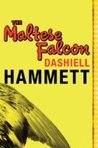
The Maltese FalconThe Maltese Falcon by Dashiell Hammett
Reviewed by Jason Koivu
My rating: 5 of 5 stars

You got nothin' on this book, see?! Yeah! That's right, skedaddle and quick-like!

Private detective Sam Spade smells trouble when this crazy dame walks into his office, and sure enough, his life is soon turned topsy turvy. Spade gets all tangled up in a fishy double murder. The coppers are on him, he's on to the dame and people keep popping outta the woodwork goin' on and on about this g. d. bird! If things keep up like this somebody's gonna get themselves killed dead.

Since its publication, the Spade character has become the ideal from which all other hired sleuths to follow would be molded. He's cool and calculating. He's no angel. No, he's in it for himself, yet only gets what he deserves (often a sock on the jaw) and somehow still comes out smelling like roses. This fantastically tight-wound story is a joy to read, made even more so by a hero who defines the word character.

Hammett's like an Italian tailor who's cut and sewn one of the finest suits you could imagine. It's sleek. It's stylish. You feel like a million bucks in it and you want it to last forever. Hell, with craftsmanship like that, it just might!


View all my reviews

Dashiell Gets His Drink On

The Thin ManThe Thin Man by Dashiell Hammett
Reviewed by Jason Koivu
My rating: 3 of 5 stars

The Thin Man is best read with a drink in hand. Do you have a drink? Do you need a refresher? Would you like another? Above all else, it is important that you be drinking!

Seriously...DRINK!

My god, a lot of alcohol is consumed in this book! It reads as if Ernest Hemingway had taken up crime noir.

Nick Charles, private detective, has hung up his hat. Nora, his wife, kinda wishes he hadn't. She likes wrapping her head around a good mystery. Well, a good one comes along in the form of murder for money, and Charles' old friends are all wrapped up in it.

The plot unfolds essentially in three places: at the Charles', at their friends', and at a speakeasy...each place being as well stocked with liquor as the next. Other than drinking, they don't do much of anything. And they don't really go anywhere, unless it's someplace to drink. They hang around and tie one on while they try to figure out whodunnit.

The writing is solid, the plot feels sound, the characters are a little dramatic (don't get me started on the women...these dames is batty!), but once all that's in motion, the book as a whole feels static. Dashiell Hammett, author of The Maltese Falcon pretty much invented this genre, so perhaps I should lay off. But I'm not always one to treat revered things precious-like...just the stuff that's precious to me.


View all my reviews

Monday, September 22, 2014

Not About a Killer Mailman? What?!

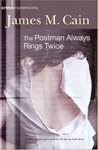
The Postman Always Rings TwiceThe Postman Always Rings Twice by James M. Cain
Reviewed by Jason Koivu
My rating: 5 of 5 stars

Don't you love it when something you've heard about for ages turns out to be really good, but in a delightfully different way than expected? ...What do you mean, "no"? Go to hell!

I've been laboring under the misapprehension that this was a play about a killer mail carrier. Maybe that's because I grew up in a time when the phrase "going postal" was coined. (In a sidebar: Isn't it great how the English language is still evolving to incorporate new words and phrases?!) My mother had just recently joined the ranks of those crazy bastards and as the years progressed her bouts with pms turned our house into the Rumble in the Jungle once a month, so I readily expected her to go fully postal. Anyway, I'm getting sidetracked. It turns out the title is just allegorical!

The Postman Always Rings Twice is a taut noir about a drifter who thinks he's the sharpest knife in the draw. He snatches up a job in one of those highwayside nothings that you can still find out there in the California desert near the Arizona border. The drifter latches on to the wife of the goodly Greek gas station/diner owner. The wife hasn't realized her western dreams. The drifter is always looking for some easy scratch. A plot is hatched and nothing goes as you think it will.

That's the beauty of this aging novel: the surprises it still holds after all these years. After all the pulp crime dramas churned out for decade upon decade now, The Postman Always Ring Twice can still ring yer bell, toots.

View all my reviews

Monday, May 26, 2014

A Classic Noir Novel by Bruce Elliott


Reviewed by James L. Thane
Four out of five stars

This is a classic noir novel, originally published in 1952, that had long been virtually forgotten. Happily, it has been resurrected by the folks at Stark House Press and republished in a new double edition that also contains the excellent Black Wings Has My Angel by Elliott Chaze.

The protagonist is Larry Camonille, who has just led a prison break in which ten cons have escaped from the state pen in Joliet, Illinois. Camonille makes his way to Chicago where his girlfriend is supposed to be waiting with the money that Camonille has entrusted to her. Inevitably, of course, he arrives in the Windy City only to find that both the girlfriend and the money are long gone.

Camonille is not in the best of health and has only one lung. He is determined to make his way to Mexico, where he believes that the weather will be better for his health. But he's broke in Chicago, and one by one, the cons he escaped with are making the mistakes that allow them to be recaptured and sent back to prison.

Camonille is determined to avoid that fate and so robs a dope house to get some traveling money. He loses that fairly quickly to a sadistic railroad detective and finds himself broke again and on the road outside a small town in Ohio. His luck seems to turn for the better when a woman named Vera picks him up in her Cadillac and gives him a ride to a roadhouse outside of town. Vera is a widow who has some miles on her, but she knows the manager of the roadhouse and convinces him to give Camonille a job as a dishwasher.

In the usual fashion of a book like this, Camonille's situation gets trickier as things move along, and before you know it, the plot involves crooked lawyers, bickering spouses and a young teenage girl who is strangely attracted to Camonille, just as is his patroness, the lush and randy Vera. It all makes for a very combustible mix that includes more than a little kinky sex, which is fairly vividly described for 1952. The poor hapless Camonille is determined to escape the lawmen who are still hunting for him and to make his way to Mexico, but all sorts of webs are tightening around him and the odds of his making it don't look good.

All fans of noir fiction should be grateful to Stark House for reprinting this book and it's companion. They are both great reads and true classics of the genre.

Sunday, February 2, 2014

Altered Carbon by Richard K. Morgan


ALTERED CARBON
Richard K. Morgan 
2002

Reviewed by Carol
★   ★   ★   ★   1/2
A fun and fast-paced thrill ride, almost impossible for me to put down. Picture a hard-boiled noir, the solitary, weary worldly detective, blunted emotional skills, stepping on toes as he investigates. Merge that plot and character with innovative science fiction–digitized personalities that can be downloaded into new bodies with the right reasons or enough cash, and the result is eminently readable.
A fast summary for those who are entirely new to the book (and for my poor, over-tasked memory): Takeshi Kovacs, most recently of Harlan’s World, has been killed in his latest caper. Kovac is a man of special skills: after leaving the military, he became an Envoy, an elite member of tactical peace-keeping force. There’s hints that the cumulative trauma of ambiguous morality eventually led him to turning those skills to a life of crime. While his personality is imprisoned in the ‘stacks,’ he is bought and downloaded to a new body on Earth and offered the deal of a lifetime.  Laurens Bancroft, three hundred and fifty year-old mogul, wants Kovacs to find out who killed his prior body. Although the local police have shut the case, calling it a suicide, Bancroft knows his personality is backed-up every two days, and with six clones on standby, suicide is pointless. Bancroft gives Kovacs carte blanche to discover his killer. Before he leaves the estate, Kovacs has a run-in with Mrs. Bancroft, bored and beautiful society wife. The first hint things aren’t on the level is when he checks into his hotel (complete with artificial intelligence) and someone attempts to abduct him. Investigation will take him from deluxe personality storage companies to the slums and brothels of Earth. 
I loved the voice of this book. Morgan achieves classic, sophisticated hard-boiled noir in a futuristic setting. Kovacs’s personality is exceptionally realized, managing to convey a weary and cynical personality who still harbors glimmers of hope and altruism.  His thoughts at his first meeting with Bancroft: The thought of scrolling through hundreds of meters of incoherent vitriol from the lost and losers of this antique world was quite sufficient to uncap my weariness again. A profound lack of interest in Bancroft’s problems washed through me.”
At a meeting with police:
The other one just stared at me the whole time as if he hadn’t eaten red meat recently. I met the stare with a gentle smile. Following the meeting with Bancroft, I had gone back to the [hotel] and slept for almost twenty hours. I was rested, neurachemically alert and feeling a cordial dislike of authority.
The world-building atmosphere excelled, and sense of tension was well-developed: “The walk out of the chart room seemed to take forever, and my footsteps had developed a sudden echo inside my skull. With every step, and with every displayed map that I passed, I felt those ancient eyes on my spine, watching.
As most sci-fiction, interwoven through the mystery is an exploration of what the ability to download into different bodies may mean, from ‘eternal’ life, to societal punishment (jail? death penalty?) to religious redemption (can you be reborn if you never die?) Hidden in the midst of this exploration, Kovacs shares an interesting view of humanity, and the possibility of eternal life. “On Harlan’s World, most people could afford to be resleeved at least once, but the point was that unless you were very rich, you had to live out your full span each time and old age, even with antisen treatment, was a wearying business. Second time around was worse because you knew what to expect. Not many had the stamina to do it more than twice.
 As only the very, very rich can afford the frequent updates, cloning and storage, there’s a tension between the “Meta,” who have lived hundreds of years,  and the “normal” person who is on their first body. Like many cultures, though the police are enforcers of order, they lack economic power, and part of the refusal to investigate Bancroft’s suicide/murder further is a belief in the essential pointlessness of resolution when he’s already downloaded into a new body.  Kovacs, like all good noir detectives, has a complicated relationship with the police he meets, particularly Lieutenant Ortega, chief investigator for the Bancroft case.
Then there’s the politics. I just about cheered half-way through when Kovacs quotes a famous sect leader, right before he unleashes his anger. “The personal, as everyone’s so fucking fond of saying, is political. So if some idiot politician, some power payer tries to execute policies that harm out or those you care about, take it personally. Get angry… Only the little people suffer at the hands of Justice; the creatures of power slide out from under with a wink and a grin. If you want justice, you will have to claw it from them. Make it personal.
The less than perfect score? A couple of ‘meh’ sex scenes, particularly as the violent death of his last lover is supposed to be fresh in his mind. But then again, it was very true to noir tradition. I may revise star opinion on re-read.
The mystery was likely the weakest part of the story, but as with any good mystery, it is thewhy that matters as much as the who. Because of the “why” being a core question, knowing the ending doesn’t spoil the convolutions of the journey, making it highly re-readable. I’m extremely pleased I have a paper copy of my very own, available any time.

cross posted at http://clsiewert.wordpress.com/2014/01/27/altered-carbon-by-richard-k-morgan/

Friday, January 3, 2014

Dead Harvest


Chris F. Holm
Angry Robot
Reviewed by Nancy
3 out of 5 stars


Meet Sam Thornton. He collects souls.


Sam’s job is to collect the souls of the damned, and ensure they are dispatched to the appropriate destination. But when he’s sent to collect the soul of a young woman he believes to be innocent of the horrific crime that’s doomed her to Hell, he says something no Collector has ever said before.

“No.”


My Review


5 stars for the cover and the publisher name!

I’ve been wanting to read an Angry Robot book and my friends’ enthusiastic reviews led me to grab this one from the library.

I just wish I could muster as much enthusiasm for the rest of the book.

I like noir and hard-boiled mysteries, but urban fantasy has been hit or miss for me lately and I’m not sure how I feel about combining the two.

Still, this was a fun, gripping and intense story for 2/3 of the book, at least.

Sam Thornton was once human. Now he is a demon without a body to call his own and has to find living or dead “meat suits” to inhabit in order to perform his job as collector of souls. His latest job is to collect the soul of a young girl who slaughtered her family. Only when Sam finds her, he learns her soul is pure and instead of taking it, he makes it his mission to protect her.

Now that Sam has incurred the wrath of his boss, Lilith, and the angels and demons are about to start a war, he and Kate are on the run.

This book was heavy on the action and dialogue, which made it fun and fast-paced and gave it a very cinematic feel. It was humorous and there were interesting flashbacks about Sam’s past and how he came to be a collector. I could have done without the helicopter hijack and the subway tunnel chases which for some odd reason slowed the pace of the book for me and I ended up setting it aside a couple of days.

While Sam was an interesting character with a distinct personality, I found Kate and the secondary characters rather thin. By the last third, I got tired of the chase scenes and found the plot twists underwhelming.

For a book about a flawed man who is trying to do the right thing, yet is doomed to be a servant of Hell for the rest of his eternal life, I would have liked some thoughtful exploration of Sam’s spiritual conflicts and his feelings about his gradual loss of humanity, particularly in comparison with the other demons.

Not sure I’ll be continuing with the rest of the series.

Also posted at Goodreads

Thursday, January 2, 2014

Not My Cup of Joe

Something More Than Night
by Ian Tregillis
Published by Tor


2 Out of 5 Stars
Reviewed by Amanda 

**I received a free copy of Something More Than Night from Tor in exchange for an honest review.**

A swell angel, Gabriel, takes a powder by way of the big sleep. But what kind of button man has the juice to take down a big player like an archangel? It's not long before heavenly forces put the screws to Bayliss, a two bit angel confined to the dive known as Earth, where he's spent centuries tipping a little rye, smoking pills, and eyeing dishy kittens who know how to fill out a skirt. Heaven wants Bayliss to case the joint and find a mortal palooka he can knock off to fill Gabriel's slot in the universe. Hoping for a mark who won't ing-bing, Bayliss instead ends up with a flametop twist who stirs up all kinds of heavenly trouble. Now Bayliss is behind the eight ball, the immortal bulls want answers, and Bayliss suspects he and this new dame may be the patsys in a universal game of whodunit. Savvy?

Of all the bookshelves, in all the towns, in all the world, this book makes it onto mine.

Something More Than Night is going to appeal to a niche group of readers: hardcore noir aficionados, of whom I am not one. I like my noir like I like my coffee--black. But with sugar and cream and flavoring so it barely resembles coffee anymore. In other words, I like my noir to be not-so-noirish.

Ian Tregillis presents a concept that sounds entertaining, but quickly becomes tedious. Beginning with the death of Gabriel as he flames across the night sky, questions are quickly asked by Bayliss, the only heavenly being who seems interested in getting to the bottom of the angel's murder. Through his investigation and the inclusion of Molly, the mortal Bayliss has bumped off to plug the hole in the universe left by Gabriel's untimely demise, we learn that, in the beginning, there was not light, but angels. Angels free to do and imagine the universe as they pleased until METATRON, the voice of a higher power, clipped the angels' wings by chaining them to the mortal realm. Denied the right to roam the universe as they once did, the angels chafed against their chains but their proximity to one another created the MOC (Mantle of Ontological Consistency) that ensured existence for mortals would continue through the angelic consensus of what reality is.

As Molly comes to terms with her divinity and Bayliss seeks the truth behind Gabriel's murder, Tregillis builds a heaven of quantum physics only tinged by religious philosophy. While I enjoyed his vivid descriptions of the angelic hierarchy and the individual Magisteriums each angel builds as a personal hideaway, his descriptions of the universe veer into physics-based purple prose. Initially, I found this inventive and enjoyed passages such as:

He'd been collecting little odds and ends since at least the double-digit redshifts. The interior reality of Gabriel's Magisterium burbled and shifted like convection currents in a star on the zaftig end of the main sequence. Because, I realized, that's what they were. Dull dim light, from IR to X-ray, oozed past me like the wax in a million-mile lava lamp while carbon, nitrogen, and oxygen nuclei did little do-si-dos about my toes. Every bubble, every sizzle, every new nucleus, every photodissociation tagged something of interest to Gabriel . . . Nuclear reactions unfolded with the calm susurration of solar wind upon Earth's atmosphere, seeding cloud formation and rain. Convective cells furled about me with the low, slow, sonorous peal of cathedral bells mourning a monarch's death. X-rays fizzed on my tongue . . . " (64).


Got physics? Because you'll need it to slog your way through endless passages like this, which, while serving to capture the complexity and immensity of creation, do nothing but slow down the narrative. The combination of unceasing physics jargon with the unending noir slang became too much for me. Add to that the fact that Tregillis's world-building on the Earthly plane is sketchy at best (we get the sense that it is set in a dystopian future, but the futuristic elements seem wedged in and serve no defined purpose) and the novel begins to buckle under too many clever ideas.

The ultimate twist is a letdown as it seems contrived to get the plot out of the corner it had painted itself into. As the reason for the narrative's reliance on the noir genre becomes obvious to the characters, one muses, "But why go to all this trouble? What did it achieve, turning himself into a hard-boiled detective pastiche in an archetypal story" (250).

Why, indeed.

Tuesday, November 12, 2013

The Pyx by John Buell

The Pyx is the story of Elizabeth Lucy, a high-end call girl who dies on the first page. The novel has many flavors: pulp noir, mystery and crime story, character study, tragedy, with some Satanism tossed in to make things even more spicy. The tale is told in alternating perspectives: 'The Present' features soul-deadened detective Henderson searching for clues and 'The Past' features soul-deadened Elizabeth, slowly moving towards her terminal destination but trying to do one last good thing. Her ending is one that she fears but somehow craves as well.
 
The Pyx - John BuellThe language has the brutal beauty of the best of pulp crime fiction. Hard-boiled and poetic in equal amounts, full of terse dialogue, barely understood longings, bleakly sardonic commentary on the smallness of lives, bottomless despair and monstrous cruelty conveyed in brief and ambiguous turns of phrase, paragraphs that describe the living breathing bustling world that suddenly end with an off-hand sentence describing bloodstains on a sidewalk. It is a beautiful novel and Elizabeth Lucy is one of the more memorable examples of the hardened prostitute with a heart of gold that I've read. The book is the same: deeply cynical and angrily pessimistic but allowing many characters - Elizabeth, Henderson, a sensitively rendered gay friend, a mourning father, an alcoholic priest, and several others - to show their souls in ways that are genuinely moving. The Pyx is a surprisingly soulful book, and I loved it for that.
 
It has a very an off-putting final chapter that reveals the mystery of the pyx and the motivations of the primary villain. It appears to be written by another person entirely - "Daniel Mannix" - but I don't know if that is true or not. The style is certainly different than anything that came before, so I'm inclined to believe it. The ending reminded me a lot of the ending of the film Psycho: that smarmy psychologist, attempting to render all of the strangeness and ambiguity that have come before his scene into something that is logical, even prosaic, an uncomfortable but still easily digestible set of formulaic motivations. And as with Psycho, the memory of all the strange ambiguity that came before renders The Pyx's final chapter as nothing more than a footnote. Or perhaps even just a wink to the reader, much as Hitchcock was winking to Psycho's audience. Sure, things can be explained, things that are horrible or beautiful or full of pathos or just unnervingly and threateningly weird. But can you ever truly explain away such things? And why would you want to? They defy explanation.


Worther or Mrs. Latimer would want the body, but alive, alive to peddle it, to feed it heroin, to dress it up, to make it entertain lechers who had nothing but money and erotic energy, to make it stop belonging to a human being, to make it wind up here with a long jump, or a long push.


She felt, not cut off, but far away from what was happening, the people existed just like a radio you've forgotten was on, and her walking was motion that she wanted to stop soon.


She said very quietly, "Coffee, please," and sat down at a table. A while ago, perhaps years, she would have noticed his action and smiled, enjoying the effect she had. She might even be pleased a little. But now, she couldn't be pleased or flattered by her beauty; it wasn't part of her consciousness; it was just a fact, a thing that was part of her life, something others thought she was lucky enough to have, something others wanted. She had no mental picture of herself as an outwardly visible person; she had only an inner vision of...

"Here's your coffee, miss."


Friday, October 4, 2013

Paris Noir


Aurélien Masson, Editor
Akashic Books
Reviewed by: Nancy
4 out of 5 stars

Summary

Paris Noir takes you on a ride through the old medieval center of town with its winding streets, its ghosts, and its secrets buried in history. This is more than an homage to the crime genre, to Melville and Godard, it’s also a lush introduction to the very best in French fiction.

Brand-new stories from: Marc Villard, Didier Daeninckx, Jean-Bernard Pouy, Salim Bachi, Christophe Mercier, Jerome Leroy, DOA, Laurent Martin, Herve Prudon, Patrick Pecherot, Dominique Mainard, and Chantal Pelletier.

My Review

Paris is a wonderful place to visit. I love the city for its grandeur, its palaces, museums, monuments, breathtaking views, restaurants, cafes, its rich culture and history. It is a dynamic, international and happening place. Being a tourist, however, is not the same as living, working, raising a family, and making friends in another country. “The City of Light” has a dark underbelly, particularly for those who do not speak French well and have difficulty assimilating into a new culture, those who are poor, or those not in the best of health. If you are young, healthy, strong, flexible, and financially sound, you can probably survive most anywhere.

Unlike Delhi Noir, the stories in this collection were all translated from the French language. I wish I had better knowledge of foreign languages, but in the meantime I am thankful for those translators who enable me to read and enjoy a wider variety of literature.

Even though I’ve visited Paris a number of times, the stories in this collection show the city and its inhabitants in an entirely different light.

It was a fun and worthwhile trip!

Here are the standouts in this collection:

Marc Villard’s The Chauffeur - Bad people get what’s coming to them, and the hooker stays alive. Gritty and sweet.

Chantal Pelletier’s The Chinese Guy - Beautiful descriptions of spring, flowers and food from the perspective of a mentally disturbed woman who becomes obsessed with a Chinese guy. One of my favorites.

Salim Bachi’s Big Brother - Highlights the lives and struggles of Algerians who live in Paris and how darkness and violence inhabits the soul of one man who feels unjustly treated by society.

Jean-Bernard Pouy’s The Revenge of the Waiters not only has a great title, it is a sad and humorous story that vividly portrays the lives of average working people and the inhabitants of old buildings about to be knocked down. A group of waiters are very concerned about an old jogger who seems to have gone missing and are determined to find him.

Dominique Mainard’s La Vie en Rose is a sad and gripping story about an aspiring author who wants to write a crime novel, but needs help understanding what could drive a murderer to kill. With help from his journalist friend, he gathers information about a brutal murder of a young girl and interviews an old man who may or may not know something about the crime.

Though the stories varied in quality, they were all enjoyable and entertaining.
Also posted at Goodreads.

Friday, September 27, 2013

Delhi Noir


Hirsh Sawhney, Editor
Akashic Books
Reviewed by: Nancy
4 out of 5 stars

Summary


Brand new stories by: Irwin Allan Sealy, Omair Ahmad, Radhika Jha, Ruchir Joshi, Nalinaksha Bhattacharya, Meera Nair, Siddharth Chowdhury, Mohan Sikka, Palash K. Mehrotra, Hartosh Singh Bal, Hirsh Sawhney, Tabish Khair, Uday Prakash, and Manjula Padmanabhan.

The eyes of the world are gazing at India—the world’s largest democracy. But the books you read about this Asian giant only show part of the picture.

Delhi Noir’s fourteen original stories are written by the best Indian writers alive today—the ones you haven’t yet heard of but should have. They are veteran authors who have appeared on the Booker Prize short list and budding geniuses who your grandchildren will read about in English class. Delhi Noir is a world of sex in parks, male prostitution, and vigilante rickshaw drivers. It is one plagued by religious riots, soulless corporate dons, and murderous servants. This is India uncut, the one you’re missing out on because mainstream publishing houses and glossy magazines can’t stomach it. offers bone-chilling, mesmerizing takes on the country’s chaotic capital, a city where opulence and poverty are constantly clashing, where old-world values and the information age wage a constant battle.

My Review


Once again, I have sought out another book from the Akashic series of short stories that takes place in a variety of cities around the world. I am still in the mood for dark, short stories, so Delhi Noir was the perfect choice.

I have never been to India, and based on this collection of stories, I'm not sure if I want to go. It is chaotic, crowded, loud, corrupt, poor and dirty. There is also amazing architecture, natural beauty and good food, even the cheap stuff you get at the roadside stalls. I'm very glad for my literary journey to Delhi. The stories were vivid enough to give me a glimpse into a culture very different from my own, even if they show humanity at its worst.

I'm a little disappointed that out of the 14 contributors, only 3 of them are women. Nevertheless, their stories are outstanding.

Manjula Padmanabhan's Cull is the very last story and one of my favorites in this collection. More speculative fiction than noir, it is very dark and would make an excellent novel. It shows the callous disregard people in power have for the poor residents of the Acres and it shows how strong and resourceful the poor can be.

"From the bottom of the pit, all roads lead up. So in one sense, this is an extremely positive place to be. Rich people throw away things at such a rate that for us, living in the dump, we only have to wait long enough before whatever we want comes sailing out of the sky - for free! Cars, food, books, furniture, machinery, medicine, bottles toys - you wouldn't believe how much gets thrown away. And very often in its original packing. So we're not complaining. We take what we need, repackage the rest, and send it back out."


Radhika Jha's very humorous How I Lost My Clothes effectively highlights the contrasts between the rich and the poor of Delhi and shows how a new set of clothes can change one druggie's perspective on life.

Meera Nair's Small Fry shows a glimpse of the harsh life of a 15-year-old street boy as he looks for a fast way to make some money. Crime, corruption and greed make this one a top-notch story.

And now the men:

Omair Ahmad's Yesterday's Man was not one of my favorites in this collection, but I did enjoy the detectives working together to solve a case involving the 1984 mass murder of Sikhs, an event I have little knowledge of, but plan to explore further.

Irwin Allan Sealy's Last In, First Out, told from the perspective of a rickshaw driver, very vividly describes the city of Delhi and some of its beautiful and more secluded spots, where young lovers like to retreat. Unfortunately, sexual assaults are rampant here and the rickshaw driver decides to take matters into his own hands.

Ruchir Joshi's Parking is probably my least favorite in this collection. The corrupt, perverted cops annoyed me and I couldn't care about a single character.

Nalinaksha Bhattacharya's Hissing Cobras features another corrupt police officer who wants to charge a woman with a crime he has no proof she committed, so he blackmails her. He picked the wrong woman to mess with. I loved this gritty and satisfying story.

Mohan Sikka's The Railway Aunty is not about someone's aunt. This term is used to refer to older female family friends or neighbors. A heady mix of greed and lust. Terrific story.

Siddharth Chowdhury's Hostel was utterly creepy and voyeuristic. I don't mean that in a good way.

Palash Krishna Mehrotra's Fit of Rage shows the effects of unrestrained male anger. Very disturbing, but well-written and compelling.

Hartosh Singh Bal's Just Another Death is an interesting story about a reporter trying to survive in a changing industry. Death is secondary.

Tabish Khair's The Scam. A shoe-shine boy and woman engage the curiosity of two journalists.

Hirsh Sawhney's Gautam Under a Tree is a sad and moving story about a former journalist who accepts an assignment to write about the murder of his friend who was a political activist. This is a dangerous undertaking, as he well knows.

Uday Prakash's The Walls of Delhi is another favorite of mine. Ramnivas the sweeper comes across stacks of money hidden in a wall where he's cleaning. He uses this money to provide a better life for his family and entertain his mistress. Of course, there are consequences to making it big the easy way.

A worthy collection. Up next, Paris!
Also posted at Goodreads.

Friday, July 26, 2013

Bronx Noir


S.J. Rozan, Editor 
Reviewed by: Nancy
4 out of 5 stars

Summary


Brand-new stories by: Thomas Adcock, Kevin Baker, Thomas Bentil, Lawrence Block, Jerome Charyn, Suzanne Chazin, Terrence Cheng, Ed Dee, Joanne Dobson, Robert Hughes, Marlon James, Sandra Kitt, Rita Laken, Miles Marshall Lewis, Pat Picciarelli, Abraham Rodriguez Jr., S.J. Rozan, Steven Torres, and Joe Wallace.


My Review


After reading Kemper's review of Kansas City Noir, I was intrigued by this series of books featuring stories that take place in different cities in the US. After exploring the Akashic Books site, I learned that there are quite a few interesting international locations too. So I decided to start with the Bronx, since that was where I spent much of my childhood, and I figured this would be a great opportunity to visit the city without actually having to drive there.
 

When I borrowed the book from the library and scanned the pages, the first thing I did was look at the author photos in the back and read their bios. Some are well-known writers, others not so much. I was thrilled at the diversity of the authors, much like the city I grew up in.  

The Bronx doesn’t disappoint. It is as grimy, unforgiving, noisy and rough as I remember it. The 70’s and 80’s were a particularly bad time to be there, with all the crime, poverty, graffiti, and burnt-out buildings. I’m really hoping the city has changed for the better and will find out this weekend when I visit my uncle in Riverdale. Somehow I can’t imagine that Mott Haven or Hunts Point have become desirable places to live; maybe in another 30 or 40 years. 

The stories were suitably bleak and moody, just as I would expect from a noir collection. There were some really terrific stories here. Others were rather forgettable. One of the standouts in this collection was Terrence Cheng’s Gold Mountain, about a Chinese delivery guy and the professor who gives him a good tip. It’s very dark, full of lonely, sad, desperate people looking for a better life. Having only known a few Chinese people when I was living in the Bronx, I appreciated this story told from a Chinese perspective. Think twice before letting someone deliver your supper. 

Kevin Baker’s Three Cheers Like Waves made me glad I never lived near Yankee Stadium. It was bad enough seeing and hearing the rumbling graffiti-covered trains while I was standing out on the fire escape of the 5-story red brick walk-up on Walton Avenue I called home. This is a story about young love gone wrong and loud baseball games that cover up a multitude of sins.  

S. J. Rozan’s Hothouse takes place at the Botanical Garden during freezing cold and blizzard conditions. The fragile lives of humans and plants are put to the test. This made me sad…and cold…and sympathetic to the bad guy. One of my favorites in this collection.  

R.J. Hughes A Visit to St. Nick’s reminded me of the church I used to go to with my friend and the white-haired Irish priest who’d give us each a little sip of Manischewitz wine after mass. This is about family relationships, friendship, the mysticism of the Catholic Church, boys who find creative places to store their stash, and the girls who know their dirty secrets.  

Patrick W. Picciarelli’s The Prince of Arthur Avenue was a most unusual gangster story.  

All in all, a very worthy collection of stories that brought back a lot of memories of my childhood in the Bronx. I’ve always wanted to visit Alaska and wonder if there are any noir stories set in Fairbanks.

 Also posted at Goodreads.