Wednesday, April 17, 2013

Up Jumped the Devil

The Death of Bunny Munro
Nick Cave
Faber and Faber, 2009
Anthony Vacca's rating: 4 out of 5 stars

I am conflicted. On one hand, Nick Cave is one of my top ten favorite musicians. For over thirty years he has consistently made some of the best emotionally and physically visceral music ever to come tearing, and sometimes aching, its way of the electric shiver of a set of speakers. The man can sing about capital letter Love in a way that will turn any person equipped with something resembling a heart into a believer; but he can also thrash and foam like a maniac about the erotic bliss of banal and lowercased murder. Age has not tempered the man. He can do the arena rock (There She Goes My Beautiful World), and then turn around and throw a dirty old man punk rock boogie your way (No Pussy Blues), and then stick his tongue firmly in cheek and strut his way through a playful poke and prod at a bible story favorite (Dig Lazarus, Dig). What I am saying here is that the man is versatile, confident, and staggeringly literate in his ability to craft a hell of a song. The same is true in every way about Nick Cave’s approach to writing a novel.

And here comes the conflict: as much as I love Nick Cave’s music, having finished reading this, his second novel (twenty years later after And the Ass Saw the Angel I am left wondering how many wonderful novels we could have had from the man if his calling had been that of a novelist first instead of a musician. Because, yeah, The Death of Bunny Munro is a wonderful book. It’s disturbing, tender, articulate, funny, monstrous, profane, humane, and everything else I could ever ask for from a single book.

Bunny Munro (could this be a respectful nod to the then recently departed John Updike and his own great creation of Harry "Rabbit" Angstrom?) is damned. We know this from the first sentence on. And we also know, even if Bunny’s own self-awareness fails him on about all fronts imaginable, that there is no one to blame for Bunny’s fate except himself. His problem is not that he is married to a long-suffering, and emotionally-disturbed wife or that he has a precocious and loyal little son charmingly named Bunny Jr.; Bunny’s problem is that he can’t stop trying to fuck anything with a vagina even if it is at the expense of everything he should hold dear.

I saw the film Shame last year, which was a powerful rumination on sexual addiction and what exactly it means to be a human being that interacts and forms relationships with others, and let me tell you this: I like sex as much as the next sane, non-repressed person, but living a life resembling anything like the shit that Michael Fassbender’s character from the aforementioned flick or that Bunny Munro goes through…well, there’s a reason why I just used the word shit.

Bunny will gladly tell you that his favorite thing in the whole wide world is a woman’s vagina: any and all vaginas. He wants to be inside them all. This is why in the first chapter of the book we find Bunny sitting in a sleazy motel room with a black hooker while he tries to talk his wife down out of a panic attack on the phone. She wants her husband to come home, but Bunny tells her he can’t because he is still out on the road selling his company’s beauty products from door to door. This is what we call a lie, because Bunny is only a few miles away from his home where his wife gets calls about Bunny’s dying father and there’s the sound of a thousand birds fleeing a burning peer right outside her window that’s driving her insane. Bunny promises his wife he will be home early in the morning, but it is late in the afternoon by the time he finally does; after he fucks a random waitress, of course.

This is the kind of man Bunny Munro is.

After a series of misfortunate events, the novel really gets rollicking when we find Bunny back on the road once more, selling his cosmetic wares all over Brighton (that’s in England) with little Bunny Jr. in tow. If I had to describe the plot of this novel then I would have to say here that it is a road-trip novel about fathers and sons. But that makes it sound so pedestrian and there is nothing ever somewhat resembling that word when it comes to something Nick Cave has created.

For one, Nick Cave weaves an encroaching apocalyptic funk throughout the novel by constantly reminding Bunny and the reader of a maniac who is terrorizing public spaces, his body painted red and horns jutting out of his skull. This is far from being just a prank because the bodies of women are starting to turn up, their bodies ripped to pieces by a pitchfork. No matter where Bunny goes he can’t escape seeing news coverage of the madman on TVs and in newspapers. He does his best to ignore the news story and the sense of dread it is welling up inside him, but he can’t help but notice that the killings are getting closer and closer to Brighton. And Bunny knows that the killings are coming home to him.

Also, Bunny is fairly certain that a ghost is haunting his every movement.

But it is hard to feel too sorry for Bunny, because he is constantly at his worst behavior. As he and Bunny Jr. drive around all day, spending nights at cheap motels and having every meal in fast food joints just as ubiquitous, we see just exactly how shitty a dad the man is. He leaves his kid in the car for hours while he goes to visit the homes of women whose names are on his list of interested customers, and when he is not trying to hawk his ridiculous sounding creams and ointments, he is seeing if maybe he can talk whatever women is in front of him into a quick screw. Because this is how Bunny sees women (and I do mean any and all women): they are vaginas with some immediate potential to be entered. It does not matter how old or unattractive a woman is, when Bunny sees them he is immediately thinking of them in terms of fucking. This does make for a lot linguistic feats on the part of the author, as he thinks up another colorful expression or play on words to talk about Bunny and his nearly constant erection.

In fact, it is the humor that saves this book from being utterly harrowing (and it is plenty enough harrowing, still). Cave does a similar trick like Martin Amis, in that, he is constantly placing Bunny in absurd and humiliating situations that the character completely deserves. One of the funniest running gags in this book (and one which Cave apologizes for in the afterward of the novel) is Bunny’s obsession with the singer Avril Lavigne. Cave sums it up nicely in this sentence right here: "Bunny is almost positive that Avril Lavigne possesses the fucking Valhalla of all vaginas." So if you can’t find humor in a dirty, middle-aged man beating off to this ridiculous notion of Avril Lavigne as the end-all be all sex object, then this book might not be for you.

Don’t think this book is all grotesquery and gallows humor, because Cave is also melancholy and generous in his portrayal of Bunny Jr. When Cave writes about how Bunny Jr. loves his father for no reason greater than the fact that Bunny <i>is</i> his father, the prose makes you ache. If anything, Bunny Jr. is the collateral damage throughout this whole story. We watch as he tries to understand exactly who this man is that is supposed to be his father. The boy is smart—he spends his time cooped in the car reading through an encyclopedia—but is too young to realize that he is or find comfort in the fact. What Bunny Jr. wants is for his father to love him back and be proud of having him as his son. Unfortunately for Bunny Jr., his father is a cad.

A quick post script: For the five-star experience, get a copy of this book on audiobook. Nick Cave reads the novel himself, and there is nothing like hearing Cave’s exact and lyrical way of speaking, as he keeps the story moving at a rapt pace. Plus, the audiobook features an original score of music composed by Nick and Warren Ellis of the Bad Seeds (Nick Cave’s backing band). The score divides each chapter as well popping up every now and then at moments in the text where the music adds a surreal urgency to the events at hand. There’s also neat sound effects placed throughout the reading, so that when Bunny walks into a room with a flickering light there is also that all too distinct sound for us to hear right along with him. It all adds up to make a unique and unforgettable experience.

Also posted on GoodReads

Tuesday, April 16, 2013

K.W. Jeter


Who is K.W. Jeter? I’m four books into this author’s oeuvre and I’m still not sure I have a grasp on what a “novel by K.W. Jeter” is going to be about or how it is going to feel or how it will connect stylistically or thematically with his other novels. And you know what? That is not a bad feeling. It is actually a rather thrilling feeling.

Here’s what I know. His first published book was Seeklight (1975). He coined the term “Steampunk” for his novels Morlock Night (1979) and Infernal Devices (1987). He wrote what was arguably the first Cyberpunk novel, Dr. Adder (1984 – although written many years prior to its publication date). He has also written various sequels to Star Wars, Blade Runner, and Star Trek: Deep Space Nine. My jury is still out on that last factoid; I’ll put a pin in it and think about it later. He is perhaps most at ease when detailing squalid, blighted, unpleasantly hallucinatory urban landscapes. And according to my best friend Wikipedia, Jeter is known for his “literary writing style, dark themes, and paranoid, unsympathetic characters”.

KWJeter-SanFrancisco-2011.jpgHe’s a happy combination of an interior writer concerned with the psychological clockwork of his strikingly cipher-like main characters and an exterior writer who knows how to craft a propulsive narrative, build tension, and deliver exciting action set pieces. He is one of those authors who seems positively disinterested in delivering characters that the reader can like, love, admire, or even empathize with as a fellow human. That disinterest creates a certain remove, a distance between reader and narrative that can feel alienating. In a good way? Well I suppose it depends on the reader. It certainly gave me the space to contemplate what exactly was going on beneath his novels’ dark surfaces.

The man knows how to write! Wikipedia pegged his writing style as “literary” and although I agree, I fear that may give a person the wrong impression of his style. He is not a wordy or verbose writer; far from it – his style is sinuous and hypnotic and, perhaps key to seeing him as a kind of jack-of-all-trades, he adjusts it to fit the topic on hand. His psychological thriller Dark Seeker combines kitchen sink realism with murky, hallucinatory dread. His cyberpunk classic Dr. Adder is all about harsh, brutal, snarky spikiness. Seeklight feels like a tense and often inexplicable fever dream. And in the wonderfully entertaining and comic Infernal Devices he manages to juggle plush, pitch-perfect Victorian language with moments of bizarrely anachronistic ‘modern’ dialogue spilling out of the mouths of a couple mysterious characters. I may have issues with some of his novels but I have no issue whatsoever with his skill and expertise at crafting quality prose and challenging narratives. Jeter’s cup runneth over with pure talent.

So perhaps there is a connecting factor between the four novels I’ve read… namely, those cipher-like main characters. When I think of his “protagonists” (and the quotes are definitely there for a reason), I get the feeling of there is no there there. Dr. Adder’s blank and sleazily ambitious young entrepreneur, Seeklight’s mild and vaguely tabula rasa boy-on-the-run, Infernal Devices’s blandly hollow and prim Victorian everyman, Dark Seeker’s drug-addled victim and former predator-who-wants-to-forget-the-past… each one is not just alienated from the world around them, they are alienated from themselves, from what makes them function and move forward, from what makes them who they are. Posing the question Who are you?  to any of these characters would probably get you a big question mark in return. They don’t know and often the reader doesn’t end up knowing either.  Each of them is a distinctly unsettling blank canvas, but one that I would hesitate to paint upon, let alone project any specifically human motivations or emotions. That canvas is better blank; it is meant to be an empty space; it is meant to trouble you. Perhaps it is covering something up that is better left unseen.

Following are some synopses and a few comments about the novels I’ve read so far.

***

SEEKLIGHT

Seeklight (Laser Books)Science fiction pulp or sweaty nightmare made real? You be the judge! Seeklight is about the son of a so-called traitor, his flight across a curiously lifeless colony full of curiously lifeless humans, his slow movement into understanding of his purpose and his powers. It has clones and fake angels and screamingly murderous robots. It has a low-key and downbeat style. It has a female character who in any other novel would be a romantic interest, but in this one is just as mindlessly, frustratingly, monomaniacally small-minded as every other character. It has a kind of theme: HUMANS ARE FUCKING MISERABLE BUGS. They are not worth the effort of saving them.

Jeter is not interested in making you happy and he is not interested in letting you understand the ins & outs of the human condition. He wants you to know about entropy, about the inherent piggishness of human nature, about quests that go nowhere, and answers that deliver questions that have no answer. He wants you to understand there is actually no hope. I hate that message and I didn’t particularly like this book. But I also really respected it, its choices and its insularity and its bleak and rather pure logic. Color me impressed! Alienated and saddened, but impressed.

***

DR. ADDER

Tohtori KyyE Allen Limmit is a disaffected young man, fresh off the giant-mutated-chicken farm, once a soldier and later the manager of the farm's mutated-chicken-whore brothel. A somewhat bland and often irritable lad with vague ambitions to be somebody, do something, whatever, just getting the hell off of the farm. Limmit travels to "The Interface" - a terminally seedy street that functions as a meeting place for the degraded, drugged-up, fuck-happy denizens of the counties Los Angeles and Orange. And he has brought a terrifyingly effective death-weapon with him - an instant-massacre machine. Woot! Guess who gets caught between a rock and a hard place.

The novel has admirable chutzpah when it comes to the sheer imagintion on display - the seedy 'Rattown' of L.A., the sewers beneath it, the mind-numbing & hypocritical lifestyle of O.C., the casually bizarre chicken farm, various vividly characterized cast members, a tremendous dream-battle, gruesome & revolting sexuality, a bloodbath on the Interface, even an extraterrestrial Visitor... all quite strikingly stylized, all of these things practically popping off of the page.

As I mentioned earlier, it is perhaps the first cyberpunk novel, being completed in 1972. It certainly has that grim, tarnished, dirty urban feeling that is key to the subgenre. It has the nonchalant violence and misanthropy, the cynicism, the snark. Its narrative includes violent corporate interests, casual murder & slaughter, bad-trip imagery, and a strange kind of psychic pre-internet that exists somewhere in between the mind and the electromagnetic static of radio waves & television transmissions. It is certainly a distinctive book: angrily snappy, grimly jokey, gleefully vindictive. An adventure and an excoriation.

***

DARK SEEKER

L'ospitePoor Mike Tyler has a problematic past: once a part of a group of pretentious college kids devoted to a pretentious professor slash guru slash svengali, these kids and their prof decided to take it to the next level by regular ingestion of the highly illegal drug The Host - which apparently induces both hallucinatory effects and shared empathic group connection. The Host is 24/7 and it also features visions of a pointy-teethed lil' guy who wants you to kill kill kill. Its hallucinogenic qualities make participants want to tear limbs from bodies, bathe in blood and laugh like hyenas. Unfortunately for Mike, not only does The Host stay in your system permanently, but now a member of the group has come out of the woodwork to recruit Mike back in. Will more zany slaughter hijinks ensue?

Kids, just say no to drugs!

Jeter's individualistic vision encompasses the Los Angeles landscape of freeways and strip malls, a grim and sour misanthropy, the need for his characters to escape from various dark pasts, and a fairly expert use of parallel narratives that comment on each other in intriguing ways. And - surprise, surprise - this novel also demonstrates an ability to write compassionately about well-meaning and empathetic supporting characters. Okay, well, two supporting characters. The rest are miserable bugs. And the protagonist... an eerie, unnerving cipher. Of course. Jeter's gotta be Jeter.

***

INFERNAL DEVICES

Infernal DevicesSteampunk, ahoy! This is a retro-chic thriller full of tricky clockwork mechanisms, foggy nights and cobblestones, demented aristocrats and dodgy lower class types, inhuman creatures from the sea and their barely human half-breed spawn, creepy flights into darkness and sudden escapes, two brassy mercenaries who are strangely familiar with 20th century slang, and an automaton who comes equipped with all of the wit, intelligence, and sexual drive that his original human model - our strangely bland hero - appears to lack.

The writing is luscious and rather gleefully sardonic. It winks at you while delivering its narrative thrills in a delightfully vivid, semi-archaic purple prose package. And hey, it almost feels like Jeter is even sending up his own traditionally enigmatic heroes. The key to the mysteries swirling around the oddly placid protagonist is his very stolidity. That blankness is actually the answer to the mysteries behind Infernal Devices' central conundrums and contraptions. Clever! And the climax is a literal climax. Ha!

A Song of Ice and Fire: George R.R. Martin's Never-Ending Story

As I pack my bags and settle my affairs before I embark on my journey to my new home, the tent city on George R.R. Martin's front lawn, I think back to how it all began... 

I swore it would never happen to me. I was bound and determined not to read the Song of Ice and Fire for a variety of reasons.

  1. I am not a huge fan of today's fantasy novels, never-ending doorstop fantasy series in particular.
  2. The series is not yet finished and I don't want to be Dark Towered into waiting years between books or having Martin pull a Robert Jordan and die without completing it.
  3. Hype. Anytime someone tells me I have to read something, I almost always dig my feet in and resist. One of these days, I'll stop being stubborn when people recommend me books. Sure, most of them read probably 20% as much as I read in a year but there are reasons why certain books sell thousands and thousands of copies.
So after my girlfriend and I blazed through the first season of Game of Thrones in a weekend, I figured it was time to cave in and give it a try. My fears were unfounded. The Game of Thrones took over my life while I was reading it. Even after watching the first season of the TV series, I couldn't be bothered with things like cleaning house and eating properly. I was captivated by the tale of the Lannisters, the Starks, the Targaryens, and the rest.


  A Game of Thrones (A Song of Ice and Fire, #1)A Game of Thrones by George R.R. Martin
My rating: 5 of 5 stars

When the King comes to Winterfell, Ned Stark soon finds himself given the post of Hand to the King by King Robert. All is not well in Winterfell, however. Stark's son is gravely injured and signs point to the King's wife's family, the Lannisters. Stark will soon find out that when you play the Game of Thrones, you either win or die...

Okay, so it's way more complicated than that but it's hard to write a teaser for an 800+ page kitten squisher like this.

I read an interview with George R.R. Martin where he mentioned liking historical fiction but hating knowing the ending before he started. Game of Thrones feels way more like historical fiction than it does fantasy. While there are magical elements, they don't dominate the story. The story is the battle for the throne of the seven kingdoms and intrigue behind the scenes by various factions. It feels way more like Pillars of the Earth than it does epic fantasy.

For me, the main strengths of the Game of Thrones are the characters and GRRM's willingness to do horrible things to them. While fantasy is usually about good vs. evil, nothing is so black and white in the Game of Thrones. King Robert is a man with a drinking and whoring problem. Ned Stark fathered a child out of wedlock. The Lannisters are a bunch of well-meaning scumbags. Jon Snow looks down upon his companions because of his noble upbringing.

As for GRRM's willingness to do horrible things to his characters? Don't get too attached to anyone. There were several shocking deaths in Game of Thrones and I'm told it gets worse from here on out. I can't wait for someone to settle Joffrey Lannister's hash!

For me, one of the marks of a good book is if it makes me want to rush out and write something similar. It happened with the Dark Tower, Fafhrd and the Gray Mouser, Elric, Hyperion, Amber, and now this. Speaking of Amber, Martin thanks Roger Zelazny in the acknowledgments. I already knew he and Zelazny were close. Now I'm wondering if the machinations in Game of Thrones were in any way inspired by the ones of the family in Amber.

Differences between the book and the first season of the show are pretty minor. One thing that really stood out was that a lot of the characters were younger in the book. Also, there weren't so many women being taken roughly from behind in Martin's text. Other than that, it was mostly chronology and a few minor scenes that were missing.

That's about all I can say since I don't want to give too much away. This book is a monstrous tome but it didn't feel like it. There's always something going on and everyone better watch their backs. After all, Winter is Coming...

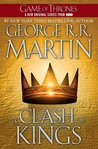
A Clash of Kings (A Song of Ice and Fire, #2)A Clash of Kings by George R.R. Martin
My rating: 5 of 5 stars

In the wake of King Robert's death, four men lay claim to his crown. The Mother of Dragons builds her khalazar as magic slowly returns to the world. Jon Snow braves the wilds beyond the Wall. Tyrion Lannister struggles to hold the power behind the Throne. And Winterfell harbors a viper in its midst...

Like I said before, it's hard to write a teaser for a book this size. Look at it! You could club a narwhal to death with it if you were so inclined.

The epic of The Song of Ice and Fire continues to unfold in the second volume. Robb Stark, the King in the North, continues his campaign to avenge his father and take the Iron Throne. His sister Sansa remains in King's Landing, still betrothed to the vile Joffrey. Arya, well, she has quite a bit going on. Jon Snow continues being my favorite character as he ventures beyond the wall, probably marking him for death sometime soon. I'm wondering if the Starks will ever be reunited.

In non-Stark news, Tyrion Lannister continues being the best character in the series and pulls the strings behind the scenes. The conflict between Robert's brothers Stannis and Renly came to a head much earlier than I thought. Jaime Lannister is still in the clink and I'm hoping he and Robb Stark get more screen time in the next book. And Theon! What a colossal douche! Cercei Lannister has a lot more facets to her character than I originally thought.

Much like the last book, most of the action happens near the end. I love the constant intrigue behind the scenes. The battle of Blackwater Bay was my favorite battle in the series so far.

Since I read this without seeing season 2 of Game of Thrones, I'm looking forward to the following events being depicted on the show:
1. Jon Snow beyond the Wall
2. Tyrion's dialog with Cercei early on
3. the battle of Blackwater

That's about all I have to say. I liked Clash of Kings almost as much as the first book.
A Storm of Swords (A Song of Ice and Fire, #3)A Storm of Swords by George R.R. Martin
My rating: 5 of 5 stars

Three kings contend for the throne and King Joffrey's wedding day grows near. Can he hold the throne with Robb Stark and Stannis Baratheon nipping at his heels?

Yeah, that's a woefully inadequate summary but it's not laden with spoilers, either.

The third installment of Weddings, Beddings, and Beheadings is my favorite one so far. Martin outdid himself this time.

First of all, there were quite a few deaths in this one. I wasn't expecting Robb Stark to go out like that. Tywin and Joffrey more than had it coming, however. The Red Wedding was pretty surprising, as was the trial by combat for Tyrion's fate. Speaking of Tyrion, his wedding to Sansa was also quite unexpected. I'm still not sure where things are going with Davos Seaworth but I'm already itching to find out.

Jon Snow continued to be my favorite character, from his stint with the wildlings to his defense of the Wall to his imprisonment and eventual election to commander of the Night's Watch. The prospect of Snow becoming Lord of Winterfell is an intriguing one and I'm anxious to see how it unfolds.

Another plotline I'm particularly enjoying is that of Arya and the Hound. The Hound could easily be a scene-chewing villain but is a surprisingly deep character. Arya is shockingly bad ass for a preteen.

One character I'm surprised I've grown to like is Jaime Lannister. He's an arrogant unapologetic bastard and I love him for it. I'd read a whole book of Jaime's exploits.

Also, how about Petyr Baelish? What a bastard!

I'm giving this five stars with an exclamation point next to it.

A Feast for Crows (A Song of Ice and Fire, #4)A Feast for Crows by George R.R. Martin
My rating: 4 of 5 stars

The throne of the Iron Isles is contested. Queen Cercei conspires to keep King Tommen's young queen from influencing him. Jaime Lannister adjusts to having only one hand. Sam Tarly and Gilly head south. Brienne quests for the missing Stark daughters. Littlefinger holds the Vale. A lot of stuff happens in Dorne. Arya Stark continues being one of the more interesting characters in fantasy...

After a years-long void, the Song of Ice and Fire returns. Well, they can't all be home runs. Sometimes you have to settle for a triple.

Aside from the lack of Jon Snow, Dany and the dragons, and one Tyrion Lannister, I enjoyed A Feast for Crows as much as the previous volumes. At this point, Jaime Lannister is hot on the heels of Arya, Jon Snow, and Tyrion as my favorite character. I could read a few hundred pages of Jaime Lannister walking around being an asshole. Sam got some time to shine and I think he'll do big things before the series is over. I love what's going on with Arya. I still don't care about Sansa or Catelyn Stark.

The bits with the Iron Isles and Dorne got a little wearisome, feeling like Martin might have wanted to keep the biscuit wheels on his gravy train for a little while longer. Still, I liked where things went despite not involving any of my favorite characters.

It's a testament to Martin's skill that he has made me care about the Lannister twins, first Jaime and now Cercei. I'm chomping at the bit to find out Cercei's fate and to see if Brienne is really dead.

On a final note, there were way too many characters whose names started with the letter E in the same chapter. Mix it up a little, George.

Four stars, although I'd probably give it a high three if I'd been one of the people who had to wait years between books.

A Dance With Dragons (A Song of Ice and Fire, #5)A Dance With Dragons by George R.R. Martin
My rating: 4 of 5 stars

Stannis Baratheon marches on Winterfell from the Wall. Daenerys's empire is threatened from within. Tyrion finds himself enslaved. Cercei finds herself in chains. The Crow's Eye desires Daenerys for his own but so do several other would-be suitors. And Jon Snow faces dissent from his brothers of the Watch...

In the latest installment of Incest and Intrigue, more of the pieces are placed on the board. Daenerys can't trust anyone. Jon Snow can't trust anyone. Iron Lords cannot trust their own brothers. Sellswords in general cannot be trusted. In short, no one can trust anyone while the Game of Thrones is being played.

This one had its share of memorable moments, both good and ill. I really like how Arya's story is developing but I don't see how it's going to tie back into things. The revelation of Young Griff's true identity was a game changer and its repercussions will be felt in the next couple books. I liked that Brienne is still alive and that Jaime Lannister chose to follow her instead of rushing to Cercei's defense. Jon Snow getting knifed on the Wall by his sworn brothers didn't sit well with me. I'm really hoping he's still alive come next book, whenever that may be.

It looks like Theon is headed for redemption but I'd rather see him dead or taking the black. Bran is progressing nicely. Whatever happened to Ricken and that bastard of Robert's that isn't Gendry? And who is Cercei's new champion Robert Strong, the Mountain, perhaps?

And that brings us to our current situation.  I honestly don't think Martin will be able to wrap things up in two more books, not with all the balls he has in the air. Plus, it would be all too easy for him to throw more players into the mix to keep the saga going. Still, with A Song of Ice and Fire, George R.R. Martin has made an Oathbreaker out of me. I once swore I'd never get caught up in a neverending fantasy series. In fact, I believe I said I'd rather eat my own testicles. However, I'm pretty caught up in this one.

So, what happens now?  Even if they split books 3-5 into two seasons each, the Game of Thrones television show is going to catch up with the books in a few short years.  Then what?  I've heard that Martin is considering adapting the novels set in the GoT world for additional seasons.  Also, he's wanting to work on other projects.  Maybe it's time to farm out some of the work to a James Patterson-style sweatshop of authors.  Just give each one a couple characters and an outline and let 'er rip.  Either that or die before the series is finished.  Whichever you're more comfortable with, George.

Now if you'll excuse me, I'm off to join the tent city.  I'm hoping to get a spot next to the garbage cans so I can get first dibs on any discarded fragments George sees fit to bless his subjects with.  Or maybe I'll try to fight my way close to the house and pray I'll get a glimpse of the king himself when he chances by one of the windows...

Lives of Tao

The Lives of TaoThe Lives of Tao by Wesley Chu
Dan's rating: 4 of 5 stars
Publisher: Angry Robot
Price: 7.99
Available: est. April 30th

When secret agent Edward Blair is betrayed and killed, Tao, the alien symbiont that lives within him, must find a suitable host to continue the centuries long war between his faction, The Prophus, and their archenemies, the Genjix. Too bad he winds up inside overweight IT worker Roen Tan instead. Can Tao whip Roen into shape before the Genjix find him?

When Angry Robot offered an ARC of this book in their weekly newsletter, I jumped at the chance to request one. Two alien factions waging war against each other using humans as hosts and pawns? What's not to like?

Nothing, as it turns out. Lives of the Tao is an engaging read from start to finish. Roen's journey takes him from being an overweight, weak-willed shlub to a major player in a war for Earth's future. Not bad for an IT guy who hasn't had a girlfriend in ten years.

The relationships in Lives of the Tao are what drives the story forward, most notably Roen's relationships with Tao, the alien living inside his head, and Sonya, the Phophys host assigned to help Tao whip him into shape.

It's a fun read. One of my favorite parts is how Tao related a paragraph or two of the history between the two Quasing factions, the Genjix and the Prophus, at the beginning of each chapter, sometimes paralleling events in the story.

The ending, while somewhat predictable, was perfect for the story and left it open-ended enough for future adventures of Roen and Tao. Four easy stars.

Also on Goodreads

Monday, April 15, 2013

The Detectives of the 87th Precint (and Their Creator) Work Under Pressing Deadlines

First published in 1958, this is the eighth entry in Ed McBain's 87th Precinct series. By this point, the main characters were fairly well-established and needed no introduction, but the book itself is something of an oddity in the series in that most of the books have the detectives of the 87th working at least a couple of cases. This book focuses on a single case, worked by all of the detectives over a the course of a long and frustrating twelve-hour day.

As the team assembles in the morning, a young boy delivers a printed message to the desk sergeant. The man who wrote the message announces that he is going to kill "the Lady" at 8:00 that evening. The detectives have no idea if this is a practical joke or not, but naturally, they have to take the threat seriously.

In a desperate race against time the detectives work along parallel tracks, trying to determine the identity of the victim and that of the man who intends to kill her. As always, McBain provides an interesting and entertaining ride, although this would not rank among the better books in the series.

In a new introduction, McBain explains that he wrote the book under a deadline, in just nine days. His contract provided that he had to produce a manuscript of 180 pages--no more, no less--and that is exactly what he did. In order to do so, though, he added a lot of filler to what otherwise could have been a fairly short novella. There are a lot of extended descriptions of the weather and of various characters where McBain is obviously just attempting to fill space in an effort to hit his 180-page target and to get the book done as quickly as possible.

In less capable hands, this schedule would have almost certainly produced a book that would hardly be worth reading. But McBain is so good that even a book written under this kind of pressure turns out to be very entertaining and demonstrates what a talented and prolific writer could do "back in the day" when pulp novelists regularly produced several books a year. I wouldn't recommend that someone new to the series start with this book, but fans of the series will want to seek it out.

Sunday, April 14, 2013

Fame, beauty, and plastic surgery

Sara's Face
Melvin Burgess
Simon & Schuster Books for Young Readers, 2007

Reviewer: Sesana
3 out of 5 stars

Publisher Summary:  Sara wants to be famous, and when legendary rock star Jonathon Heat offers to take her under his wing and pay for her cosmetic surgery, it's like a dream come true. But beauty comes with a hidden price tag. Is Sara willing to pay?

My Review:  Strange book. Written partly as a faux-true crime book, Sara's Face is about Jonathan Heat (a Michael Jackson expy if ever there was one, with a dash of Bowie for good measure) and a teenager named Sara, who has a tenuous grip on reality, a manipulative streak, destructive tendencies, and a deep dislike of her own appearance. Bad combination. From the start of the book, the reader knows that something terrible will happen, but not the specifics. I think that's supposed to add tension and mystery, and it does, to a degree, but it's so plainly obvious what will happen that it's only the how and the why that remains mysterious. Luckily, the concept alone is hair-raising enough and the personalities of Sara and Heat both so morbidly fascinating that it remains a creepy page-turner.

I do like the idea of a novel written in the style of true crime, but sadly, Burgess doesn't stick with it. He includes far too many specific conversations (nonfiction would have the basic gist of the conversation, with maybe a few specific lines) and sometimes includes Sara's (very detailed) thoughts at exact moments when he would have no way of knowing exactly what she'd seen, thought, and felt. Sticking with the true crime novel would have cut some scenes that he was obviously very fond of, but it would have made a better book. In fact, the parts of the book that stick most closely to the true crime style are the best by far.

Of course, the basic premise is far fetched enough that I considered marking this book science fiction. Or fantasy, since the book hints at supernatural elements in a very underdeveloped way. There are a lot of unanswered questions, which is intentional, but it didn't feel necessary to me.

I have to make note of a scene that happens at the beginning of the book that really took me aback. At Sara's high school, there's a gang of boys who regularly drag girls into a bathroom to feel them up. When they do this to Sara, she calls the police, the local news station, and informs the school. My personal reaction is to be proud of her and cheer her on in this. So when the narrative voice dismisses this as just more of her attention seeking behavior, I'm honestly stunned. Wow, really? Now, because of the style of the book, there's the question of whether the narrative voice reflects the author's voice, so I can't necessarily blame Burgess entirely for this. But it was offensive (if not exactly surprising) for me to read.

I do sometimes like books that experiment with style, and I love a good, creepy read, but Sara's Face fell a little flat for me.


 Also reviewed at Goodreads.

Easy Does It

 
Devil  in a Blue Dress
Walter Mosley
Originally published 1990,
Republished 2002 by Washington Square Press
Price: Free at the public library

 
Reviewer: Carol
Rating: Four out of five easy stars
Recommended for: fans of detective noir


If you don't immediately start humming the song when you see this title, play it while you read. It is a classic:
http://youtu.be/KVbr37_yPeY

Easy Rawlins is just trying to get by. Laid off from his job building jets, he needs to make payment on his mortgage or face the loss of his house.
description
Drowning his woes at a tiny bar above a meatpacking warehouse, his friend and bar owner Joppy hooks him up with DeWitt Albright. Easy can't help but notice that Joppy, an ex-heavyweight fighter, is nervous, a sure tip-off there's something wrong. But Dewitt's a businessman with a simple job for Easy-- he offers him a hundred dollars to find a white girl known to hang out in the African-American community. In 1948, that's more than a couple mortgage payments to tide Easy over while he looks for his next job.
"'And just exactly what kind of business is it he does? I mean, is he a shirt salesman or what?'
'They gotta sayin' for his line'a work, Ease.'
'What's that?'
'Whatever the market can bear.' He smiled, looking like a hungry bear himself. 'Whatever the market can bear.'

Dewitt shows Easy a picture of the missing girl. Originally black and white, it's been touched up in color. "After staring at her a full minute I decided that she'd be worth looking for if you could get her to smile at you that way."
description
Everybody's seen her but no one wants to say where she is unless they get a piece of the action. Unfortunately, the devil has a blue dress, no doubt, and she seeds a trail of destruction in her wake. Part of the reason she breathes scandal is that her relationships transcend race, taboo at the time. Part of the reason is that the crowd she runs with includes pimps and underworld businessmen.

Soon the bodies start piling up, and the cops haul Easy in. But Easy fought in World War II, and if there is one thing he can't tolerate, it is disrespect. He decides to take control of the situation instead of letting himself be played.
description
"Somewhere along the way I had developed the feeling that I wasn't going to outlive the adventure I was having. There was no way out but to run, and I couldn't run, so I decided to milk all those white people for all the money they'd let go of."

His detective work takes him around various hangouts in L.A, including Ricardo's, a rough bar that you don't go into without an inside man. "Joppy had taken me to Ricardo's a few times after we locked up his bar. It was a serious kind of place peopled with jaundice-eyed bad men who smoked and drank heavily while they waited for a crime they could commit." Unsuccessful, he heads for a cut at the local barbershop, sure source of news and a neutral zone in the black community.
description

description
Devil in a Blue Dress won Moseley the Shamus award for first PI mystery, and it is easy (ha-ha) to see why. Succinct but encompassing descriptions that create a feel for L.A., the mood of post-WWII America, and an even better sense of what it felt like to be poor and black with the deck stacked against you. The experience of race weaves in and out of the storyline without being dominating or self-pitying, and has all the more impact for being so dispassionate. It affects Easy's life in so very many ways that it is an indirect commentary on race relations in the late 40s. The dialect has the flavor of Easy's southern heritage, contrasting with the more crisp language in his head. It makes for a nice reading balance, as it can be a reading challenge when dialect used for an entire book. This was an enjoyable, fast moving story that put Mosley on my authors-to-watch list.

Four easy stars.

And, of course, there's the movie.


description

Also published at Goodreads and http://clsiewert.wordpress.com

Saturday, April 13, 2013

Frank Bill takes us on a crime spree into the heart of Southern Indiana

Crimes in Southern Indiana: Stories
Frank Bill
FSG Originals, 2011
Available Now

Reviewer: Trudi
Rating: 4 out of 5 blood-soaked stars

Iris kept driving....He reached over and rubbed Spade between his black ears, not knowing where he was headed, but knowing he wouldn't stop until he was several states shy of the crimes in southern Indiana.
This book ::flails helplessly:: How do I begin to review these raw and ruthless stories and do them justice? I probably can't ladies and gents, but I want to try goddammit. Frank Bill's collection of crazies and crimes in southern Indiana deserves that much at least.

This is prose that sings -- not with the sweetness and harmony of a Mama Cass, but rather a whiskey-soaked growl and feverish screech of a Janis Joplin. It's jagged, fragmented, and toothsome; ready at any point to tear a chunk out of the reader and leave him or her panting and bleeding like the sordid cast of cutthroat characters that populate the pages of these 17 inter-connected stories.

The stories piece together a harsh portrait of poor, scrabbling, backwoods people -- where victims become victimizers, and the brutalized do their fair share of brutalizing in return. As Frank Bill weaves together his tales of madness and mayhem, he is not interested in telling mere exploitative snapshots of gratuitous violence; his carefully crafted stories resonate with gritty themes of PTSD, poverty, domestic violence, addiction, greed and corruption. Each story flashes bright and fierce, a powerhouse on its own, but when melded with its brethren featured in the collection, the sum definitely becomes more awesome than the parts.

Frank Bill is writing Southern Noir and making it his bitch. This is Quentin Tarantino meets Cormac McCarthy. For make no mistake Frank Bill convinces his readers that his Indiana landscape is also no country for old men.
Jagged marrow lined his gums like he'd tried to huff a stick of dynamite. But when he stuttered into Medford's ear he sounded like a drunk who had Frenched a running chainsaw.
This isn't a collection to love per se; it certainly won't leave you with the warm and fuzzies. It will shake you up and smack you around a bit though, and you definitely won't forget it easily. It also made me green with envy over how easy Frank Bill makes it all seem. What he accomplishes isn't easy; if it were we'd see the likes of this kind of writing more often. Bill's prose is rough; there isn't the same kind of lyricism to be found in these stories as is in the work of Daniel Woodrell, Tom Franklin, or even his closest kin Donald Ray Pollock. However, if you have a penchant for the raw and brutal side of life, this collection is required reading in my books.

If that doesn't whet your appetite, look for Bill's new novel hot off the presses called Donnybrook. Word on the street is that it's even more an orgy of violence than the short stories that appear in Crimes. I've got a copy in my hands as I type this and you can bet I cannot wait to crack it open and see what carnage awaits me inside. Stay tuned!

A version of this review also appears on Goodreads


Kasher In The Rye

Kasher in the Rye


Moshe Kasher
Reviewed by: Brandon
Rating: 4 out of 5 stars.

I only really know Moshe Kasher from the two times I've heard him as a guest on Stop Podcasting Yourself, an excellent podcast from Vancouver based comedians Graham Clark and Dave Shumka. His appearances were pretty funny, the guy has a quick wit and an interesting sense of humor.

On his most recent two appearances, he talked about writing a book that detailed his pretty sordid past involving drugs and mental health. Having gone through so much before his sixteenth birthday, there was no way this book could be anything but enthralling.

I certainly wasn't wrong.

It can be jarring listening (snagged a copy of the audio book) to Moshe explain how one drug led to another and how serious his addictions became. The combination of drugs that he had been taking at one point was mind boggling, it’s unbelievable just how much memory he retained. When you add a vicious and unforgiving attitude toward any authority figure as well as his mother, it’s a wonder he came out the other end with such a positive attitude and achieved this level of success and comfort.

Oh, and this book is really funny. Kasher is now a stand-up comedian and part time actor so he knows how to entertain. While he’s regaling you with stories of his troubled youth, he keeps certain topics light by infusing his unique sense of humor  It takes a special kind of person to make you laugh while trying to justify being too lazy to walk the ten feet to the bathroom, electing rather to piss in empty soft drink cups and cast iron heaters.

Also posted on Every Read Thing

PHEDRE
Racine, Translated by Ted Hughes
Reviewed by: Arbie Roo
HHHH


Greek families! Histrionics, rash reaction instead of considered response, inability to control emotion. Tragedy.

I don't know much about this play: what was Racine's source? It feels very Classical Greek and very Ted Hughes and not really French at all in this version. The language is not as extreme, stylistically, as in Hughes' version of Seneca's Oedipus put the trademark bluntness, abruptness and anachronisms are all present and correct. If Hughes achieved anything with his translations of Classics and material with Classical sources, it was making gripping reading of them. He really did rescue these plays from lecture theatres and put them in real theatres.

I like this less than Hughes' other Greek-based works but I think it's to do with the source material - it's not as nutty as Oedipus or as philosophically interesting as The Oresteia - but that's not to say I disliked it at all: it got devoured in two short sessions.