Wednesday, January 14, 2015

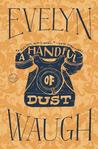
A HANDFUL OF DUST BY EVELYN WAUGH

A Handful of DustA Handful of Dust by Evelyn Waugh
My rating: 5 of 5 stars

"'I never thought it would last but she seems really keen on it . . . I suppose it's a good plan . . . there wasn't much for her to do at Hetton. Of course she would rather die than admit it, but I believe she got a bit bored there sometimes. I've been thinking it over and that's the conclusion I came to. Brenda must have been bored.'"

 photo kristin_scott_thomas2_zps775ebf6f.jpg
Kristin Scott Thomas adds sizzle to the 1988 movie version as Brenda.

Tony and Brenda Last have been married for seven years and although they don’t have a fiery passionate relationship they have settled into a predictable, comfortable one. They live on the Last family country estate named Hetton Abbey, an ugly neo-gothic creation that would need to wait a few decades more before coming back into fashion. Tony is perfectly happy with the house, but Brenda is subtly, or maybe not so subtly, convincing him to make changes. Plans are made to slowly convert the interior to a more modern appearance and also add some much needed bathrooms to the house.

They have one son who is mostly just a source of annoyance to them. He is precocious and starved for attention, and is often shuffled off to the horse trainer or to the housekeeper to keep him from under the feet of his parents.

They are moderately rich, but feel pinched for money as most of it is being funneled back into Hetton Abbey. Entertainment, as most of us know when we hit a financial snag, is the first and easiest to cut back on. This does create childish resentments in Brenda towards Tony and towards the house, even though, she is the one that is insisting on the remodel. After all she doesn’t even like that ugly old house anyway.

Overall, though, despite the snag in their social life things are going rather well

Until…

John Beaver invites himself down to Hetton Abbey for the weekend. He is a social parasite who lives off the family associations. He was reasonably desperate for some one to sponge off or he would have never ventured out to the country to spend time with the Last family.

”Beaver was so seldom wholly welcome anywhere that he was not sensitive to the slight constraint of his reception.”

He is oblivious, completely oblivious to any irritation his hosts might feel at his presence. He is relying on the unshakable, ancestral sense of decorum that people have for guests, even uninvited ones.

 photo evelyn-waugh_zpsc55ab620.jpg
The ever so clever Evelyn Waugh.

Beaver is not a dashing figure nor is he all that charming. He is mostly just a young lad more boy than man. He is surprised at Brenda’s interest in him. She has been out of London society for a while and seems to have lost all her bearings for what she should find attractive in a man. Beaver really has nothing to offer except youth.

She ends up leasing a small apartment in London from Beaver’s rather disreputable real estate mogul mother. Brenda begins to instruct Beaver in an attempt to mold him into a more respectful version of a man she should be seen with. This starts to create some friction with young Beaver.

”You are one for making people learn things.”

Beaver goes along as she is paying for most of their expenses as they start appearing in society together.

Brenda tells Tony she is taking economic classes. Tony does the best he can to believe her.

Beaver as far as society is concerned is just a family friend. It is so nice of him to escort her around town. The rest...well...that is all hush hush.

”That’s always the trouble with people when they start walking out. They either think no one knows, or everybody.”

It has been way too long since I’ve read Evelyn Waugh. This may be one of his bleakest novels, but also the one most rife with wonderful biting sarcasm that exposes the self-absorption of the English upper class and the disregard they have for any retributions for their actions. When tragedy strikes the Last family the understated, cold reactions of both Tony and Brenda are so selfish it reveals their truest nature. I felt sorry for Tony for most of the novel because the decisions that Brenda was making were so destructive and based on such an absurd set of reasoning that it all just seemed so unfair. My feelings for Tony changed and by the end it felt like each got what they deserved. Both are so naive and though raised in this upper crust, seemingly conservative society, they seem to know very little about how to conduct themselves in such a rigid system of socially judgmental families.

 photo HandfulofDust_zps74174908.jpg
A Handful of Dust

A bleak story, filled with a flurry of witty daggers that I’m sure stuck between the ribs of many a reader in 1930s Britain, but at the same time the book is laugh out loud funny. The plot is a series of absurd situations in which the Lasts and their friends ignore the most sensible course and sail into the rocky reef completely oblivious to the fact that they will most likely lose the ship.

Certainly Waugh was pointing a few fingers and wagging his eyebrows at the upper classes. This is a superb balancing act of black humor and social commentary writing that is not only difficult to do well, but also entirely entertaining in the hands of Evelyn Waugh.


View all my reviews

Tuesday, January 13, 2015

You Lost Me At Hello

Not That Kind of Girl by Lena Dunham
2014
Reviewed by Diane K.M.
My rating: 1 out of 5 stars


This book reminded me of that scene in an action movie when an older man performs a stunt, and then he mutters to himself, "I'm getting too old for this sh*t."

I am, indeed, too old to have any patience for this kind of sh*tty, self-indulgent writing.

I had wanted to like this book. I like the idea of having a voice like Lena Dunham in the world, telling a different story of womanhood. And I thought the introduction to this book was good. It had this quote:

"There is nothing gutsier to me than a person announcing that their story is one that deserves to be told, especially if that person is a woman. As hard as we have worked and as far as we have come, there are still so many forces conspiring to tell women that our concerns are petty, our opinions aren't needed, that we lack the gravitas necessary for our stories to matter. That personal writing by women is no more than an exercise in vanity and that we should appreciate this new world for women, sit down, and shut up."

I agree with that sentiment, however, I don't think that gives one license to then write drivel about a silly email you wrote to a boy, or about weird boyfriends, or all the times you shared a bed with a guy but didn't have sex, or your burgeoning interest in exhibitionism, or entries from your food journal, blah blah blah.

After a strong introduction, this book quickly became painful to read and I had to skim to get through it. It's a hodgepodge of essays that are fine for a blog, but it doesn't make for a compelling read in print. I cannot recommend this.

Knots and Crosses

Knots and Crosses (Inspector Rebus, #1)Knots and Crosses by Ian Rankin
My rating: 3 of 5 stars

Girls are being kidnapped and murdered around Edinburgh and John Rebus is on the case. But what, if anything, do the disappearances have to do with bizarre letters Rebus has been getting in the post?

The mother-in-law of the owner of my favorite used bookstore has been on my ass for years to give the Inspector Rebus books a shot. When this one turned up during one of my semi-weekly visits, I decided it was time.

This slim volume packs quite a punch. As the first book in a mystery series, it has a lot of heavy lifting to do, which it does quite well. John Rebus left the SAS under mysterious circumstances and joined the police department. Fifteen years later, he's divorced with a teenage daughter and has large blank areas in his past. When the past comes knocking at his door, it's time to pay the piper.

John Rebus reminded me of a lot of detectives from the time Knots and Crosses was written, like Elvis Cole, for instance, but what he really reminded me of was a late 1980's version of Dorothy Sayers' shell-shocked aristocrat detective, Lord Peter Whimsey. Rebus' buried past lurks on the periphery of his day to day life with the Edinburgh PD, much like Lord Peter's.

Rebus has a lot baggage, from his stage hypnotist brother to his ex-wife and everything in between. He's a sad bastard in a long line of sad bastard detectives but has enough uniqueness that I'll be happy to visit him again in the future.

The mystery wasn't really solveable but I think Knots and Crosses was more of a setup book than anything else. Rankin's writing was pretty good. I think he did a good job of portraying cops as real people. I have to wonder if Tana French's Dublin Murder Squad was influenced by Rankin.

That's enough rambling. 3.5 out of 5 stars. I didn't love it but I liked it enough to want to read more books featuring John Rebus.


View all my reviews

Monday, January 12, 2015


Reviewed by James L. Thane
Five out of five stars

This is the eleventh entry in Lawrence Block's excellent Matthew Scudder series, and it remains my favorite book in the series. As the story opens, Scudder and his girlfriend, Elaine, are thrown together with a young couple named Glenn and Lisa Holtzmann. Elaine and Lisa are taking a class together; the Holtzmanns live in the same neighborhood as the hotel where Matt lives, and the two couples wind up going out to dinner one night.

Matt is not overly impressed. He and Elaine have little in common with the younger couple and there's something about Glenn that puts Matt off. Given that they're something like neighbors, Matt runs into Holtzmann occasionally on the street and Holtzmann keeps proposing that they get together for lunch. Matt always manages to find a reason for refusing the offer and then, suddenly, he no longer needs one when Holtzmann is gunned down while using a pay phone a couple of blocks from his apartment.

The police immediately charge a street person named George Sadecki with the killing, and the evidence seems overwhelming. The police do not recover the weapon used, but Sadecki, a Vietnam vet, has policed the area and the police find the shell casings in his jacket pocket. Sadecki, who has never been quite "right" mentally, admits that he might have killed Holtzmann, but he doesn't remember one way or the other.

Sadecki's brother, Tom, knows Matt from AA, and doesn't believe that George would have been capable of killing anyone. He knows the odds are long, but he convinces Matt to look into the case in the hope of giving him some sort of closure. Matt agrees, although the case looks open-and-shut, and he warns Tom Sadecki not to expect much.

In a case like this, SOP is to start by investigating the victim to see who, if anyone, might have had cause to wish him harm. On the surface, Glenn Holtzmann appears to be a pretty straightforward yuppie lawyer, but as Scudder begins poking around, he uncovers some secrets about the late Mr. Holtzmann that are troubling, to say the least.

The case itself is intriguing, but what sets this book apart for me, above all the others in the series, is that Scudder is presented with two very critical moral issues that are not really directly related to the case itself. The real strength of this series has always been the development of the characters, Scudder in particular, and it's extremely interesting to watch him wrestle with these two issues.

To describe either dilemma would be to give away too much. Suffice it to say, that neither is easy, and both will require that Matt look deeply into his own soul in the hope of finding some sort of resolution. Fair warning: watching him do so may well require the reader to examine his or her own conscience as well. This is at least the third time I've read this book, and I'll eagerly look forward to it again as I make my way through this series the next time--one of my favorite crime novels of all.

Find Your Florence With Lonely Planet

Lonely Planet Florence Encounter (Travel Guide)Lonely Planet Florence Encounter by Robert Landon
Reviewed by Jason Koivu
My rating: 4 of 5 stars

Firenze, tu sei il mio preferito città Italiane!

I was working at a map company, was about to go on vacation to Italy, and this was the only book we carried specifically on Florence, so I bought it. It wasn't the most useful travel guide I've ever used, but it's very compact (an actual "pocket book" that fits in the pocket, wow!), it's got some fancy pictures and if you're looking for places to eat, it gives you a nice, general rundown of what to expect in this most wondrous city!

Slim and more snapshotty than other more thorough and comprehensive Lonely Planets I've used, Florence Encounter provides a few good ideas that may not have been on your vacation itinerary if you're a first time visitor to Florence. One of my favorite experiences, learned about in this little book, was I Fratellini, a curbside wine and sandwich shop that serves up a simple, but delicious and inexpensive meal that you eat standing in the street or while literally sitting on the curb as we and my others did. It's a fantastically quick and cheap way to get something good in your belly, so you can move along to more touristy sights without spend all afternoon at a restaurant (sometimes it takes a while to eat in Italy I've found).

Travelers' Tip: When my wife and I went to Italy a few years back I learned some basic Italian so we could get around via train and bus, order in restaurants and handle hotel reservations. Because we were always in the major urban areas, it probably wasn't necessary, but it did come in handy now and then. Many Italians speak English, but certainly not all. And heck, it's just polite to exchange pleasantries in your host country's language.

View all my reviews

A Jesus For Everybody!

Muhammad: A Prophet for Our TimeMuhammad: A Prophet for Our Time by Karen Armstrong
Reviewed by Jason Koivu
My rating: 4 of 5 stars

Muhammad

description

Looks a little like Jesus, doesn't he?

This was one of my first forays into the life of a man who has meant so much to so very many. Muhammad: A Prophet for Our Time felt easily digestible to me, an outsider and an utterly ignorant one at that.

Having lived about 500 years after Jesus, we seem to know more concrete information about the life of this prophet, thought by Islamists to be the last prophet, than we do of the Christians' "son of god". He came from Mecca and is the man who brought all of the Arabian nations under one religious umbrella. He was a fighter, who raised a Jihadist army that he turned upon his own hometown, in the name of god of course.

Perhaps that sounded too snarky. I do not intend to belittle the man or his religion. My scorn is for all organized religions. However, I try to set aside my prejudices when reading non-fiction on religious matters or biographies regarding their saintly figures. For instance, some of Muhammad's deeds did not seem entirely honorable in hindsight, but that is hindsight, which is distorted by the distance of time.

Muhammad: A Prophet for Our Time is a nice primer, a good first step towards greater knowledge. During these difficult times, when many of us Americans do not readily accept the followers of Islam with open arms, getting to know the history of the people is an important step in realizing our overwhelming similarities as humans, the one an only tribe of man and woman that should truly matter.

View all my reviews

Saturday, January 10, 2015

Embassytown

Embassytown
China Mieville
Del Rey 2011

Reviewed by carol

4/5 stars

In ninth grade, Mrs. Muench–who had an uncanny resemblance to Miss Marple‘s friend Dolly Bantry–endeavored to teach us the difference between similes and metaphors.
 
Similes use “like” and “as” to compare two unlike things.

Metaphors state two unlike things are the same.

But dear, enthusiastic Mrs. Muench could not have anticipated China’s sophistry: metaphors are lies.


Embassytown is a deep-thinking book, not one to pick up if you are in a the mood for a fast action read. China’s use of a futuristic language, coupled with representation of an alien speaking that tongue (in a form that looks disturbingly like a fraction equation), requires attention to detail, an ability to read for an hour or two at a time. Along with altered language, he throws in the isolation of a human city in the middle of an alien world on the edge of known space; altered biology, in an alien race that somehow biologically fuses/grows their mechanical needs out of organics, including their homes; and an alien race that not only speaks with two mouths simultaneously, but cannot lie. Further complications come from his solution to deep space travel, by way of the immer. The challenge for both races is in communication. In order to communicate with the alien Ariekei, two people have to speak simultaneously, mimicking the double Ariekei mouth. But since the Ariekei also sense the thought/mind behind the word, two different people speaking the same thing makes no sense to the Ariekei, so the solution was to raise human clones to function as Ambassadors to the aliens.

Forget Being John Malkovich. I’d like an hour in China’s mind.

Overall, I found it a fascinating, immersive read, reminding me strongly of The Dispossessed–and that is highest praise–although he doesn’t always have LeGuin’s kindness in contextualizing most oddities. Still, it’s well done, and balances the personal and the political well. He taps some eternal truths in the midst of alien outlandishness: “As I’ve grown older I’ve become conscious of how unsurprising I am.” There’s a sly sense of humor occasionally tempering the seriousness: “I knew something would (happen) as certainly as if this were a last chapter.” It shows again in the initials of the lead character’s name: “A.B.C.,” fitting in a book about language.

There is tenderness and compassion, however alien, when one of the self-aware bio-machines downloads herself into a new body, just so she can give Avice a hug.

The crux of the novel lies in the Arikei limitation to speak literally. Avice becomes part of their language when she takes part in an event, thus allowing the Arikei to use her as a simile. It is a fascinating and fun idea (ever wonder about the first cat out of the bag?) that allows China to play with the definitions of truth, lies, language and meaning. However, language evolves, and interaction with the humans is starting to push the Arikei language to it’s limits. Avice ends up pushing them even further. “I don’t want to be a simile anymore,” I said. “I want to be a metaphor.” He unfolds the examination of language within both Avice’s own life when she brings her linguist husband home to her world, and the politics of her province-city. China’s genius shows when he throws in issues of addiction and identity into the mix.

Why not five stars? It is not a comfortable book. It could have been tightened up a little bit; as I work my way through the review, I marvel at all the things China tried to accomplish, and wonder if he should have limited a variable or two in favor of greater coherence. Was the immer necessary, for instance? There’s interesting hints at Avice’s friendship with an autom/biological robot as the biological systems break down, but I’m not sure what role it really played, and if it just confused the story further. Still, an impressive work, and likely to be a classic.

Interesting quote:
“Beside him, Ez was like a ventriloquist’s doll, existing only when he spoke, or was spoken through.”
The army of hopeless and enraged had been driven to murder by their memories of addiction, and the sight of their compatriots made craven to the words of an interloper species. That degradation was the horizon of their despair.”


cross posted at my blog at  https://clsiewert.wordpress.com/2013/03/07/embassytown-by-china-mieville-or-limbo-with-language/

Friday, January 9, 2015

The Hour Before Dark


Douglas Clegg
Leisure Books
Reviewed by Nancy
5 out of 5 stars


Summary


As children, they played the Dark Game.

When Nemo Raglan's father is murdered in one of the most vicious killings of recent years, Nemo must return to the New England island he thought he had escaped for good, Burnley Island...and the shadowy farmhouse called Hawthorn. But this murder was no crime of human ferocity. What butchered Nemo's father may in fact be something far more terrifying...Something Nemo and his younger brother, Bruno, and sister, Brooke, have known since childhood.

There are secrets buried on Burnley Island.

Within the rooms of Hawthorn, beautiful Brooke Raglan has begun to go mad. She sees faces at the windows and wanders the night, trying to find what she believes is a monster.

Bruno Raglan has wiped the memory of a terrible event from his mind. Now he compulsively picks apart Hawthorn and discovers that within its walls lies a forbidden secret.

As he unravels the mysteries of his past and a terrible night of his childhood, Nemo witnesses something unimaginable, and sees the true face of evil while Burnley Island comes to know the unspeakable horror that grows in the darkness.


My Review


Nemo Raglan returns to his family home on a remote Massachusetts island after learning that his father had been brutally murdered. His sister, Brooke, was the one who found him in the smokehouse. She spent hours with him, sitting in a pool of blood. His brother, Bruno, who still lives on the island, is worried about Brooke’s deteriorating mental state as a result of her father’s slaughter. The three siblings attempt to figure out who could have butchered their father while they reconnect, discover dark family secrets, and recall old and painful memories.

The remote island with its harsh weather and provincial neighbors seems so far from the mainland that it may as well be another country. The large family home is old and creepy, with its many doors, secret compartments, and mysterious happenings.

This was a wonderfully written story, with believable and well-drawn characters that are easy to relate to, and a creepy and unsettling atmosphere. The horror is more of a psychological nature and does not rely on excessive amounts of gore.

I’m looking forward to more of Doug Clegg’s work.

Wednesday, January 7, 2015

THE FORGERS BY BRADFORD MORROW

The ForgersThe Forgers by Bradford Morrow
My rating: 5 of 5 stars

”Book collecting,” he memorably told me, though at the time I couldn’t fully grasp his theory, “is an act of faith. It’s all about the preservation of culture, custodianship, and that’s why when I add a book to the collection I’m taking on the responsibility of keeping it safe. And then there’s the joy of the chase, of striving to find a copy of a book that helped make me who I am. But not just any copy--the copy, the most historically interesting and finest copy you can find. Most of all it’s about something I’ve never quite been able to put into words.”

How about we look to Mr. Eliot?

”These fragments I have shored against my ruins.”
The Waste Land by T. S. Eliot


This book begins with a pair of severed hands.

Adam Diehl, a reclusive collector, is found nearly bled out surrounded by the trampled and torn remains of his exclusive, and expensive book collection.

His hands are never found.

His sister Meghan who runs a local bookstore is devastated because she is very close to her brother, but also because he is all the family she has left. Her boyfriend, Will, who also serves as the narrator of the story never liked Adam very much and the feeling was mutual. They should like each other. They even have the same interest in the same types of books, but see there is a factor here unknown to Meghan that creates a rivalry and a certain amount of disdain.

They are both forgers.

Will is better at it than Adam and like many perfectionists he finds it insulting that someone else would try to pass off what he can do so much better. Of course he is supposed to be reformed after he experienced a brush with the law that nearly landed him in prison.

The desire is still there.

”I would sometimes find myself physically aroused when my hand, my pen, my paper were coordinating so perfectly that a kind of calligraphic, pornographic ballet took place before my eyes.”

Will’s father was a great book collector. He was well respected and venerated in the book collecting world. In fact, the quote at the beginning of this review was his attempt to explain to his son the gentle madness of collecting. If his father had known he was defacing books with forged signatures or that he was changing literary history with his arrogantly conceived counterfeit letters and ephemera he would have been beyond disappointed. He would have felt a complete failure in his attempt to raise someone in his own image.

”Would he have had any choice other than to hand me my loathsome heart bundled up in the butcher’s paper?”

His father was always searching for a more perfect copy of a book for his library. When he did find a better copy he would even keep the inferior copy as well which is fascinating. I often do upgrade a book in my library, but usually I sell or trade the more inferior copy. It is a way to offset the cost of the upgrade and it also frees up more room on the shelves for...another book.

Now Will does see history in the same way as I do. It is all a muddled mess of half truths, but I would never be willing to add to the muddle.

”History is subjective. History is alterable. History is, finally, little more than modeling clay in a very warm room.”

Everyone strives to know singular truth, but the truth is that there are many truths. For any one truth there are several other versions just as true. A historian uses the most accepted version of the truth or makes a case for an alternative truth that he believes or wants to believe is more true.

It is one thing to add thoughts believed to be true to the narrative, but it is quite another to manufacture them from whole cloth.

I’m with Will’s father regarding his activities. Bring me the butcher’s paper.

When Will starts to receive threatening letters, cleverly written in the style and penmanship of Henry James he knows that his secrets are known by someone who holds all the threads of his life.

This starts a desperate search for solutions that will hopefully appease his accuser and keep his secrets safe.

This book may not be a five star book for most other people, but I have to give Bradford Morrow credit for writing a pitch perfect novel about the book business. Most books I’ve read about the subjects of book collecting or working in a bookstore ring falsely for me. I can assure those that are interested in books beyond just the words they hold that Morrow knows his stuff. I often found myself feeling a tingle as he made connections that only the “gently mad” will understand. Speaking of Gently Mad, Nicholas Basbanes, a hero of mine, also endorsed this book.

The character of Will is so interesting because I couldn’t help liking him and loathing him in equal measure. Both diametrically opposed aspects of my feelings about him were tangled in almost every thought I had regarding his behavior. Forgeries are hanging on walls in museums and are locked up under glass in prestigious universities all over the world, and are believed to be real. So a gifted forger like Will can forever alter literary history. He might buy, say an expensive first edition of a Charles Dickens book and add an association inscription to Wilkie Collins thus making the book a priceless one-of-a-kind item that he could then sell at a huge profit. Inscriptions are one thing, but writing letters perfectly in the handwriting of a writer to another writer or to a lover or to a publisher asserting thoughts that never existed before(or probably didn’t)is certainly taking the molding clay and constructing a fabricated creature of words.

The plot is good, but the perspective of the world of books that Morrow presents is like having a window in a flat with a panoramic view of the Hay-on-Wye in Wales.


View all my reviews

Tuesday, January 6, 2015

The Great Train Robbery

The Great Train RobberyThe Great Train Robbery by Michael Crichton
My rating: 4 of 5 stars

In Victorian London, can Edward Pierce and his cronies pull off a train heist and get away with a fortune in gold bullion?

Like quite a few of my reads over the years, this book appeared on my radar courtesy of Kemper. We were discussing the Breaking Bad episode Dead Freight and he asked if I'd ever read The Great Train Robbery. I said I hadn't and promptly forgot about it for a couple years until I ran across the Great Train Robbery in the local used bookstore.

The Great Train Robbery is a gripping heist novel set in the 1850's. Crichton doesn't skimp on the Victoriana, either. The social climate and attitudes of the time are in full force, as is Victorian criminal slang. Critchton throws the reader into the deep end with his talk of bone lays, twirls, drums, and gammons.

As with most capers, the joy is in the planning and watching Pierce deal with getting key impressions, ferreting out key impressions, and dealing with setbacks along the way. Pierce proved to be quite a cracksman and would make Richard Stark's Parker smile with admiration, if such a thing were possible.

The way Crichton tells the story is masterful, alternating the story as it occurred with newspaper clippings from after the caper went off and the subsequent trial. It was excellent way to misdirect readers such as me. I thought I had things pegged pretty early on but Crichton surprised me at the end.

If I had to justify not giving this a five, I would mention that the characters were a bit weak, Pierce included. However, the story is entitled The Great Train Robbery, not An Examination of the Psyche of a Train Robber so some slack must be cut.

Four stars. Now I want to track down the movie version.


View all my reviews