Friday, July 5, 2013

Truly doesn't live up to the hype


True Grit by Charles Portis
Published by Simon and Schuster
3 out of 5 Stars
Reviewed by Bryce

Fourteen-year-old Mattie Ross's father is shot and she heads out to find the culprit. It's as direct and upfront as that and the writing is the same. For example (demonstrating both the straightforward prose and directness of the main protagonis, Mattie Ross):
Yarnell said, 
"You can't stay in this city by yourself."
I said, "It will be all right. Mama knows I can take care of myself. Tell her I will be stopping at the Monarch boardinghouse. If there is no room there I will leave word with the sheriff where I am."

He said, "I reckon I will stay too."


I said, "No, I want you to go with Papa. When you get home tell Mr. Myers I said to put him in a better coffin."


"Your mama will not like this," said he.

True Grit is told from the point of view of a very abrupt and bold young lady, but there's not a lot to it other than a description of events from one place to the next. She decides something and she does it no matter how many times everyone else tries to dissuade her from that path. She gets a U.S. Marshall to help and then events happen.

Good, but definitely didn't live up to the hype. I honestly don't even understand it other than that it's a person who does what it takes no matter what, but she doesn't even seem all that passionate about it. It's just something she has to do. I think the prose style hurt that part of the story as well. There are some entertaining scenes but for the most part I thought the style of the writing, while true to the character it was portraying, kept it from being more.


For me, this could have been a much better book had he made her an English teacher or novelist (like Gordie in Stephen King's The Body which I just read) later in life when she "wrote this." Then she could actually have the writing chops to make this a well-written story instead of a play-by-play of events. As it stands, it kept feeling like something I could have written in high school and that left me unimpressed with what is considered a classic. I understand it as it relates to the themes of revenge, but not in terms of the writing.


Also posted at Goodreads.com.

Thursday, July 4, 2013

Gather Round, Me Mateys, While I Tell Ye About Emer, Scourge of the Seven Seas!

The Dust of 100 Dogs

by A. S. King

Published by Flux

4 Out of 5 Stars
Reviewed by Amanda

This is definitely one of the more interesting premises that I've encountered in young adult fiction and, given all of the carbon copy Twilight/Harry Potter series books out there, it deserves high praise for that alone.

Young Emer Morrisey has a loving family and a happy childhood until her parents are brutally killed and her village destroyed during Cromwell's invasion of Ireland. From that point on, Emer's life is one disappointment after another: poverty, arranged marriage, abusive uncle, hunger, imprisonment, and rape. It's no wonder that she loses hope in goodness and kindness and, when fate brings her to the pirate haven of Tortuga, she decides to take from others as viciously as life has taken from her. That's right--Emer is kicking ass and taking names as the captain of her own pirate ship and it's not long before she manages to make a name for herself as one of the most cunning and bloodthirsty pirates to ever sail the seven seas. When Emer crosses the wrong man, she is killed and cursed with "The Dust of 100 Dogs," meaning that she will be reincarnated 100 times as a dog before finally being reincarnated as a human being and able to take care of unfinished business.

The novel begins with the birth of Saffron Adams, the human reincarnation of Emer after she has endured several canine lifetimes. Saffron is her own person, yet still has all of Emer's memories and knowledge. As Saffron searches for the treasure Emer was able to bury before her death, the novel deftly switches from past to present as we learn of Emer's past and Saffron's future. If all of this sounds bizarre and confusing, well, it is, but in a good way. The novel maintains suspense and draws all of the storylines together to a satisfactory conclusion. The one expectation that wasn't met for me is that we learn very little about Emer's dog lives; instead, the chapters are interspersed with short vignettes about what Emer the dog learned about human nature from various owners in various time periods. This is probably a smart move on the part of King as reading about the lives of 100 dogs, while intriguing, could become pretty tedious somewhere around the third Milkbone treat given, leg humped, or fire hydrant peed upon.

In reading other reviews, many readers were shocked by the brutality and the sexuality in the book (which I actually found to be pretty tame). Um, yeah, I think that it could be because it's a FREAKIN' PIRATE book and not a Disney theme park ride. Others seemed to be shocked to find such content in a young adult book, but I have no such worries. I'm sure teenagers have already figured out the sex thing, yeah? And they've probably done it from unsupervised watching of cable television and unmonitored Internet usage their parents make accessible. And it's a hell of a lot better than reading three books of Bella lusting after sparkling Edward's cold, hard . . . well, you know. (*removes self from soapbox and drags it back to the corner*)

So, yes, good book, definitely enjoyed it, and suffered no negative side effects other than a desire to walk around saying, "Arrrggghhh, me matey" to everyone I met for a week.

Jay Lake Pre-Mortem Readathon, review the second: MAINSPRING


MAINSPRING (Clockwork Earth #1)
JAY LAKE
Tor Books
$24.95 hardcover, available now

Reviewed by Richard, 4.75* of five

The Publisher Says: Jay Lake's first trade novel is an astounding work of creation. Lake has envisioned a clockwork solar system, where the planets move in a vast system of gears around the lamp of the Sun. It is a universe where the hand of the Creator is visible to anyone who simply looks up into the sky, and sees the track of the heavens, the wheels of the Moon, and the great Equatorial gears of the Earth itself.

Mainspring is the story of a young clockmaker's apprentice, who is visited by the Archangel Gabriel. He is told that he must take the Key Perilous and rewind the Mainspring of the Earth. It is running down, and disaster to the planet will ensue if it's not rewound. From innocence and ignorance to power and self-knowledge, the young man will make the long and perilous journey to the South Polar Axis, to fulfill the commandment of his God.

My Review: Several things militate against my discovery of pleasure in this book, such as a Low Tolerance for Capitalization Errors, a complete and oft-expressed disdain for the kind of god present in this book, and its celebration of the Love that Should Shut The Hell Up Already, aka heterosexuality.

But there's an exception to every rule, and this is one.

I confess that the thoroughly requited love story elicited weary, disgusted sighs, and I did a bit of flippity-flip to get past the bits that made me most annoyed, but there's not a whole helluva lot of it, thank goodness. And working for the couple is the fact that she's a different species, sort of.

But the central joke of the book, the mainspring (!) of the humor, the drama, and the action, is the brass track in the sky that the Earth runs on. The Universe IS the clockwork that the famously disproved watchmaker-parable proof of god's existence posits! (If one finds a watch, that is proof there is, somewhere, a watchmaker...the rest is just as silly, so no need to go into it here.)

This I love. This alone gets five whole gold stars with an oak-leaf cluster. This is a new Universe, not just a warmed-over Operation-Sealion-worked yawnfest of an alternative history. (Side note to writers: WWII? Done, done, done, done, done. Aliens even. DONE. Pick something else! ANYthing else!) (Except the American Civil War, also DONE.)

Also because of this complete re-imagining of the laws of physics (good one, Mr. Lake!), I put aside my abiding mistrust of majgicqk as deus ex machina. After all, there's a giant brass track in the sky that emits a mechanical rumble forming the backdrop of all life, the gears of the track must be navigated to go from Northern to Southern Hemisphere, and there are airships! In for a penny, in for a pound. Majgicqk it is.

But it's like all the other tropes that annoy me in fiction (indeed in life), it's *used* in Lake's novel. It's not a Get-Out-Of-Jail-Free card. It's a necessary component of the kind of world this clockmaker god would create. It makes sense. And it happens to be made of desperate needs, which is more like the way the world works anyway.

Hethor, like all heroes, suffers on his quest to save the world, and loses his sense of himself outside his quest. He defines himself as his quest, and is forced to confront the inevitable end of such a self-definition: Complete and utter aloneness and alienation. Because Lake is on the Hero's Journey, the Hero must lose it all.

But Lake is on the Hero's Journey. So, in losing it all, Hethor is rewarded with his heart's desire, and it is not the one he started the quest desiring. That, in my well-read opinion, is how a writer of great gifts ends a Hero's Journey: Wishes granted; now what will those be?

A quarter star off for a villain who isn't a villain but a collection of nasty until far too late in the story to matter. His villainy, as finally expressed, would've launched me into six-star orbit had it been explicit earlier in the narrative.

Whipping back through Mainspring convinces me that a thoroughgoing re-read cannot come amiss. It's that good. It's that rich and dense and satisfying. Just wonderful, and thank you for it, Jay Lake.

Creative Commons License
This work is licensed under a Creative Commons Attribution-NonCommercial-ShareAlike 3.0 Unported License.

Wednesday, July 3, 2013

Make My Funk the P(elecanos) Funk!


King Suckerman
by George Pelecanos
Reviewed by Anthony
5 out of 5 stars
It’s summer and everyone we know has come out tonight to see the big, new movie. It’s the one we’ve all been talking about: King Suckerman. A movie about the baaaaadest of the bad. A movie about a pimp who is taking it straight to the man. A movie that’s, in all honesty, probably going to be exactly the same as a hundred other Blaxploitation movies—but that’s okay. Like I said, it’s summer and not just any summer but it’s the US’s birthday, the bicentennial. 1976. Here we all are, all the young people, and for the next 90 minutes we’re going to be free from all thoughts, worries, prejudices, anything else that makes up that troublesome thing called reality that lurks in wait outside in the July heat.

And things start off well. The opening credits roll up on the screen and there’s that funky theme, because every superhero—even one that’s a pimp—needs his or her own theme song. (Don’t know what I mean? Then allow me to edify your eardrums, baby:

"Super Fly"-Curtis Mayfield

"Shaft"-Issac Hayes

"Hammer’sTheme"-Solomon Burke

"Cleopatra Jones”-JoeSimon) And the girls, man some of the girls are even dancing in the aisles. Digging those out of sight scratchy guitar riffs set to the pulse pound of bass and drums and there’s the singer’s voice already telling you exactly what you already know. He’s telling you about what you’re about to see: King Suckerman. This is a James Bond Movie. A superhero movie. An escape.

This is going to be fun.

But then something happens. The title character, the King, is no charmer. He is no Carl Weathers or Fred Williamson. He’s big and ugly and vicious. The crowd goes silent as up on the silver screen the King beats one of his prostitutes with a wire coat-hanger. Beats her bloody and ragged and chip-toothed. Then he sends her out to peddle her ass, the blood still dripping from her wounds, and she better not even think of showing her fucking face until she brings back enough money to prove she’s worth a fucking cent.

And so the movie continues its gritty descent into urban hell until we have the final closing shot of the big, bad King Suckerman sitting in a prison cell, rotting away from syphilis…staring right into the camera with his holocaust eyes.

People, the ones who decided to stay through the entire movie, leave the theater in silence. And somewhere among the press of people, an acne-scarred white boy with a ratty-afro turns to the large, powerful black man sitting beside him and asks, “Is that really how it is, Wilton?”

“Yeah, little brother,” Wilton Cooper says, “that’s the stone truth.”

And maybe I paraphrase here, but the nature of this scene and what these two killers say strikes a deep and dark chord that reverberates throughout the course of this book. This blaxploitation movie, from which the title for George Pelecanos’s second novel in his DC Quartet derives its name, stands as a metaphor for the whole of the novel: it’s the subliminal space where reality and fiction blur.

Wilton Cooper and B.R. Clagget are living their own warped and violent fictions. Each sees themselves as heroes in their own self-framed movie screens. But whereas Clagget, a shotgun-toting piece of white trash, sees himself as some kind of Superfly waiting to bloom; Wilton Cooper has a lizard-like understanding that, if he’s any kind of hero, then he is an existential hero burning his way to the credit roll of a nihilistic 35 mm. Not that this difference in perception matters much when the two hook up at a Drive-In in North Carolina. Cooper watches as Clagget kills a man working the film booth, using gunshots in the movie to mask his own, and decides this kid would make a good addition for his crew. Clagget joins up with Cooper almost immediately, excited by the chance that a real-deal cool character like Cooper will in turn think he is cool. And so, along with two lowlife brothers, Russell and Ronald Thomas, the gang heads on up in Cooper’s sweet ride to Washington DC, where Cooper has his sight on running a drug deal with some bikers for a small-time loser of a gangster Eddie Spags.

Eddie Spags is a from an Italian Mafia family out of New Jersey, but was sent to Washington DC so that he’d basically be out of the way of the real family business. And you can’t really blame them too much: when your nickname is Eddie Spaghetti, you’re pretty much guaranteed to be a fuck-up. And he fucks up royally here while trying to show off to Cooper and his boys. Eddie also sells premium weed to various low level pushers like Dimitri Karras. So when Dimitri comes with his friend Marcus Clay to pick up the weed—with Cooper and his thugs hanging around in the background— and Eddie sees that his dead-beat hippie girlfriend Vivian is making eyes for the rugged and athletic Dimitri Karras, he decides to put Vivian in her place with the back of his hand. On reflex, Dimitri punches Eddie and then things get out of hand quickly. Before they know it, Dimitri and Marcus are walking out of Eddie’s office with twenty grand, a pound of weed, and Eddie’s girlfriend.

Humiliated, Eddie turns to the amused Wilton Cooper and tells him to go retrieve his money. And so, Eddie unwittingly lets loose the devil this holiday weekend in DC circa 1976.

In some ways, the scene plays out sort of nonsensically. One moment everyone is shooting the shit, the next guns are drawn and insults are thrown. For a catalyst that sets the action of the book in motion, it seems almost entirely based on ego and machismo. Which is exactly the point, and is one of the reasons that this book is sort of a crazy work of genius on George Pelecanos’s part.

While the movie within the book, King Suckerman is a deconstruction of the over-the-top criminal glorification and the plastic-sheen of a commoditized idea of black culture, the Washington DC in which Pelecanos’ novel takes place stands as a counterpoint to this brutal reality by constantly merging into Hollywood fantasy, overall creating a postmodern crime novel that tackles the author’s favorite themes, such as identity and friendship in the face of various cultural and racial tensions.

These are displayed most candidly with the heroes of this book, Dimitri Karras and Marcus Clay. Marcus is a hard-working black man that owns his own independent record store (with the awesome name Real Right Records), while Dimitri makes a living off of selling weed to teenagers. Marcus is a Vietnam vet, Dimitri skipped out on the draft by getting an English degree. And the two have been best friends since they were kids. And even now, as they reach the end of their twenties, they still find time to drive around, listen to music, smoke a little reefer, and shoot some hoops. But the main difference is that Marcus is responsible and fairly straight-laced—that is, until Marcus let’s himself get talked into riding along with Dmitri for a drug deal with Eddie Spags.

The pacing of the rest of the novel even matches most of the low-budget Blaxploitation movies that I have seen. Sections of those movies will appear to be aimless at times, seeming to be an excuse to have characters do things that look cool to a backing soundtrack that is usually the coolest part of the scene. But no section in this book is placed within the narrative to stand as “cool” filler. Pelecanos uses these moments to present the allure of the 1970s and many of the attitudes that prevailed pop-culture, especially the ones hijacked straight from black culture; which, in turn, is set as a counterpoint to the very real personal decisions the characters must make within their own lives, if they are self-aware enough to realize the fact.

Are Cooper and his gang self-aware enough? Not so much. Their lives are a perpetual search for the next high, be that from an actual drug or from acts of senseless violence, all the time trying to assure every person they meet that they are the “coolest” person in the room.

But Dimitri is starting to reach that self-awareness himself as he realizes that he is getting older and that there is very little he has meaningful in his life besides his friendship with Marcus. And even though Marcus will still hang out and play with Dimitri, he is a man who has seen the real violence that flows through the world, and knows that there comes a time when one must be thankful and responsible towards the people and things in his or her life that matter.

With each of the characters’ various perspectives on display, Pelecanos once again creates a panoramic of a place in a moment in time. And here is the 70’s as he remembers it as a teenager, but with the cynical lens of an older, wiser man. He does well to neither make this book a condemnation or an act of indulgent nostalgia. Pelecanos has said before in interviews that his PI character Nick Stefanos is in a lot of ways a fictionalized version of himself. And here in King Suckerman we have Nick in a cameo appearance as a careless and headstrong 19 year-old. And I can’t help but wonder what Nick even really remembers about how it really was.

Existential Monsters


Freddy's Book

John Gardner

Ballantine

Reviewed by: Terry 

3.5 out of 5 stars


“I have a son who’s a monster.”

So declares Prof. Sven Agaard, an old-school historian of former glory, now an outcast at his own university. His audience is Prof. Jack Winesap, the academic star of the moment and expert in the somewhat rarefied (and questionable?) area of “psycho-history” (no, not Asimov’s). He is Agaard’s polar opposite, sitting happily on the other end of the academic spectrum in terms of both popularity and academic rigour. Despite the animosity that Agaard displays towards Winesap and his field he ends up inviting him to his home. For his part Winesap is intrigued, who or what can this monster be? Why is this obviously antagonistic man even speaking to him? Of course he accepts. Thus Gardner sets up the mystery that will lead us into the first part of the novel which plays out this uncomfortable, though enlightening, scenario.

In the course of an evening where Winesap is snowed in and forced to partake of Agaard’s ‘hospitality’ he comes to learn the answers to some of his questions. Freddy, Agaard's son, turns out to be an outcast himself. A giant of a boy, he not only has a physical appearance that sets him apart, but is apparently subject to rages that make his cohabitation with others somewhat dangerous. At the boy’s own instigation locks and bars are kept on all of the doors and windows of Agaard’s drafty old house, meant not to keep Freddy in, but to keep others out. What at first seems like a horrific confinement comes to take on a different colour as we learn more about this small family and come to see that Agaard is not just a crusty old man hiding an unwanted child from the world, he is a father sick at heart over the pain he has seen Freddy suffer whenever he has been exposed to the world at large. Freddy has thus learned to be an introvert with an intellectual bent. His entire experience of the world has come from books and his room is cluttered with them, along with the various drawings and dioramas he has made based on their contents.

It also appears, much to Agaard’s chagrin, that Freddy is something of a fan of Winesap’s and so he has called in this man, whom he views with nothing but disdain and contempt, in the hopes that he can reach out to his son who otherwise remains locked in an ivory tower of his own making. Their initial meeting does not seem to go well. Winesap is nonplussed while Freddy is virtually silent, doing his best to hide his enormous bulk from view. Ready to set the matter at a dead loss as he readies himself for bed, Winesap is surprised when Freddy creeps up to his room in the dead of night and leaves behind a present for him. It is the eponymous book of the title, and is also, perhaps, the only method Freddy has learned of communicating freely with another person.

What follows, and which contains the bulk of the novel’s content, is the text of Freddy’s manuscript that is half fable and half history, detailing the adventures of a 16th century Swedish Knight and his conflict with the devil. I’m a little uncertain of how to proceed with this review. Gardner packs so much into this relatively slim volume that to cover all of the ideas he explores would be counter-productive. Suffice it to say that this is an existential novel and as we follow the main character Lars-Goren in his travails we touch on a host of philosophical and political issues that run the gamut of human experience. Lars-Goren and his cousin Gustav Vasa begin the story watching as their kinsman Sten Sture and his fellow revolutionaries are slaughtered for their revolt against the Danes that currently rule Sweden. Lars and Gustav barely escaped this fate and long to avenge the deaths of their family and friends. At this point the devil appears and, taking Gustav under his wing, the road starts to be paved for the rise of King Gustav and the expulsion of the Danes from Sweden. Lars-Goren, a man who has known no fear in his life, suddenly becomes gripped by this unknown sensation. Of what is he afraid? Upon examination he realizes it is neither his death, nor eternal damnation that worries the knight. Just what it is proves to elude him and his search for an answer takes up the rest of the story.

Into the tale of Gustav’s rise comes another major figure: Bishop Hans Brask, an old confrère of the devil’s and a man able to easily weather the numerous instances of political turmoil his nation has undergone with equanimity and safety. He is a man ahead of his times, an ironic and disillusioned cynic in the dying days of the age of faith. The idealism of his learned youth has given way to realpolitik on a political scale and nihilism on the metaphysical.  Brask first uses Gustav for his own ends, lending his support to his rise when it suits his purposes, but willing to let him hang when he is no longer of use. Much to the chagrin of both Brask and the devil Gustav turns out to be a much wilier fox than they had anticipated. Lars-Goren can do little more than watch in dismay as his cousin moves from idealist to tyrant. He wishes for no further part in things, especially as they concern the devil, and wants only to return to his own family and demesne.

Gustav is convinced that it is only the prince of darkness that stands in the way of his true success as king, for it seems that everything he touches goes astray and every plan he makes goes awry…whose fault could it be other than the devil himself? As a result Brask and Lars-Goren get thrown together by Gustav and tasked with the impossible commission of killing the devil. Thus we have the seemingly simple, though deep thinker Lars-Goren, who still wants to believe in the good of the world with Brask, the man who has seen it all and is certain that the world ultimately holds no meaning. What will they learn from each other, and how in the world will they kill the devil?

Gardner (or, if you wish, Freddy) uses each of his characters to evaluate the different ways of looking at the world and struggling with its eternal questions. One can see in this novel a real cry of pain from the post-modern man who has at once both embraced the view that all of the old meanings no longer hold sway and that new methods are leaving even the concept of ‘meaning’ as a questionable one at best, with the nostalgic looking-back to these beliefs with a yearning that is nearly all-consuming. I’m not really quite sure what answer, if any, Gardner comes up with. I will have to think about this book a lot more before I even pretend to have an opinion on that, but there is ample food for thought here. My biggest complaint would probably be that we never return again to “our” world and see Freddy, Winesap and Agaard again. I’m fairly certain that Gardner felt that any answers we wanted about Freddy’s life, and any meaning he derived from it, were contained in the text of his tale of knights, kings and devils, but I would have liked to visit him again for some kind of closure to his own tale.

Also posted at Goodreads

No I won't be afraid, oh I won't be afraid, just as long as you...

The StandBy Stephen King; Read by Grover Gardner
Publisher: Random House Audio
Publication Date: February 14, 2012
ISBN: 9780307987570
37 discs – 1 day 21 hours 36 minutes [UNABRIDGED]

Reviewed by: Bryce

4.5 out of 5 Stars (very highly recommended)

Themes: / good versus evil / super-flu / post-apocalypse /

Publisher summary:
Stephen King’s apocalyptic vision of a world blasted by plague and tangled in an elemental struggle between good and evil remains as riveting and eerily plausible as when it was first published. A patient escapes from a biological testing facility, unknowingly carrying a deadly weapon: a mutated strain of -flu that will wipe out 99 percent of the world’s population within a few weeks. Those who remain are scared, bewildered, and in need of a leader. Two emerge—Mother Abagail, the benevolent 108-year-old woman who urges them to build a peaceful community in Boulder, Colorado; and Randall Flagg, the nefarious “Dark Man,” who delights in chaos and violence. As the dark man and the peaceful woman gather power, the survivors will have to choose between them—and ultimately decide the fate of all humanity.
I know, I just listened to Stephen King’s Carrie and now The Stand. I’ve found that reading one King book begets more just about every time. There’s something to these tragic characters that you need more and more of.

Now, I have to tell a quick story on this one and I promise this will (probably not) be the last time I tell it to intro a review for a Stephen King novel. This is THE novel I hated so I figure it has to be told here if anywhere.

A number of years ago, I was in Borders and that tells you it was a least a couple years ago. I hadn’t read Stephen King before this time, but you can’t help being an avid reader and reading King, it’s bound to happen at some point, he’s way too prolific. I was looking through his section and I decided I would either buy The Stand or The Talisman as I’d heard very good things about both. There happened to be a guy in the same section and I asked him to make the call. He enthusiastically pointed to The Stand and thus it was purchased. I was in the middle of a huge fantasy binge at the time, making up for lost time I guess since I was never a huge reader growing up. I had read The Lord of the Rings and Chronicles of Narnia and a number of other fantasy books, but it was always sporadic at best and this was a HUGE binge I’m telling you.

I had just finished The Riftwar Saga and loved it immensely. I had The First Law sitting on my shelf and waiting to be read, calling to me even. But I was determined to read this book everyone was talking about – The Stand by Stephen King. I started reading and it was compelling enough. The super-flu, or Captain Trips was interesting and it was obviously creating this world change, but the characters were almost too real. I didn’t really like any of them, maybe Nick Andros (and how do you not like him?) and it seemed to drone on and on without anything really happening. Yes, there were the coughs in the theater, the slow spread of the flu is documented ad nauseum, but at 300 pages in, I still felt like nothing was ever going to happen.

I figured, if I’m not enjoying myself at 300 pages, then when am I ever going to enjoy this book? So I stopped. This was no easy decision, let me tell you. After all the praise, I don’t even think I’ve ever heard one poor word said about this book, I had to keep pushing and 300 pages in is really a lot since I can drop a book now after 50 to 100 pages without any qualms whatsoever.

Somehow, a couple years later I was drawn into Stephen King’s world again. This time it was The Dark Tower series with the good folks at Goodreads. Everyone seemed to be reading this series a couple years back and so I jumped in. I didn’t love the first book, but it has some great moments. The second book made me rethink my whole opinion on King because it blew my mind in so many ways. The third and fourth are two of my top ten books I’ve ever read, so you know I got to thinking about my problems with The Stand and how this fantasy fan couldn’t get into it.

Thus, the reread or more like “retry.” This time, things were completely different. I loved it from just about the first page. The way the super-flu spreads is genius – one accident leads to the cough that’s heard around the world. Then we have the characters. The first time, I could hardly stand any of them. But this time, I absolutely loved them. It was simply genius to put them in situations that seemed monumental to them at the time and you just know it’s about to become the smallest thing in the world. The girl who has to tell her parents she’s pregnant, the guy who’s just had his first hit on the radio and blows all his money, the guy who works at a failing factory, the kid who just got beat up and robbed. Simply genius.

Then there’s the “bad guys” who aren’t even all that bad, who in fact have plenty of redeeming qualities, but who happen to be on the other side. Again, genius. I can’t stop using that word.

And for some reason none of this clicked the first time I attempted reading The Stand. I do have some theories, so indulge me if you would.
I don’t think I was read for King and all his King-ness. You’d think after having read George R.R. Martin I could take brutal reality, but that was more an exception at the time from all my other non-realistic heroes and villains reading that I just wasn’t ready for this kind of reality.

I didn’t really get the fantasy part of the book. I KNOW! The fantasy fan doesn’t get the fantasy! What is the world coming too? But I didn’t get it at all. We had this very realistic situation with very real people and then all of a sudden there’s this “walking dude” who embodies pure evil and even sparks some supernatural events. It just didn’t gel for me at the time and started to pull me out of the story. I knew this was considered a fantasy novel, but that wasn’t the kind of fantasy I was remotely comfortable with so it didn’t work for me at the time.

The characters. I don’t know if I’ve grown a lot as a person since then (I like to think I have), but the first time I thought Frannie was just being a brat and Larry was completely dumb. Now, I can’t even believe I thought those things of some of my favorite characters. Frannie’s giggling in awkward situations alone should have made me love her! But how else would you deal with such a situation? It was so great, I didn’t even realize it.

M-O-O-N. That spells didn’t even realize it.

Needless to say, I’m very happy I gave The Stand a second try. This is one amazing book that’s constantly compelling, especially witnessing the birth of a new civilization and the interactions of some of the greatest characters I’ve ever read. Really the only problem I had was that it felt a little too long and drawn out and that’s got to be the expanded version. For me, if there’s ever the choice between more editing and less, you should really go with less. I feel like a great book was made a little less great by adding back in what was cut in the first place. But then again … money!

I know that was the longest way in the history of anything to say, wow, what a good book. From the rise of the super-flu to the dawning of a new civilization and the ever-overshadowing and always looming confrontation, this was one epic read. Not for the faint of heart (or even close – The Kid, just think of The Kid!), but definitely an experience not to be rivaled.

Grover Gardner is just about the perfect narrator for this story. He has just the right amount of twang to his voice for the multiple southern accents and it’s gruff enough for the subject matter as well. There are plenty of characters in The Stand and he nailed every one of them.

Also posted at SFFaudio.com.

Tuesday, July 2, 2013

The Vorkosigan Saga by Lois McMaster Bujold

I've been making my way through the celebrated Vorkosigan Saga and it has been a real treat so far. A delightful and often moving series. "Delightful" and "moving" are not words that I usually associate with space opera but Bujold has crafted something rather different here. It has all of the fast pace and explosions and space battles and galactic span of your standard space opera but what it lacks are the operatic yet two-dimensional characters that often populate such enterprises. The characters here act real and feel real. They feel genuinely human. It is a human-sized space epic, and it is lovely. Hey that's another word I usually wouldn't think to associate with the genre. Lovely.

***

SHARDS OF HONOUR

Shards of Honour  (Vorkosigan Saga, #1)Cordelia Naismith is the captain of an astronomical survey ship from the peaceful Beta Colony. Lord Aral Vorkosigan is the leader of a secret military mission from the warlike planet Barrayar. the  title "Shards of Honor" no doubt refers to the small bits of honor that Aral must cling to as he finds himself a central figure in a massive undertaking that will sacrifice thousands of innocents for the greater good; it also may refer to the honor that Cordelia herself gains and loses and gains again as her fate becomes increasingly intertwined with that of the unjustly infamous Aral - also known as "The Butcher of Komarr". this excellent novel is the first in the massive Vorkosigan Saga, which currently numbers over 25 novels and short stories. it is also Bujold's first full-length work - an impressive achievement.
 
the novel is a chamber piece with a galactic background. space opera boiled down to two major characters and several intriguing supporting characters, with acts of policy and war that become palpable moral and ethical conflicts for those characters. it is space opera made intimate and personal; space opera where the psychology of its characters is writ as large and made as important as the various exciting twists and turns of the narrative. it is also a romance - one that is by turns surprising and moving and life-affirming. there are no ridiculously giddy or angsty moments that made me roll my eyes. Cordelia and Aral are decidedly adults, with a whole lifetime of pain and experience behind them. watching them matter-of-factly fall in love was key to my enjoyment.

it is a novel with some teeth as well. its issues are timely and timeless... is a terrible sacrifice worth all of those lives to stop the deaths of even more lives? should nationalism be a thing that we live and die for, a thing that defines our lives' trajectories? and what is "honor" anyway - a personal thing? a public thing? the thing that we cling to that gives our lives some kind of meaning, some sense of purpose? all are interesting questions to contemplate.
 
the prose is smart, clean, unfussy. our heroes veer towards the nonchalant rather than towards the melodramatic - they are life-sized, not larger-than-life - and so the prose is a perfect match for the characterization. the whole novel is excellent and thoroughly entertaining, but my favorite part may be the opening third - which is basically a two-person trek across an unknown planet. the reader gets to enjoy interesting bits of xenobiology (not delivered via massive world-building infodumps) while Cordelia and Aral's intriguing and entirely sympathetic personalities slowly unfold, to the reader and to each other. it was lovely. "lovely" may be an odd word to use for a novel that encompasses war, assassination, depraved villains, forced drug use, attempted rape, the children of rape, a mental breakdown, and the abandonment of one's home... but Shards of Honor is indeed a lovely thing - a quietly moving experience.

***

BARRAYAR

Barrayar (Vorkosigan Saga, #7)Barrayar continues and completes the story of former survey ship Captain Cordelia Naismith and her husband Aral Vorkosigan, Regent of Barrayar. it is pretty enjoyable. is Bujold becoming one of my favorite scifi authors? i'm surprised at that realization. her style is not particularly striking, often rather plain and unadorned. i don't usually gravitate to those sorts of writers - the straightforward ones. but her themes, her careful way with characterization, her undramatic recognition of the complexity, fallibility, and occasional heroism of the human species are all things that this usually impartial robot observer finds himself genuinely responding to, with uncharacteristic human warmth.

characterization is clearly Bujold's major strength and this novel supplies ample opportunity for intriguingly multi-leveled characters to shine. in particular Bothari - poor Bothari! - so damaged by life and the terrible things done to him that he has become a person who will take on the persona of whoever he is needed to be. his need for someone to guide him, his craving for validation and for purpose... made so palpable by Bujold.

the first half of the novel is pretty intimate in scale. it mainly concerns various domestic issues (and by "domestic" i mean "in & around the home" rather than "homeland") as Cordelia acclimates to the overly formal, high-strung, and resolutely warlike Barrayaran culture. it feels odd and a little wrong to use the words domestic and intimate when describing a (low-key) space opera whose first half includes two assassination attempts and various other dramatic incidents. but that is the feeling i got and it worked really well. the reader gets to know Barrayar in an unhurried fashion, just like Cordelia. and the reader continues to understand Cordelia in that same deliberate, slowly unfolding sort of a way. i liked the lack of hustle & bustle and i appreciated the calm, unrushed pace.

it all changes in the second part. and so swiftly! from slow acclimatization right into a fast-moving adventure narrative, things happening pell-mell... a flight, a rescue, a secret journey, confrontations, deaths, a raging fire... my gosh, a head gets cut off and carried in a bag to be dramatically tossed onto a boardroom table! awesome. it was incredibly satisfying to see how well Cordelia adapted to her new world, how easily she is able to win others to her side, how passionate and furious and even murderous she can get when dealing with people who have attacked her loved ones. Mother Bear! yet she still stays herself - compassionate, warm-hearted, saddened & angered by the small-mindedness of others. she's an awesome character. and this is a satisfying book.

***

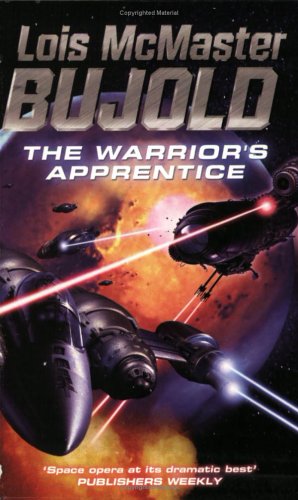
THE WARRIOR'S APPRENTICE

The Warrior's Apprentice (Vorkosigan Saga, #2)ah, Miles. what a great creation he is! clever and sharp-tongued, vaguely ambitious, shorter than most, the opposite of a physical threat, kind and even-tempered, clear-eyed in his self-assessments, a little bit self-sacrificing but not in an eye-rolling way, queasy at the thought of causing others harm, full of both self-doubt and ego, always the girl's trusted best friend rather than the object of her passion, the wittiest man in the room and he knows it but he is going to try to keep that to himself so that you don't get upset and take it out on him in surprise smack-attacks. and he talks and he talks and he talks. i love Miles. his character is usually the supporting character, the hero's best friend, the brother who dies, an amusing cameo. it's a great thing for me to know that there is a whole series practically devoted to this lil' guy. he's endearing i suppose, but i personally don't see him as "endearing" because i don't see him as a cute character type. he feels very real to me. part of that may be due to reading all about his parents in the prior books - i know where Miles comes from, i understand the context, i get how his background informs his present. part of that may be due to how much i empathize with him and his various personal travails.

the novel itself is about Miles leaving his home planet of war-like Barrayar and inadvertedly creating a mercenary army. oops! for me the plot is really secondary to just sitting back and enjoying Miles. the writing is fine, nothing special but certainly nothing problematic either. Bujold veers towards the bland. style is not the selling point in her skill set - readers come to her for the surprisingly grounded and rich characterization. and so The Warrior's Apprentice may have space battles, mercenaries, revolutionaries, mechanized war-suits, etc, but that's almost besides the point. Miles is the point.

Miles - and Bothari. the latter character - a former brainwashed rapist and sadistic torturer who now acts as Miles' bodyguard - is the other big selling point of the novel. Bujold does not downplay his past or excuse it - although in some ways it can be excused (i would say that brainwashing excuses many things) - nor does she overplay his redemption. she gets the character right, she doesn't leave out the ugly or disturbing parts, and yet she still allows the character grace and dignity within his tragic arc. Bujold definitely knows how to write characters that the reader can feel. i felt Bothari, i felt Miles, i felt Elena and Ivan and i am looking forward to feeling the rest of the characters that will be introduced to me in this saga.

***

THE MOUNTAINS OF MOURNING

The Mountains of Mourningi'm getting old - i'm 42! that is definitely old to a lot of people. happily, i've always felt i was born old so getting older doesn't really bother me. but what does bother me is the idea that in a couple decades my viewpoint may have become so inflexible, so stubbornly outmoded, that my opinion will simply have no value. i think that to be relevant, pretty much every thing and every one needs to be considered as a work in progress. capable of change and adjustment and re-evaluation. fortunately i have met many older people who are fully capable of such things. fully capable of revisiting concepts and laws and ways of interacting with people that are now understood as potentially offensive and demeaning and dehumanizing. i would like me and my age-peers to be that kind of old person. and so, in a way, not really old at all. not a barrier to change, but instead a positive part of the living, breathing, ever-changing world.

but i have also met many older people who are truly "old". who are so stubborn in their narrow viewpoints and who view change as automatically threatening. who uphold disgusting laws and repulsive ways of interacting with people. who live within some nonsensical so-called moral high ground that they had to deal with all of their lives and so everyone should deal with the same. hell no they're not going to change because they've always been this way and plus why should anyone get away with what they never got away with, what gives them the right when they never had that right? it's a simplistic, toxic mind-fuck that they seem to embrace. i can't help but look at those sorts of folks with both pity and scorn. and then wait for them to die - because that's the only change that they can't stop.

so this thoughtful little novella is about Miles Naismith Vorkosigan and his encounters with both types. it is melancholy and tragic and, somehow, uplifting in the end. nice work, Bujold.

***

THE VOR GAME

Miles be nimble!
Miles be quick!
Miles jump over the candlestick any situation or dumbass that gets in your goddamn way!


Go, Miles, Go!

The Vor Gameso Miles finds himself stuck in a miserable freezing arctic station as his reward for graduating from the Barrayar military acadamy with top honors but also with a serious issue of not treating authority with the respect and passivity and obedience that authority apparently deserves. and from the arctic station he finds himself tossed pell-mell, willy-nilly, etc, right into the middle of a plot teeming with ruthless villains, a young emperor trying to escape his duties, nervous colonies, anxious bodyguards, two mercenary camps, new space gadgets, and reunions galore with characters from prior novels. the novel is fast and fun fun fun.

I suppose one take-away from the series is ALWAYS QUESTION AUTHORITY. nice.

the character of Gregor le petit emperor really comes into his own here. a beautiful bit of characterization and not a little tragic as well.

my favorite part of the novel was the first third, in that freezing arctic station. watching hyperactive Miles practically bounce off of the walls trying to figure out what to do was wonderfully amusing. and the setting was certainly well-rendered. cooooooooold.

there's a spicy lil' villainess just like Miles is a spicy lil' hero. she wears some kind of sexy catsuit. or it may be a jumper but I much prefer to imagine it as a catsuit, plus I really wanted to type the word "catsuit". much like Miles, she has a quick and improvisatory way of thinking, always on the fly and always taking advantage of any opportunity she sees. for some reason the novel takes pains to compare Miles and Catsuit, at times even theorizing that if Miles doesn't watch out, he may end up like the amoral Catsuit sometime in the future. ha! as if. equally key to Miles' persona are his decency and his compassion and his refusal to see death as something that just happens so time to move on. those traits are hallmarks of this book and its predecessors as well. Miles ain't gonna turn into no Catsuit! although I do predict that he will eventually tap that Catsuit.


Ask the Reviewers - Benoit Lelievre

Today's guest is Benoit Lelievre.  Benoit also posts at Dead End Follies.

How did you discover Goodreads?
At the first and last writing conference I've ever been to. Authors Catherine McKenzie and Claude Lalumière mentioned being on it, so I checked it out and been a members ever since. I'm still following the two authors' careers from their Goodreads account also. Catherine is very active, she does a lot of contests and whatnot.

What have been your most memorable Goodreads experiences?
Reading "Most Read Authors" sections that blow me away. Most recently, Charles Gramlich's. If someone I share interests with has read 70 novels by an author and 100 by another, maybe he's on to something I should check out for myself. That's the beauty of literature. Just when you thought you've seen it all, you get hooked into a whole new world. A whole new current.

Name one reviewer not in the Forbes 25 that people should be aware of.
Caleb J. Ross. He mainly does video reviews, but sometimes he graces Goodreads with his tremendous, accurate insight. He's both pertinent and not intimidating, which I think is a rare gift.

What was your initial reaction to Amazon buying Goodreads?
Long story short, not much. I don't think Amazon is that supreme evil people make it out to be. At least not publishing-wise. They are not great by any means either, but they shuffled the board of an industry that abused writers and published crap for money since before them and I think they're making things interesting because other publishers will have to adapt.

Ultimately, the purchase of Goodreads is another step in their takeover of the publishing industry and that could become an issue given a multiple number of what-ifs. But right now, nothing really changed. If status quo remains, it won't change anything except that the business revenue will go in Amazon's pocket instead of whoever owner Goodreads before and that doesn't really affect me.

How many books do you own?
About 600-700. I have two and a half bookshelves filled, two with fiction only. Given the lack of storage in my home, I'll consider doubling up on my shelves' rows. They're big enough for me to do it.

Who is your favorite author?
Dennis Lehane. Many made my heart race, but not quite the way Lehane did. Honorable mention to Chuck Palahniuk, Haruki Murakami and Francis Scott Fitzgerald.

What is your favorite book of all time?
That's hard. I'd say it's a tie between Fight Club and Mystic River. The first turned me full-time reading and the second turned me to writing.

What are your thoughts on ebooks?
They're fine. I own a Kindle. Most of them are a lot cheaper than paperbacks.

What are your thoughts on self-publishing?
It's a complicated question. I'm all for it, because as a book reviewer, I was lead to dive head first into the self-publishign revolution. Lots of people don't really understand what it is. Basically, it's powered by Amazon's Kindle Store, which is kind of a thunderdome for writers. Whoever has been unjustly rejected by publishing, feels unjustly rejected by publishing or has written something that was called great, but unpublishable has a fighter's chance there.

For now, it's like a parallel universe to print publishing. You will find a lot of writers who you've never heard about, who make a good name for themselves. People like Vincent Zandri and Dani Amore. The most beautiful part of that is that it's all part of Amazon's marketing plan. They're cherry picking the best selling authors and offering them contracts with their publishing company Thomas & Mercer. It's brilliant and they end up with the best new writers doing that. Self-Publishing and mostly the Kindle Store made the publishing democratic again with prose quality and online buzz being the only two variables that matter.

Any literary aspirations?
Yes. I think it's a normal reaction when you read viscerally and lots of people do that. I have about ten, fifteen short stories published. Crime fiction, mostly. Some published in places like Crime Factory, Needle Magazine and Beat to a Pulp, which I'm pretty proud of. I'm still figuring out how to write something decent that's over 10 000 words, but that's another story.

Monday, July 1, 2013

Obsession, Horror and Unearthly Lust, Indeed!


Reviewed by James L. Thane
Five out of five stars


In Greek Mythology, Sirens were irresistibly beautiful women who lived on an island with a rocky coast and who lured unsuspecting sailors to their deaths by singing and calling out to them with their enchanting voices. Something of the same sort of thing occurs in Kurt Reichenbaugh’s new book, Sirens.

Reichenbaugh has cleverly updated the legend to the Florida Gulf Coast in the late 1970s and has woven into the tale a couple of psychopathic redneck wrestlers, a dog-like beast with a killer tail; some sexy, nubile and deadly cheerleaders; rotting corpses that refuse to die, creatures from outer space, and four relatively clueless teenage boys. And, of course, there’s Suzie, the devastatingly beautiful and alluring Siren whose actions propel the story forward. The cover blurb advertises Sirens as “A novel of obsession, horror and unearthly lust!” It’s certainly all of that and more.

The story opens when three bored teenaged friends, Kevin, Brad and Nick, are joined by a loser named Benny. None of the three really likes Benny, but he’s older and bigger and a hard man to refuse. So when Benny insists that they get some beer and go to a party he’s heard about, Kevin, Brad and Nick reluctantly go along.

The four wind up out in the middle of nowhere in front of a dilapidated house guarded by a snarling animal that would send any sensible boys scrambling back into their car and screaming the hell out of there. But, of course, if they did that, there’d be no story.

It seems pretty clear that there’s no party going on here, at least not in the conventional sense. But then a stunning woman steps out onto the porch and invites the boys in. In the living room are two massive, ugly specimens who seem to pay little attention to the boys. The woman, Suzie, sizes them up and agrees to party with them. Now, even Kevin, Brad and Nick are beginning to get enthused about the evening. Suzie leads them out and through the woods to a strange lake and just as things are getting interesting, the two rednecks and their four-legged “pet” materialize behind the eager boys.

With that, the book is off and running and it’s a wild ride to say the least. In less capable hands, this story could be formulaic and clichéd, but Reichenbaugh delivers the goods page after page, mixing horror, sci-fi, and coming of age themes into a great story. If “obsession, horror and unearthly lust” are the kinds of things that get your motor running, look no further. For that matter, the great pulp-inspired cover is worth the price of admission all by itself.

Ace Atkins Strikes Again

The Broken Places
by Ace Atkins

Reviewed by Kemper
4 out of 5 stars.

I guess Ace Atkins gave his publishers some kind of Buy-One-Get-One-Free deal because he released two new books in one month this year. His generous nature is good news for fans because Wonderland showed again that he was the right writer to give us more Spenser while this one adds even more depth to his Quinn Colson series.

Quinn is a former US Army Ranger who saw extensive service in Iraq and Afghanistan before returning to his Mississippi hometown and becoming the county sheriff. After a year on the job, Quinn has the department set up the way he wants, but he’s got a problem caused by a recently released convicted murderer.

Jamey Dixon was sent to prison for killing his girlfriend, but he was freed as part of a large group of pardons issued by a corrupt governor leaving office.  Most of those who got out were the result of money or influence, but Dixon had neither so no one can figure out why he was released.  The family of the murdered woman keeps coming to Quinn to do something, but his hands are tied.

The situation is made stickier because Dixon has started dating Quinn’s sister.  Caddy Colson had left town and became a drug addicted stripper, but she returned as a born again thorn in her brother’s side.  Dixon found Jesus in prison and has started a homegrown ministry that is gathering support.  Caddy believes that Dixon had been railroaded and is angry that Quinn and others in the town want nothing to do with him.

When two convicts escape prison, they head for the loot they had hidden from an armored car robbery, and they’re convinced that Dixon, who had learned of the money while doing time with them, may be going for the cash himself.  Complicating the manhunt is a huge storm that is deluging the county with rain and the possibility of tornadoes.

This series is just getting richer and deeper as it goes as Atkins expands the world of Tibbehah County.  Unlike some writers who either try to sentimentalize rural life or sneer at it, Atkins conveys the rhythms of a small town with easy authenticity. Living in a place where you have some kind of history with almost every other person makes for tangled relationships, and the main character is a prime example of that.

On one side, Quinn has a grief stricken family asking for justice he can’t provide while his sister is stubbornly refusing to consider even the possibility that Dixon might not be the reformed man he claims to be.  Quinn also has to deal with the politics of running a sheriff’s department, and he’s locked in constant battle with his nemesis, a corrupt county commissioner.  The town is also buzzing about a potential romance between him and the woman who runs the funeral home, and she just so happens to be the sister of the woman that Dixon killed.  Quinn also still has some unresolved feelings for his old high school sweetheart who is married to the town doctor.

It’s the blending of this small town world with a first rate crime story that is making this series a must-read.  The two escaped convicts and their quest to retrieve their stolen loot kicks off a chain of events that will further complicate Quinn’s life.

Some readers may be a bit frustrated that there are several elements that aren’t resolved here and will apparently carry over to the next book, but Atkins has delivered another great entry in the Quinn Colson series while setting up potential plots that should make this series intriguing for a long time to come.

I got to meet Ace Atkins and some other crime authors a few months back.  Read all about the encounter here.